A 39-year-old man with a history of serious mental illness has spent nearly 10 months in federal immigration detention while fighting deportation to Jamaica, despite records supporting his claim that he was born in Florida and is a U.S. citizen.
Phillip James, who has also used the name Felibi Siagha-Coke, remains in custody at an immigration detention facility in Indiana.
His legal team is challenging an immigration judge’s decision ordering his removal to Jamaica and has asked a federal judge to release him while the case proceeds.
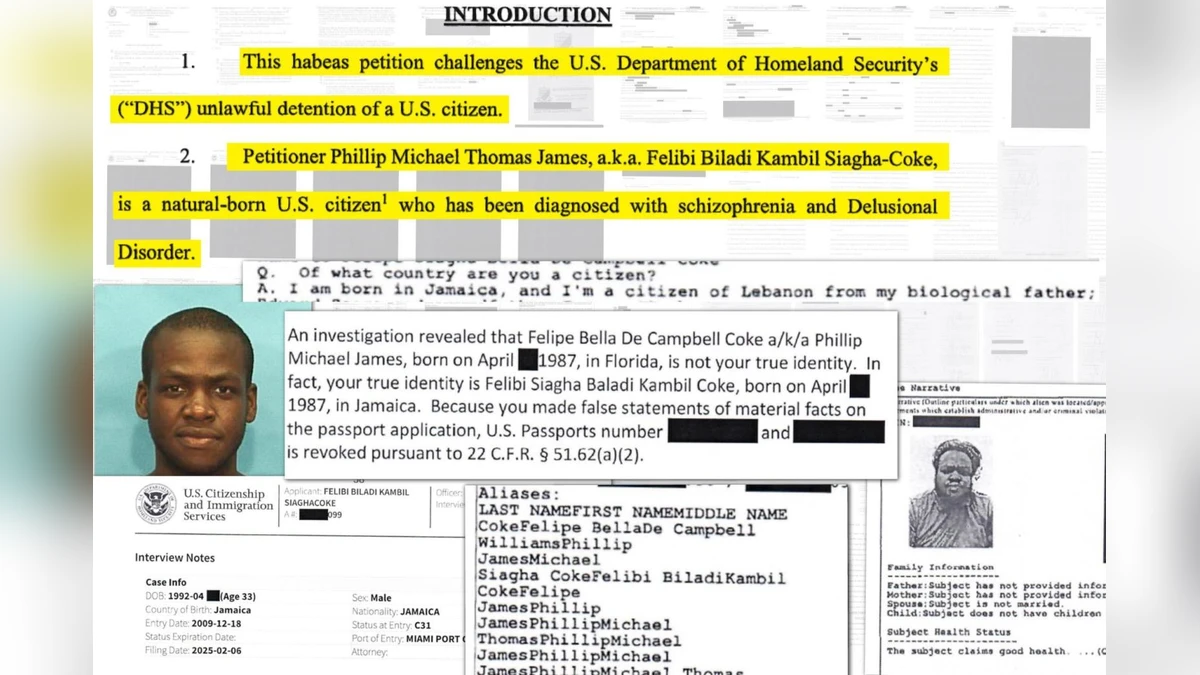
The Department of Homeland Security disputes James’ citizenship and maintains that a birth certificate he used to obtain a U.S. passport was fraudulent. The department has not provided evidence to support that allegation, the Associated Press reported.
Meanwhile, Jamaican authorities have told James’ attorneys that they have no record of his birth or citizenship in the country.
The case raises questions about how immigration authorities evaluate citizenship claims when a detainee’s statements conflict with official records, particularly when mental illness may affect the person’s account of their own background.
Black Couple’s Rental Home Search Goes Horribly Wrong as Realtor’s Racist Text Sparks Lawsuit
Nordstrom Bans Black Luxury CEO from Stores, Warns of Police Action After Racial Profiling Claim
Documents reviewed by the AP support the account provided by James’ mother and attorneys, who say he was born in Orange County, Florida, in 1987. His mother, a U.S. citizen, submitted an affidavit confirming his birthplace, while a Florida birth certificate and a separate court record from 1988 contain matching details about his birth and parentage.
James received a U.S. passport in 2008 after submitting his birth certificate. He later obtained another passport in 2023 following a court-approved name change in New York.
Those records are central to his attorneys’ argument that immigration authorities have no legal basis to deport him. Federal law generally recognizes people born in the United States and subject to its jurisdiction as citizens at birth under 8 U.S.C. § 1401. The law’s application to a particular person, however, can become the subject of a dispute when the government challenges the authenticity of citizenship documents.
The government revoked James’ passport after he began submitting applications related to citizenship and protection from deportation in 2024.
During those proceedings, he said he had been born in Jamaica and described a history involving adoption by American citizens. His accounts also included claims of Lebanese citizenship and royal ancestry that medical experts later characterized as delusional.
Court records indicate that James has paranoid schizophrenia, a condition that has affected him since childhood, according to an affidavit from his mother. Medical professionals who assessed him concluded that his beliefs about his identity were symptoms of his illness.
A psychologist who evaluated James determined that his condition made him an unreliable source of information about his own history, according to the AP’s review of court documents.
Despite the conflicting accounts, the Department of Homeland Security has continued to dispute the evidence supporting his Florida birthplace. The department told the AP that James obtained his original passport using a “fraudulent birth certificate,” but did not provide documentation establishing that claim or answer follow-up questions.
James himself was unable to explain how he obtained the Florida birth certificate. During a July 2025 interview with U.S. Citizenship and Immigration Services, he said, “To this day, I don’t understand.”
James’ case moved through the immigration system after he repeatedly described himself as a Jamaican national who had entered the United States unlawfully in 2009. Jamaican officials, however, have told his attorneys that they could not find records confirming that he was born there or that he holds Jamaican citizenship.
Authorities also cited James’ criminal history, including a 2011 conviction for assault with a deadly weapon that resulted in a five-year prison sentence in Florida. Records connected to that case, along with other documents, identified him as a U.S. citizen, according to the AP.
Immigration and Customs Enforcement began removal proceedings in December 2025, when James was living in New York City. After an immigration judge postponed a hearing on Jan. 5, agents arrested him and transferred him to the Miami Detention Center in Bunker Hill, Indiana.
The facility, which the White House has nicknamed the Speedway Slammer, operates under a state-federal arrangement that allows it to house immigration detainees. It has faced complaints about overcrowding and inadequate medical care, and at least two detainees have died there, the AP reported.
James initially challenged his detention without a lawyer. He is now represented by the Bronx Defenders, a nonprofit legal organization that represents people facing immigration proceedings.
After locating his mother and obtaining the Florida birth certificate, his attorneys filed a federal court petition seeking his release on Aug. 19. They are also appealing the deportation order to the Board of Immigration Appeals.
In a Sept. 28 court filing, Assistant U.S. Attorney Brian Irvin maintained that James was born in Jamaica and entered the United States without authorization. The government argued that immigration court, rather than a federal district court, should determine his citizenship claim.
U.S. District Judge Damon Leichty is expected to rule on the petition seeking James’ release.
James’ detention comes amid longstanding concerns about immigration authorities mistakenly holding people who may be U.S. citizens.
A 2021 Government Accountability Office report found that ICE and Customs and Border Protection had taken enforcement actions against potential U.S. citizens. The agency’s review of available records identified hundreds of arrests and detentions involving people who may have been citizens between fiscal years 2015 and 2020.
The GAO also found that ICE did not systematically track these encounters and that some of its guidance for officers handling possible citizenship claims was inconsistent. The agency recommended better training and more comprehensive data collection.
Northwestern University professor Jacqueline Stevens, who has researched cases involving U.S. citizens held by immigration authorities, told the AP that James’ situation reflected a wider concern about how officials assess evidence. She said records supporting deportation may receive greater weight than information that challenges it and warned that James’ case was not isolated.
The Department of Homeland Security rejects the assertion that ICE detains U.S. citizens and says people facing removal proceedings receive due process.
Immigration proceedings also differ from criminal court in a significant respect: the government does not have to provide a lawyer at no cost to the person facing deportation.
The Justice Department says people in immigration court may hire a representative or seek assistance from legal service providers, but many must navigate the process without government-funded counsel.
Deborah Fleischaker, a former ICE official who served as the agency’s chief of staff, described James’ case as complicated while saying the evidence supporting his citizenship appeared substantial. She said wrongful detention should be “rare and for as brief a time as possible.”
James’ attorneys have declined to comment publicly, and he has not agreed to an interview, according to the AP. His case remains unresolved, with his deportation appeal and federal petition pending.
For now, the central dispute remains whether the government can establish that James is a Jamaican national when records, his mother’s sworn statement, and his history of holding U.S. passports support the claim that he was born in Florida.


