
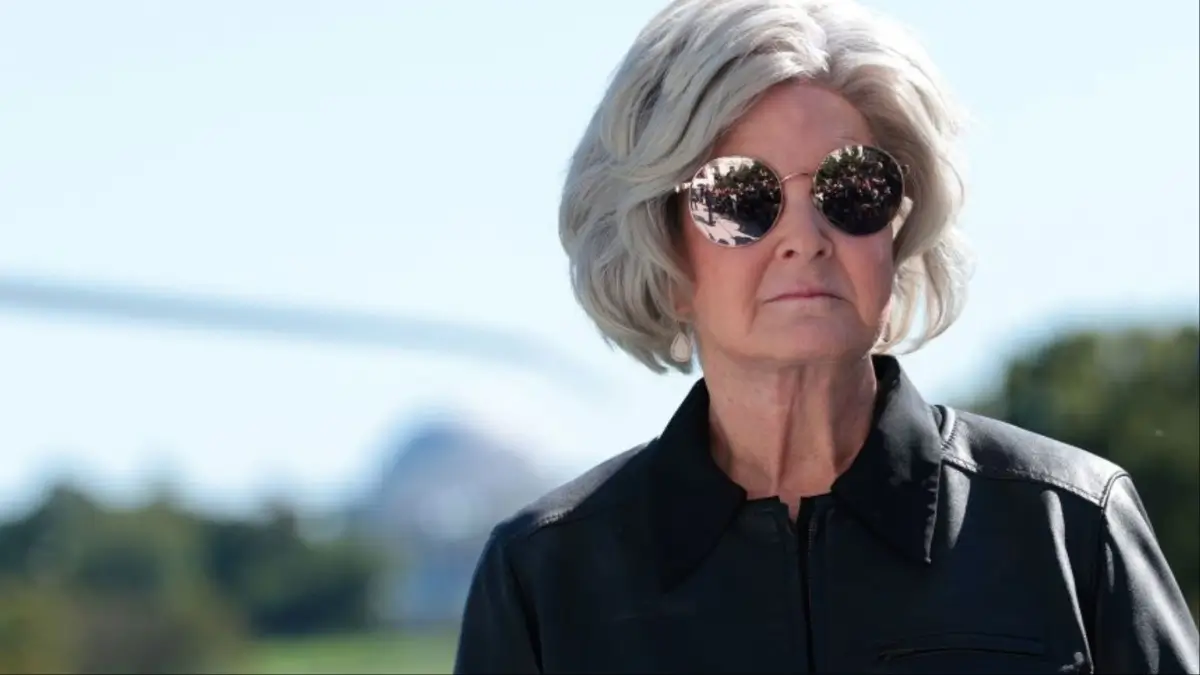
Susie Wiles was still showing up for work at the White House while undergoing treatment for breast cancer, determined to maintain her position as one of President Donald Trump’s most trusted advisers.
But according to a new account from a veteran journalist, her health battle may have marked the beginning of the end of that relationship, with Trump reportedly growing increasingly hostile toward the woman who helped him return to the White House.
Maggie Haberman of The New York Times says Trump began “picking on” Wiles after she disclosed her early-stage breast cancer diagnosis in March, reportedly viewing her illness as a sign of weakness.
The revelation offers a different perspective on the deterioration of their relationship, which culminated in Wiles leaving her position as chief of staff following Republicans’ disastrous midterm election losses and Trump’s reported fury over the results.
Haberman discussed Wiles’ departure Monday during an appearance on Jessica Tarlov’s “Raging Moderates” podcast. Tarlov asked whether the controversy surrounding Wiles’ daughter, Katie, who was accused of “trading influence” through her position at lobbying firm Continental Strategy, had contributed to the split.
Haberman said the situation was more complicated, describing a familiar pattern in Trump’s treatment of senior aides.
“In terms of why she left, there were a lot of reasons,” Haberman said. “The main one is that everybody has an hourglass timer with Trump on their own timeframe of how long they’re going to last. You know, the egg timer turns, and the sands start falling — it is literally true for everyone. And then they can end up coming back in some fashion.”
But Haberman pointed to Wiles’ cancer diagnosis as a significant turning point, saying people close to the White House had noticed Trump’s behavior toward her changing around that time.
“Susie was with Trump at his lowest point in 2021. He was with her at her lowest point when Ron DeSantis, after she had helped manage the late stages of his gubernatorial campaign, they had a huge falling out and it was over money-related issues,” Haberman said.
She then described how Wiles’ illness affected her ability to maintain a constant presence at the White House and how Trump reportedly responded.
“When Susie Wiles got sick — she’s been fighting cancer since February — she’s said publicly she’s cancer-free. But I don’t know anything more about her condition. A couple of people have said to us privately that you can trace the beginning of chaos becoming more visible — doesn’t mean it wasn’t there — but more visible and reverting to the Trump mean, around her diagnosis. She wasn’t physically as present, she tried working through it. People knew that she wasn’t there, and Trump does not like…illness. He sees it as weakness. And so, he started picking on her.”
Haberman also noted that Wiles was not the only person whose overlapping responsibilities and outside connections became an issue inside the administration. Some people were serving in multiple roles, including as special government employees while maintaining relationships with lobbying firms. Wiles’ daughter became part of that controversy, adding another source of tension.
“So, this was always going to end poorly this way,” Haberman added. “But it is true that Susie Wiles…she’s a transactional political figure in a way that Stephen Miller just is not.”
Wiles announced her breast cancer diagnosis in March, with Trump publicly disclosing the news. Despite undergoing treatment, she continued working as chief of staff, even making a rare trip to Capitol Hill in July to meet privately with Republican senators as the administration tried to break a legislative stalemate over Trump’s SAVE America Act.
In September, Wiles announced that she was cancer-free following treatment for early-stage breast cancer. She said pathology results came back after an appointment at the Mayo Clinic and thanked her family, doctors and supporters for helping her through the ordeal.
At the time, Wiles publicly praised Trump for his support. But Haberman’s account suggests the relationship had already begun deteriorating months earlier, reports said.
“Thank you to my family, friends, doctors, and everyone who prayed for me, checked in, and supported me along the way,” she said. “A special thank you to President Trump for his unwavering support. I am deeply grateful and will continue to work to advance his America First Agenda.”
The final break came after Republicans suffered major losses in the November midterms, handing Democrats control of both chambers of Congress. Trump was reportedly furious with Wiles and directed much of his anger at her, according to CNN reporting. Wiles offered her resignation Thursday evening, and Trump announced Friday that Stephen Miller would replace her as chief of staff.
Wiles said Friday would be her last day in the position, describing the experience as “the honor of a lifetime.” Trump said she would move to his political operation, although the precise nature of that role remained unclear.
Miller’s promotion also marked a significant shift in the administration’s leadership. A longtime MAGA hardliner, he has been a central architect of Trump’s immigration crackdown and other major policy initiatives.


