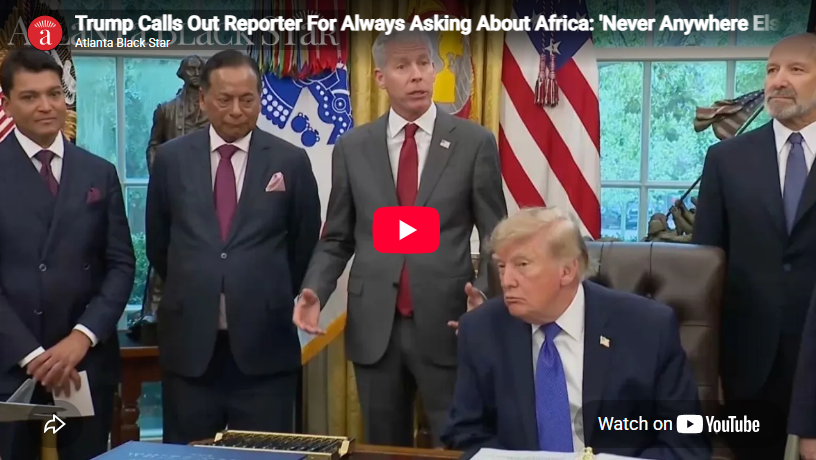
President Donald Trump boasted about a new steel plant an India-based company is planning to build in Iowa, but one question from an African reporter blew his cover wide open. And he never had a clue.
In an Oval Office event Monday, Sept. 28, Trump announced Mesabi Metallics is planning to build a $15 billion steel mill in Iowa with a production start date of 2030.
Surrounded by members of his Cabinet, company leaders and Iowa Republicans, Trump touted the project as the largest planned steel plant in the U.S. and one of the largest globally.
The White House says the planned construction in Lee County, Iowa, will create 6,000 construction jobs and 1,750 permanent jobs paying $49 an hour.
“This steel will be mined, melted and made right here in the USA, which is something very unusual,” Trump bragged.
But during a press gaggle after the announcement, Angolan White House correspondent Hariana Verás asked Trump directly where he planned to source the raw materials for the plant.
“Mr. President, two questions, one for the investors. I would like to know if in this project, as you know Africa is a very rich continent that can pretty much supply things for this project. Are you considering to import some of the materials for this project from an African country? Like Congo and Angola can pretty much supply,” Verás asked.
A company official jumped in. “Absolutely. Most of the critical materials that are required for this project will be sourced from America itself, within the U.S. There are some materials, like manganese, that may need to be imported for making and refining the highest quality steel. So that is not something necessarily available in the U.S. So, we will be looking at global sourcing for those. … and Africa is possible.”
Trump, clearly thinking about the reporter he once called “beautiful,” pointed at Verás and interjected, “She loves Africa. She always asks about it. She never talks about any other place. That’s the way it should be. Right?”
“Good job,” he added.
He clearly didn’t understand what she was really asking or that the executive who responded poked a hole in his “Made in America” claims.
In June of 2025, Verás was at a meeting with Trump following a peace treaty signing by DRC Foreign Minister Thérèse Kayikwamba Wagner and her Rwandan counterpart, Olivier Nduhungirehe.
She told Trump that people in the DRC were grateful for the work he is doing to help bring peace to their country.
An unfiltered Trump couldn’t help himself.
“That’s so nice,” he said, before shockingly mentioning he was asked not to comment on Verás’ appearance. “That’s so beautifully stated. Karoline said this, number one, she did say that I shouldn’t say this because it’s politically incorrect, she said, ‘She’s beautiful.’ And you are beautiful!”
But he continued gushing over the reporter.
And he said it anyway, as Verás laughed at the compliment while others in the meeting smiled.
“I’m not allowed to say that, you know that?” Trump continued. “It could be the end of my political career, but I’ll say it anyway. You are beautiful, and you’re beautiful inside. I wish I had more reporters like you.”
Of course, a clip of the exchange went viral at the time, and social media lambasted Trump for once again focusing on a female reporter’s looks.
Since Trump retook office in early 2025, he has gutted billions in traditional aid for Africa replacing it with private investment and commercial deals.
Critics argue the slashing of aid is directly responsible for an Ebola epidemic that has already killed more than 3,900 people with more than 8,000 confirmed cases, according to the United Nations.