The district attorney of Gwinnett County has joined four other Black female Democratic DAs in metro Atlanta in their fight to overturn a new state law they believe was designed by Republican lawmakers to diminish their chances for reelection.
Patsy Austin-Gatson announced last week that she has filed a lawsuit against the state of Georgia challenging House Bill 369.
The controversial statute makes elections nonpartisan for district attorneys and other county offices exclusively in counties that utilize a medical examiner system instead of an elected coroner — a classification that applies only to Clayton, Cobb, DeKalb, Fulton, and Gwinnett counties.
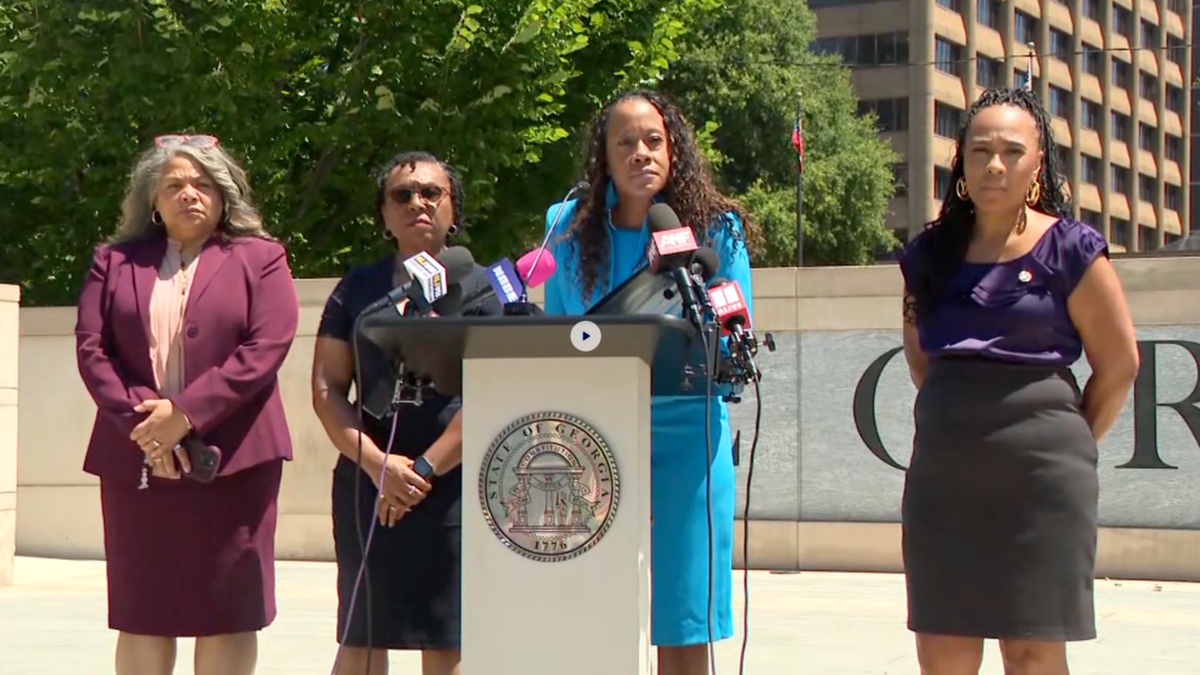
Lawsuit Filing
According to the lawsuit filed in Fulton County Superior Court and obtained by Atlanta Black Star, each of those metro Atlanta jurisdictions has elected a Democratic district attorney in recent years, with all five positions currently held by Black women — a detail fueling the legal challenge against the legislation.
The remaining 154 counties in Georgia that maintain an elected coroner are exempt from the statute, allowing them to continue holding partisan primaries for countywide offices under the new law.
Austin-Gatson’s complaint — like a similar lawsuit filed by Dekalb County District Attorney Sherry Boston on June 3rd — characterizes the legislation as irrational, racially discriminatory, and unconstitutional. Pointing out that the changes selectively target metro Atlanta judicial circuits, the suit petitions the court for an injunction to block the law’s implementation.
The next election cycle for district attorneys in those five counties, the most populous in Georgia, is in 2028.
DAs Allege Political Harm
“HB 369 is very strange and prejudicial legislation,” Austin-Gatson said at the news conference last Friday. “Legislation was passed that covers five metro areas that happen to have five Black women as district attorneys and without input by you, the people.”
Noting that she is the first Black woman to hold the position of district attorney in Gwinnett County, one of the 10 most racially and ethnically diverse counties in the U.S., she said, “I have a duty to stand up and fight against what I believe to be unjust and racially discriminatory legislation.”
The lawsuit contends that HB 369, by stripping the party affiliations of candidates for district attorney and other county offices (except sheriffs and boards of education) from election ballots will harm the candidates in those five metro Atlanta counties “by limiting their ability to associate with the party of their choice, limiting their ability to communicate with voters, and limiting the amount of funds they can raise.”
Voters will not see “D” or “R” next to the names of candidates on nonpartisan ballots, depriving them of important information about candidates in counties that have long elected Democrats, the Gwinnett DA argues.
Financial Handicap
Austin-Gatson’s complaint stresses the financial handicap created by the law, noting that political parties can no longer nominate or field district attorney candidates through primary elections in those five counties.
By forcing candidates into a single general election window, the statute caps their fundraising potential, whereas prosecutors across Georgia’s remaining 154 counties can raise funds across both primary and general election cycles while retaining formal party labels.
By singling out counties that have replaced the elected office of coroner with a medical examiner for disparate treatment — a classification the complaint calls “arbitrary and not rationally related to any legitimate state purpose” — the lawsuit argues HB 369 violates the Equal Protection Clauses of both the Georgia Constitution and the Fourteenth Amendment to the U.S. Constitution.
The plaintiffs allege HB 369 also violates the uniformity clause of Georgia’s Constitution, which says “laws of a general nature shall have uniform operation through the state,” with a few exceptions related to police powers.
A Dead Bill Sneakily Resurrected
A third major constitutional argument raised in the district attorneys’ lawsuits asserts that lawmakers violated Georgia’s “Rejected Bills Clause.” Under the state constitution, a proposal rejected by either chamber cannot be re-introduced during the same legislative session without two-thirds consent from the rejecting body — a threshold the plaintiffs contend lawmakers failed to meet when reviving the nonpartisan election measure under HB 369.
Austin-Gatson and Boston assert that the legislature illegally resurrected SB 573 — a measure proposing nonpartisan elections in metro Atlanta that previously failed in the Senate — by stripping the text of HB 369, an unrelated bill originally dealing with food truck safety standards and replacing it with the defeated nonpartisan election language in an effort to circumvent state constitutional restrictions on rejected bills.
By gutting the original House bill and replacing it with SB 573’s text — making only minor “technical cleanups” such as shifting district attorney elections from May to November — the lawsuit argues HB 369 remained substantively identical to the defeated proposal, directly violating the state constitution.
Because HB 369 passed the House with a simple majority of 93–64, and the Senate’s 32–21 vote fell short of the two-thirds threshold required to revive a rejected bill, the complaint contends the statute — signed into law by Gov. Brian Kemp on May 12 — was enacted in violation of the Georgia Constitution.
‘Can’t Let It Stand’
At her news conference last week, Austin-Gatson said the way the legislature’s Republican majority handled the bill demanded a legal response.
“I feel it’s unjust in the way that it even traveled through the House (and Senate) and we just can’t let it stand,” she said. “It’s not good for people to think their lawmakers are doing backroom deals and things like that. We have to be upfront with the public.”
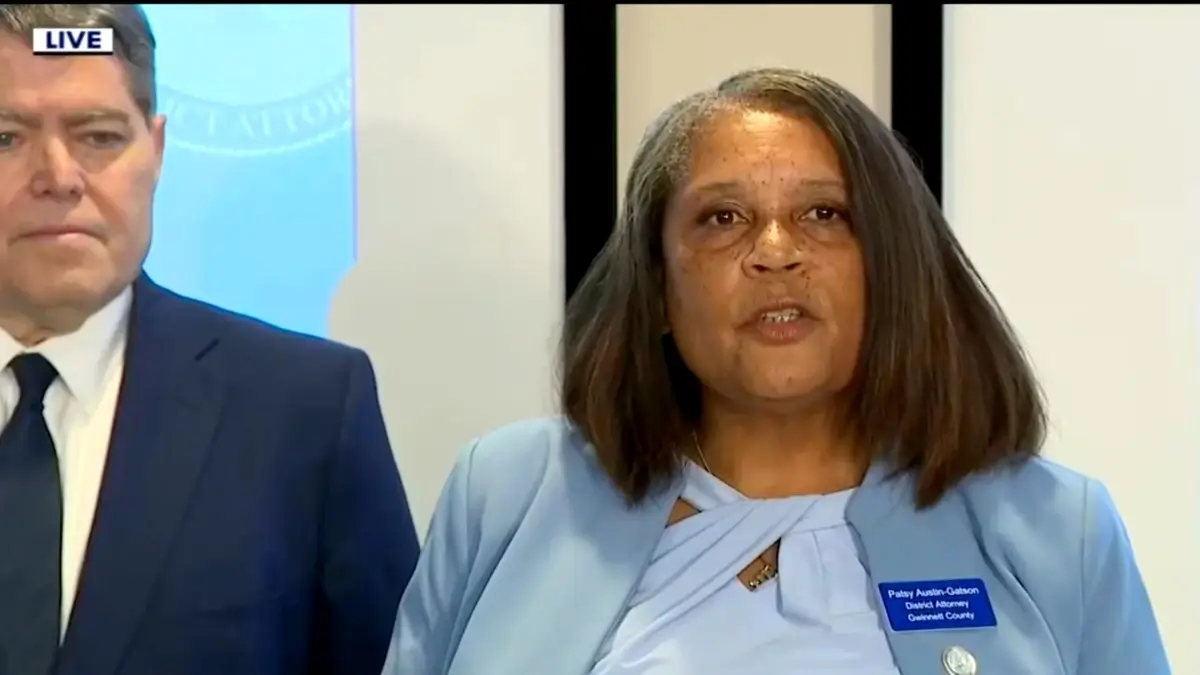
Austin-Gatson also said that she decided to file a separate lawsuit to challenge HB 369 because Boston had filed “in her individual capacity and that concerned me. I think with more people on the field we have a better chance of winning.”
The Gwinnett DA has filed as a plaintiff in both her individual and official capacities.
Her attorney Michael Terry said Austin-Gatson will work in a spirit of cooperation with the legal team of Boston and the other district attorneys who have joined Boston as co-plaintiffs — Fulton County DA Fani Willis, Clayton County DA Tasha Mosley and Cobb County DA Sonya Allen.
“They’re going to do a great job, we’re going to cooperate with them,” Terry said. “It’s going to be a united front, but it’s important that Gwinnett be represented in this.”
The State Counters
While the State of Georgia has not yet filed a formal response to Gwinnett DA Austin-Gatson’s August 21 complaint, state attorneys moved to dismiss DeKalb DA Boston’s initial lawsuit on July 20. A Fulton County Superior Court hearing on the state’s motion to dismiss is scheduled for September 18.
In the state’s motion, Georgia Attorney General Chris Carr argued that Boston “cannot demonstrate a cognizable injury” because she does not specifically allege in the complaint that she plans to run again for district attorney in 2028.
“She claims generally that ‘candidates for district attorney’ in the five consolidated law enforcement counties ‘will no longer be able to affiliate themselves with a political party that will support their campaign for office’ … and will be subject to lower fundraising limits” than candidates not in consolidated law enforcement counties, Carr stated.
But Boston does not explain how those limitations would impact her fundraising relative to any future opponent she would have in the same county, Carr asserted, as that opposing candidate “would be subjected to the very same fundraising limits.”
The Politics Behind the Push
The motion defends the rationale behind SB 573 (which became HB 369), noting that co-sponsor Republican state Sen. Ed Setzler argued during committee hearings that counties “complex enough in their operations” to replace elected coroners with medical examiners hold a “concentration of power related to law enforcement” that justifies nonpartisan elections.
Setzler further explained that in large counties with significant operational “volume and complexity,” “a lot of issues emerge,” according to the complaint, including “fierce political passions surrounding policing incidents and police training.” In metro Atlanta, Setzler asserted, the “politicization of prosecution has become an issue” that nonpartisan elections aim to address.
Setzler argued that changing how district attorneys are elected in metro Atlanta counties was necessary to combat “selective enforcement of laws by politicized DA offices,” according to reporting by the Georgia Recorder.
Other Republican lawmakers argued during the session that HB 369 would “take the politics” out of countywide positions that should be nonpartisan.
“If you’re playing politics, you’ll be against this,” state Sen. John Albers, a Republican who co-sponsored SB 573, said from the well of the Senate floor. “If you want to keep Georgians safe, you’ll be for it.”
When ‘Nonpartisan’ Becomes Political
Announcing her lawsuit on June 3 alongside her “sister DAs” from Cobb, Clayton, and Fulton counties, Boston laid out the political stakes directly: “I think the intent of the law when you look at who they targeted is clear. They’ve chosen to go after Democratic strongholds where Democratic DAs and Democratic elected officials have been successful… Their goal is to weaken the power in Democratic areas and make it easier for Republicans to get elected.”
Boston, who has served as DeKalb County District Attorney since taking office in 2017, ran unopposed in both the Democratic primaries and general elections in 2020 and 2024.
Austin-Gatson, who has served as Gwinnett County DA since taking office in 2021, won reelection after securing roughly 54% of the vote against two Democratic primary challengers in May 2024 before running unopposed in the general election.
Willis first became Fulton County District Attorney in 2021 after defeating six-term incumbent Paul Howard in an August 2020 Democratic primary runoff and running unopposed in the general election. In her 2024 re-election bid, she won the Democratic primary with 87% of the vote before defeating Republican challenger Courtney Kramer with 68% of the general election vote.
Nonpartisan Races Still Attract Party Money, AG Argues
The state’s motion to dismiss the case contests the allegations by Boston that the new law prevents her or any other candidates in nonpartisan races from benefiting from political party affiliation.
While the new law “dictates that candidates in nonpartisan races cannot have a party label printed next to their name on the official ballot, Plaintiff does not cite to any law or regulation” that would prevent candidates from “publicizing partisan enforcements or from receiving campaign help outside of the ballot box,” state attorneys wrote.
To underscore that point, the attorney general noted that the Democratic Party of Georgia was reported to have spent $8 million to support candidates in the state’s nonpartisan Georgia Supreme Court elections, demonstrating that candidates in nonpartisan races retain access to significant party resources and public backing outside the ballot box.
“Nothing in HB 369 prevents political parties from endorsing the candidates of their choice, campaigning for them, or raising funds for them,” Carr stated.
Carr denied that the new law violates the state and federal Equal Protection Clauses, arguing that all candidates for office in consolidated law enforcement counties “are treated alike” and “have the same political opportunity.”
He further asserted that the state is protected from liability from other claims in the lawsuit through sovereign immunity and asks the Court to completely dismiss the plaintiff’s complaint.
The litigation now moves toward key court dates in downtown Atlanta. A status conference in Boston’s lawsuit is scheduled for Tuesday, Sept. 1, followed by a Sept. 18 hearing in Fulton County Superior Court to consider pending motions, including the state’s request to dismiss the case.
Under Georgia law, the state has 30 days after being served with process to file its answer or responsive motion to Austin-Gatson’s August 21 complaint.


