A Florida police officer is accused of tracking his estranged wife hundreds of times. He wasn’t following her car; he was searching a government-connected database.
Officer Christopher Goodson is accused of using Flock to track his estranged wife more than 700 times between September 2024 and June 2026, according to People Magazine.
Flock Safety is a surveillance system with 120,000 cameras operating nationwide. Its cameras use AI-powered license plate readers to track and reconstruct a vehicle’s movements.
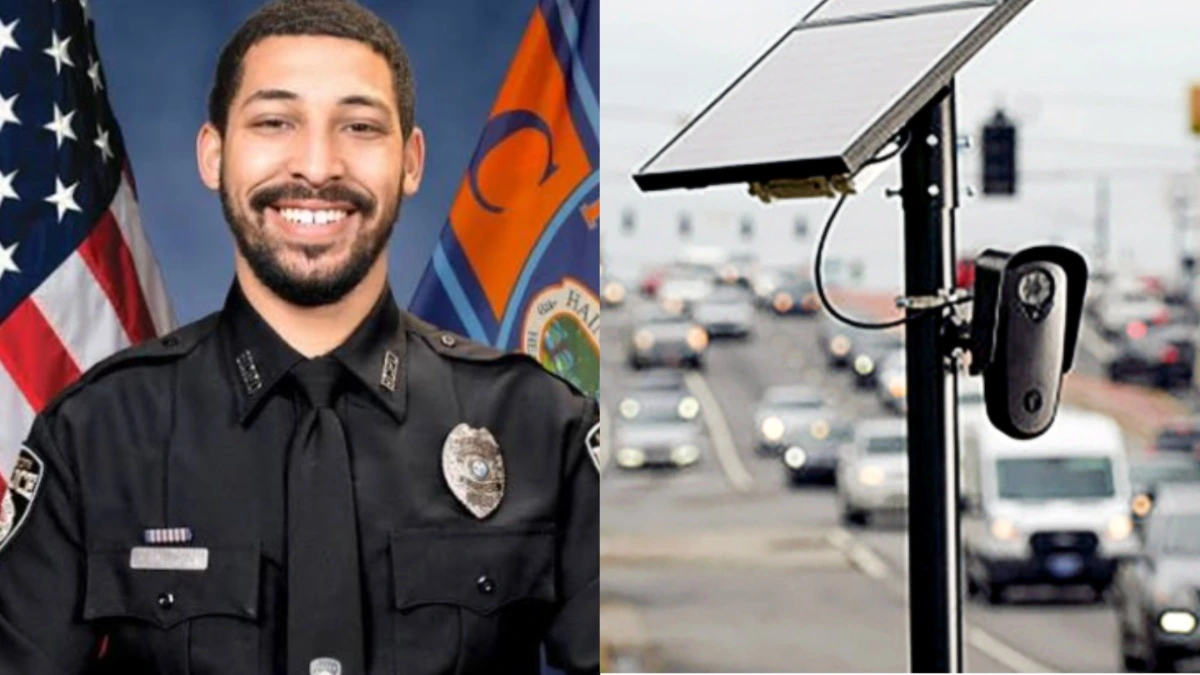
But the company didn’t consider that it had just given law enforcement full access to the American public’s lives.
Goodson reportedly entered fake justifications for accessing the technology, such as “Criminal Motor Vehicle Offense” and “Drugs/Narcotics,” despite his wife not being involved in criminal activity. He is now facing misconduct and computer-related offenses.
Abuse of Power
Goodson is not the only officer accused of misusing the technology.
The Institute for Justice identified at least 43 cases of officers allegedly using Flock cameras to stalk romantic interests.
On June 12, Cherokee County Deputy Cynthia Jodesty, 30, was arrested after an internal audit found that she had used the Flock system for non-law-enforcement purposes.
The review found she had entered the license plate information of a coworker into the automated plate reaser system.
Police didn’t specify who she was watching and why.
Five former Albany, Georgia police officers were arrested in July after an internal Flock audit uncovered repeated non-law-enforcement searches, according to the Georgia Bureau of Investigation.
Prosecutors charged the five officers with misusing license plate data and violating the oath of office. One officer, Nicholas Richardson, faces 11 counts of camera misuse.
Authorities did not specify what the five officers did with the technology.
Four Savannah Police Department officers are also facing accusations of misusing the technology.
An internal audit found that the officers and two civilian staff members accessed Flock for unofficial business in late July. The investigation found 127 inappropriate searches out of roughly 39,000 searches in Savannah’s Flock system.
Some of those “searches focused on personal acquaintances and family members,” the department said. One of the officers also gave outside law enforcement agency personnel access to the system.
High-ranking officials have also been caught misusing the technology.
Pasadena, Texas, Sgt. Michael Palitz was accused of using Flock to stalk a female colleague. He resigned and surrendered his law-enforcement license, avoiding total criminal prosecution.
Cherokee County Sheriff’s Office also arrested Lt. Chris Bryant, 45, and Sgt. Mike Creeden, 35, for misuse of the system. CBS Atlanta reported they were charged in June before they were terminated from their positions.
“Maintaining the public’s trust requires that our employees uphold the law, safeguard sensitive information, and use the tools entrusted to us only for legitimate law enforcement purposes,” Sheriff Frank Reynolds said in a statement.
Police officers aren’t the only ones being accused of abusing the technology.
Paige Forte, a dispatcher supervisor in Conyers, Georgia, was arrested on July 22. She is accused of accessing the Flock system more than 30 times between April and July of 2026 for “non-law enforcement purposes.”
Forte allegedly used the system to search for her domestic partner’s car.
New Study Reveals Troubling Statistic
For Black Americans, allegations that officers misused Flock cameras are part of a much larger concern: the history of police surveillance in America. These cameras also put a spotlight on the disproportionate scrutiny Black communities have faced.
A study by Christopher Newport University professors published in January found that ALPRs are more highly concentrated in Black communities and high-poverty areas.
Researchers found that Flock cameras are found in areas where law enforcement said there is a need for more crime prevention.
Black neighborhoods also experience Flock surveillance at nearly four times the rate compared to white neighborhoods, according to the study.
The Electronic Frontier Foundation also found more than 3,9000 agencies logged more than 12 million Flock searches between December 2024 and October 2025. Hundreds of them were associated with political demonstrations, including the 50501 protests, Hands Off protests, and No Kings protests.
Now the question isn’t whether Flock technology can solve crimes. It clearly can. It’s who watches the people who can watch everyone else?
Flock CEO Addresses Concerns
On August 13, Flock founder and CEO Garrett Langley apologized for instances in which law enforcement misused the company’s data.
“Hindsight tends to be very clear,” he told CBS News. He explained he had just read a Washington Post article about a woman who accused her police officer ex-boyfriend of stalking her with the help of Flock.
“It gets to this issue that when you are given power, which many people are, particularly in law enforcement, you should have higher standards of accountability,” Langley said. “And so I don’t think that Flock created police abuse. I think we’re the first company to ever shine a light on it and build the tools to find it.”
The system will now reduce the default data retention period from 30 days to seven days. However, if data is tied to an investigation that needs more time, it can be preserved.
The company also told the outlet that every search of its data will now require a case code to be entered beforehand. But that can be overridden in an emergency, like an Amber Alert.
CBS News asked Langley if he had a message to any officer who was considering using Flock to follow someone who’s not part of an investigation.
“You will get caught, plain and simple. If you try to use this tool illegally, you will get caught,” he said. “And I hope that state regulators pass bills that make that a criminal offense. It should not just be a termination. It should be a criminal offense if you abuse your power.”


