The fallout over a Facebook post by a North Carolina mayor’s wife has opened a broader conversation about race and political power in Halifax County, where one Black mayor says he has faced years of racism, death threats and resistance after challenging a Confederate monument.
Mondale Robinson, the mayor of Enfield, North Carolina, told Atlanta Black Star that the controversy surrounding Yvonne Doughtie’s comments cannot be separated from what he describes as a longstanding racial divide in Halifax County.
Robinson believes the environment may have helped create what he sees as a level of comfort that allowed Doughtie to make openly racist remarks about Black residents in neighboring Roanoke Rapids.
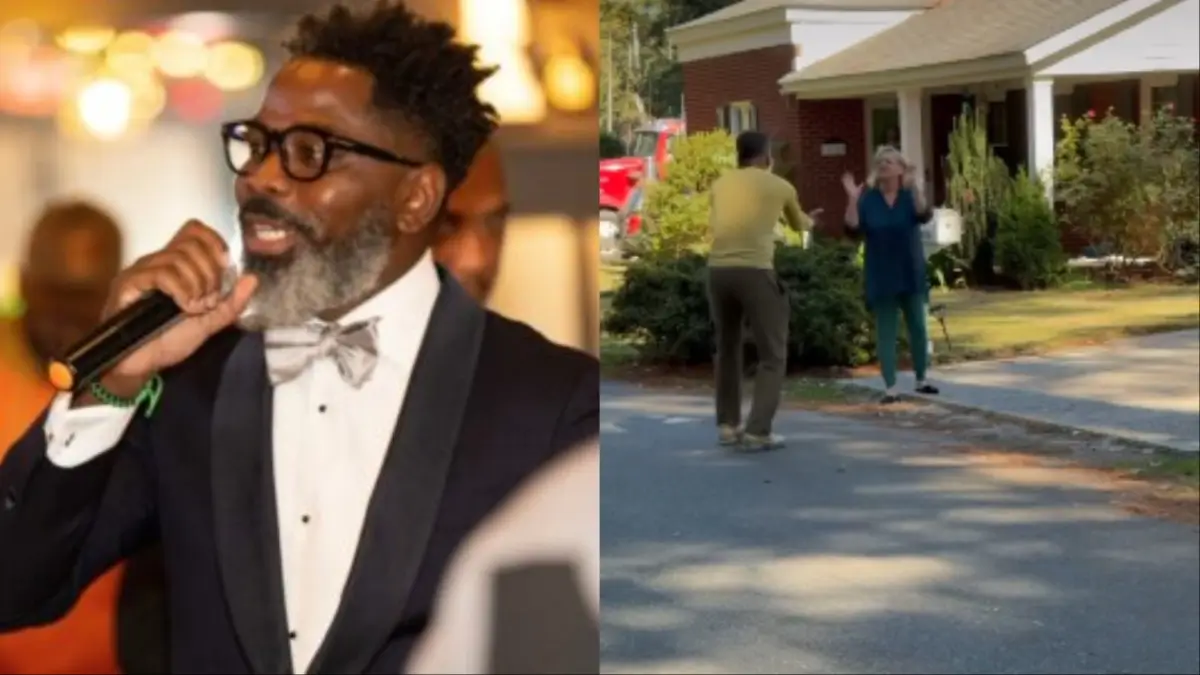
“Halifax County is a hot mess,” Robinson told Atlanta Black Star.
Mayor’s Wife’s Comments
Halifax County includes Enfield, Roanoke Rapids, Littleton, Hobgood, Scotland Neck and Weldon. Robinson said Yvonne Doughtie, the wife of five-term Roanoke Rapids Mayor Emery G. Doughtie, likely understood the potential reach of her Facebook comments because of how heavily residents rely on the platform for local information.
The controversy began after Doughtie responded to a Facebook discussion about differences between neighborhoods in Roanoke Rapids.
‘My Kid Is Right Here!’: Disturbing Video Captures Moment Black Father’s Pleas Go Unheard as LA Cops Arrest Him in Front of Frightened Daughter
In the post, she blamed some of the city’s problems on Black residents, writing that “Black Citizens have moved into the City of Roanoke Rapids” and that there had been problems involving housing and schools. She went on to say that some Black residents “just don’t take care of their houses, especially if they are renting.”
The original post was later deleted, but screenshots circulated online.
The discussion began with local rental property owner Jim Garrett, who described differences between the city’s east and west sides.
Doughtie responded by claiming that the city’s “backbone” had disappeared and said some current residents “just do not care and are not willing to work.” She later criticized what she called “Slum Lord Rental people” for failing to maintain their properties.
The city subsequently issued a statement distancing itself from the remarks. Officials said the account appeared to belong to the spouse of an elected official but emphasized that she is a private citizen and does not speak on the city’s behalf. The city also said it had not independently verified the comments’ authorship or authenticity but rejected the racial and socioeconomic stereotypes they contained.
A Larger Problem
Robinson, however, sees Doughtie’s post as part of a much larger problem.
He said Black residents make up a majority of the county’s population but remain underrepresented in positions of political and administrative influence. Robinson specifically pointed to several top county positions that he said are held by white officials, including the county manager, planner, attorney and officials overseeing finance, business development and tourism.
Robinson argued in an interview with Atlanta Black Star that the disparity extends beyond government offices and into economic development. He said Roanoke Rapids, which he described as one of the county’s whitest communities, has received more investment in hotels and other infrastructure than predominantly Black communities such as Enfield and Scotland Neck.
“So, they’re doing dastardly things to ensure that there’s no development in the Black parts of town,” Robinson alleged. He pointed to Enfield’s lack of sewer lines as one example of what he believes is an uneven distribution of infrastructure and development.
Repeated Threats
Robinson’s own experiences have shaped his view of the county’s racial tensions.
As previously reported, Robinson livestreamed the removal of a Confederate monument in Enfield after the town’s Board of Commissioners voted 4-1 to remove the roughly 10-foot monument, which had stood in the town’s Randolph Park area for more than 90 years.
A viral video shows Robinson defending himself against a wild accusation from a white female neighbor who confronted him while he was heading out to get coffee for his wife.
Robinson said the backlash didn’t end with that encounter. He told Atlanta Black Star that he continues to receive death threats.
“I’m the mayor of the blackest town in one of the blackest counties in North Carolina…with a white guy telling two town members that he can ‘shoot a deer from 600 miles away so imagine what he can do with that black a– mayor,’ talking about me,” Robinson said.
He said the threats have affected where he feels safe staying overnight.
“I mean I can’t even spend the night in my town, so what used to be a sundown town my town is still a sundown town for me because I can’t spend the night at home,” Robinson said. He claimed he has had to drive “three–four hours away four or five times a week because of death threats.”
Robinson also alleged that someone shot at his home several years ago.
“I’m not safe at home. My house got shot up a couple years ago,” he said.
Robinson claims police told him they had no leads in the case. Atlanta Black Star reached out to the department for comment but has not received a response.
History Runs Deep
Robinson believes those experiences provide important context for understanding the reaction to Doughtie’s post and why he considers the comments more serious than an isolated social media dispute.
“Black people, in my district, are afraid to be. They called me radical because I took out a Confederate monument,” Robinson said.
Despite the backlash, Robinson said he would make the same decision regarding the monument again. He said he thinks about the effect of Confederate symbols on Black children who encounter them in public spaces.
“I mean I’m thinking about the epigenetic trauma associated with being young and Black in a public park seeing a Confederate monument, and a poem to confederacy,” he said.
Robinson believes that history, combined with what he describes as limited Black representation in county leadership and persistent racial tensions, could help explain why Doughtie appeared comfortable making such explicit comments publicly.
“For her to do that like speaks to an arrogance of ‘I’m going to say this and there will be no repercussions,’” Robinson said.
For now, the city of Roanoke Rapids maintains that Doughtie’s comments do not represent its official position. But Robinson argues that the controversy has exposed deeper issues he says extend far beyond one deleted Facebook post.


