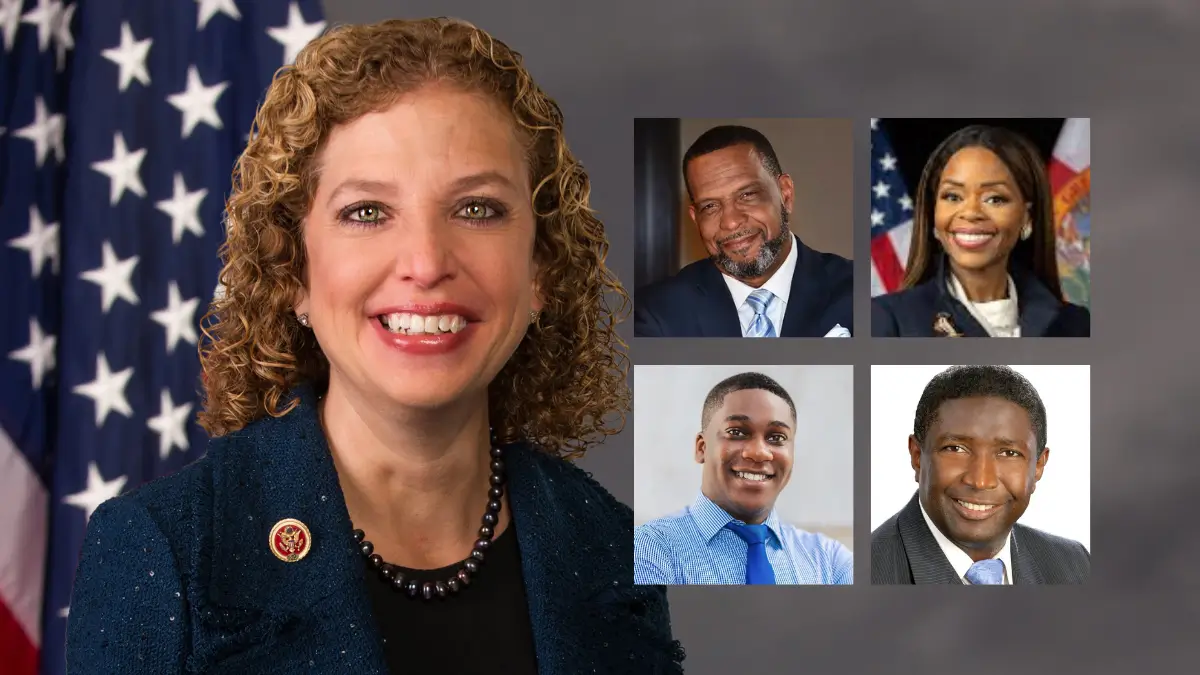
U.S. Rep. Debbie Wasserman Schultz won the Democratic primary for Florida’s recently redrawn 20th Congressional District on Tuesday, defeating four Black opponents in the historically Black district, and angering some Black leaders in the community.
A staunchly Democratic stronghold with a majority-Black population, the South Florida district, which includes Broward County and parts of Palm Beach County, has long elected Black representatives who have served continuously since 1992.
Wasserman Schultz, 59, has served in Congress since 2003, mostly representing Miami-Dade County and south Broward County in the 25th District, steadily gaining stature as a Democratic leader, serving on the powerful Appropriations Committee and chairing the Democratic National Committee.
But after Florida’s legislature joined other Republican-led states in a political gerrymandering campaign this year, Wasserman Schultz’s district was among four of eight Democratic-leaning districts eliminated in the redrawn maps. The new 22nd District, where she lives, leans Republican.
So, amid much criticism in the Black community, Wasserman Schultz chose to run in District 20, where she had served previously, emphasizing her plans to bring affordability, especially in housing and health care, back to constituents, and the value of her seniority and connections in Congress.
“I know the people and the people know me,” Wasserman Schultz told The New York Times. “It was critical that we not start over with a beginner and ensure someone like me with the seniority and clout represents this community.”
Black Candidates Incensed
Her decision infuriated many in the racially diverse South Florida community, including her Black Democratic competitors.
Progressive candidate Elijah Manley, 27, a teacher and civic activist, has accused Wasserman Schultz of trying to dilute Black representation by running in the newly drawn 20th district where she faced three other Black Democratic candidates, including former Broward County Mayor Dale Holness, 68, a Jamaican-American; former U.S. Rep Sheila Cherfilus-McCormick, the first Haitian American elected to Congress (who resigned from office in April after being indicted on charges of embezzling $5 million in federal disaster aid to use for her campaign, which she denies); and Luther “Uncle Luke” Campbell, 65, a free speech activist who was leader of the rap group 2 Live Crew.
During an interview on CNN on Monday, Manley said, “I think it’s cynical for the congresswoman to carpetbag into a district and try to take away Black representation in a split field.”
An openly gay Jewish convert, Manley has argued he brings the lived experience of both Broward County’s Black community and Florida’s LGBTQ residents.
“She is no different than the Republicans that are eviscerating Black representation across the South,” he told Florida Politics. “She is everything that’s wrong with the broken, unpopular Democratic establishment.”
Everyone Thought They Could Win
But others fault the Black candidates themselves for not being more strategic when they had the chance.
In June, the four Black Democratic candidates met and tried to coalesce around a unity candidate to challenge Wasserman Schultz, The New York Times reported. But they couldn’t agree on which one of them would prevail and should stay in the race.
“Everybody thinks they can be the one who will win,” Holness said at the time.
But Wasserman Schultz, leveraging her long-established donor network and incumbency, easily outspent her competitors. She entered the final weeks of the race with $2.8 million in campaign cash — more than six times the combined funds of her four Democratic opponents, the South Florida Sun-Sentinel reported.
She also had endorsements from some Black community and political leaders, KDH News observed. Notably, Maisha Williams, the stepdaughter of the late congressman Alcee Hastings, a revered Black Democratic stalwart who served in South Florida from 1992 to 2021, recorded a video testimonial distributed by Wasserman Schultz’s campaign.
“My Dad and Debbie Wasserman Schultz were more than just colleagues in Congress; they were friends. He was also her mentor, and together they fought like hell for the communities he cared so much about,” Williams said. “When Debbie sees injustice and racism, she stands up, she speaks out, and she fights just like my dad. Listen, results matter. I’m voting for Debbie because she has the passion and the experience and will continue to deliver for all of us.”
On Tuesday, Wasserman Schultz won 45.3 percent of the vote, easily winning the plurality Florida elections require. Holness received 23.1 percent of votes, Manley 13.9 percent, Cherfilus-McCormick 9.2 percent, and Campbell 8.4 percent.
‘Regression of Black Political Power’
“Count me among the chorus of Florida natives who condemned (and continue to condemn) Rep. Debbie Wasserman Schultz’s decision to flee from her normal District and run in what was considered a safe predominantly Black District,” Florida political analyst Chuck Hobbs posted online.
“And while I respect ambition, I will continue to believe that the four Black candidates should have come together in deference to that history and selected one candidate to run against DWS. At first glance, the math below suggests that a coalition candidate could have won, which means that I don’t have to wonder what legendary Nupe Rep. Alcee Hastings (D) would be saying right now.”
Rudy Shango Theophin, a Haitian-African American activist who unsuccessfully ran for mayor of Miramar in South Florida, agreed in a biting observation posted on Tuesday.
“Debbie didn’t win congressional district 20 because the community overwhelmingly chose her, she benefited from division. The selfishness and political egos of some Black leaders helped split the vote, and that fragmentation ultimately created the path for her victory. When leadership puts personal ambition ahead of collective strategy, the entire community pays the price.”
Luke Campbell had a different take, blaming low Black voter turnout for the election results.
“White folks came out and supported Debbie,” he said in a video posted on Tuesday night. “Black folks stayed home. …Over 140,000 Black folks with voter registration cards stayed home and didn’t vote for me or any other candidate. So it wasn’t a thing of all the candidates consolidating. There were enough people with cards to overcome her numbers. But the people of Broward County didn’t vote. … So they have her.”
Former state Sen. Dwight Bullard, now a senior political advisor at Florida Rising, an advocacy group supporting communities of color, told Atlanta Black Star of the election outcome, “I’m saddened by it as someone who knew former Congressman Hastings for a long time, and remember all the hard work it took to get those original seats in ’92. Seeing any regression of Black political power is sad. It’s even more sad because it could have been prevented.”
He said that Wasserman Schultz “should not have made the move that she did, just because you know she wouldn’t appreciate it being done to her. And so the political calculus, the ego that was clearly involved in a move like that, frankly, is disappointing, and District 20 voters should be angry.”
Bullard said Democratic pols hoping to elect Black candidates in South Florida should learn from this result as they plan future campaigns.
Looking Forward
“I would hope that in the lead up to 2028, that there are a series of discussions, because her getting 45% of the vote last night means that 55% of the vote can clearly go to somebody else. But it’s not going to work if you have a situation like you had this go around, where you had multiple Black candidates.”
Bullard said he believes Wasserman Schultz will “bring project dollars home” to South Florida, “given her tenure on the Ways and Means Committee. But Black interests aren’t just fiscal. I think the Black electorate is looking for fighters who have a clear vision of where they want to see our communities go in the next 25-30 years.”
He cited Wasserman Schultz’s support of “funding for the Israeli government and the ongoing war in Iran … when infrastructure in Black communities is insufficient or failing” and the Haitian, Jamaican and Caribbean immigrants who make up a sizable portion of District 20, and now face deportation threats from ICE under the Trump Administration, and need fierce advocacy from federal leaders.
“I just don’t see her necessarily equipped to take on those fights,” Bullard said.
Wasserman Schultz lists Israel among her legislative priorities, with an emphasis on “the threat of antisemitism at home and abroad.” She has stressed the Jewish state’s right to defend itself while also expressing continued support for a two-state solution, the Jewish Telegraphic Agency reported.
On July 30, Wasserman Schultz made an unannounced oversight inspection of the ICE Broward Transitional Center in Pompano Beach. She also announced two new bills, the No PREJUDICE Act to prohibit ICE from racial profiling, and the Build Homes, Not Hate Act to redirect ICE funds to instead build housing.
Despite the fierce criticism during the campaign, Wasserman Schultz tried to send a message of unity to her new constituents after her victory on Tuesday night.
“Our campaign galvanized an unstoppable coalition of energized congregations, unions, LGBTQ+ advocates and proud Black, Caribbean and Hispanic communities, and we did it in the face of a rushed, brazenly illegal Republican gerrymander,” Wasserman Schultz said in a statement. “Voters showed their strong unity by ensuring Broward’s formidable Democratic political power in Washington stays intact. And what drives Democrats’ work in Congress is to make food, housing, and healthcare more affordable, and fiercely protect our democracy.”
Wasserman Schultz faces Republican Brent Andersen, a Pompano Beach insurance broker, in the general election in November.
With District 20 52.0 percent Democratic, 26.5 percent independent/no party affiliation, and 18.2 percent Republican, she is all but assured of winning.


