A federal judge sided with the Virginia NAACP and five Black and biracial students and ordered a county school board to once again remove the names of three Confederate officers from two of its schools and to adopt new names “on a racially nondiscriminatory basis with all deliberate speed.”
The Shenandoah County School Board’s decision to rename the schools after Stonewall Jackson, Robert E. Lee and Turner Ashby in 2024 “cannot be divorced from racial discrimination” and violated the civil rights of the Black students who attended those schools, U.S. District Court Judge Michael F. Urbanski wrote in his Aug. 6 opinion.
The judge noted that the school board’s recent name changes marked an “abrupt reversal” of its decision to eliminate the Confederate names in line with its “Resolution condemning racism and affirming [its] commitment to an inclusive school environment for all” adopted in June 2020 in the wake of the death of George Floyd and a reckoning with racism and discrimination that was taking place in the U.S. and Shenandoah County that year.
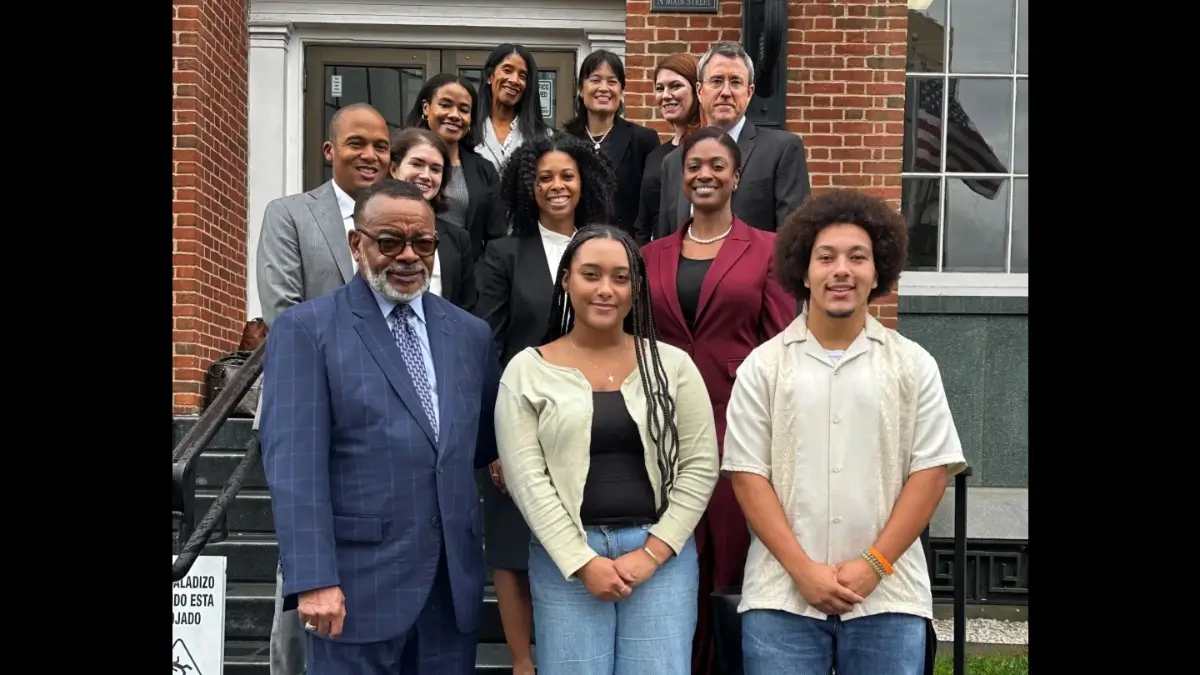
Confederate Names Changed To Address Racist School History
Virginia’s then-Gov. Ralph Northam, a Democrat, called upon school boards to change school names and mascots “that memorialize Confederate leaders or sympathizers” so that public schools do not continue to “tacitly endorse their values.”
After a lively period of public comment that drew speakers for and against the name change, the Shenandoah County school board voted 5-1 on July 9, 2020, to retire the names of Stonewall Jackson High School and Ashby-Lee Elementary. It also voted to retire the Rebel mascot at North Fork Middle School.
‘Might As Well Be a Plantation’: Black Entertainment Anchor Fired After Calling Out Racial Discrimination Now Getting Millions from NYC Station
Those who supported the name changes argued that while Stonewall Jackson High was being built between 1957 to 1959, just after the Brown v. Board of Education decision by the Supreme Court ordering the desegregation of public schools, the school name was deliberately chosen to reflect the state government’s campaign of “Massive Resistance” to integration and to send a message to Black families that they were not welcome in the new school.
Stonewall Jackson High defiantly opened and operated as a segregated, whites-only school until the federal government forced it to integrate in 1963. Until that time, Black students in Shenandoah County had to attend segregated high schools in neighboring districts, some riding on buses for more than an hour each way.
One of the first Black students to attend the high school told the school board in 2020, “To me, Stonewall Jackson, as a Confederate soldier, and Confederate flags make people of color hurt. These symbolize hatred. … I know it’s old history, but it’s hate history, and we don’t need to continue that way.”
During a public hearing several months later, after taking public input on new names, the school board voted in January 2021 to rename the schools Mountain View High School and Honey Run Elementary School, respectively.
A Conservative Backlash
But a campaign to revert to the old Confederate names was already afoot among some members of the community.
In 2021, the Coalition for Better Schools was formed to challenge what its members deemed the school board’s insufficiently democratic processes for changing the names.
The coalition’s politically conservative members ran for, won and turned over all six school board seats during elections in 2021 and 2023, campaigning against what they called the rushed, “politically correct” and “woke” actions of the prior board members and touting their plans to reinstate the Confederate school names.
Despite strong opposition during the public comment period at a school board meeting, when 50 out of 80 people spoke against doing so, on May 9, 2024, the new board members voted 5-1 to restore the Confederate school names.
One school board member, Thomas Streett, said during the meeting that the decision to retire the schools’ Confederate names in 2020 was “a knee-jerk reaction” and then spoke highly of Confederate General Stonewall Jackson.
“I find it very interesting when you read about this man, who he was, what he stood for, his character, his loyalty, his leadership, how Godly [a] man he was, those standards that he had that were much higher than any leadership of the school system in 2020, and are higher than anybody now,” he said. “But yet we want to put that individual down, we don’t want to look at him as a person.”
NAACP and Black Students Sue The School Board
In their lawsuit filed in June 2024, the Virginia chapter of the NAACP and the parents of five students who attended the two schools said the reaffirmation of the original names assigned to the schools to honor Confederate generals endorsed “a discriminatory and harmful message of Black inferiority and subjugation.”
They asserted that the names embraced those Confederate leaders’ pro-slavery and White supremacist views and said that when Black students “are compelled to attend schools that glorify the leaders and ideals of the Confederacy, they are subject to a racially discriminatory environment that has significantly damaging psychological, academic and social effects.”
The lawsuit alleged that the school board had violated the students’ First Amendment rights regarding freedom of expression, as well as the Equal Protection Clause of the Fourteenth Amendment and the Equal Educational Opportunities Act.
The plaintiffs sought injunctions against the continued use of Confederate names and symbols by the school board, as well as orders to adopt new non-racist names and to require the board to remove “all remaining vestiges of the dual school system previously operated in Shenandoah County.”
Experts Lay Out the Confederate Legacy
During a five-day bench trial in Harrisonburg, Virginia, in December, expert witnesses for each side testified about the historical context and meaning associated with the school names.
U.S. Army Brigadier General Ty Seidule, a history professor at Hamilton College and an expert in the history of the Confederacy, testified that the single animating purpose of the Confederacy was the preservation and expansion of slavery.
In response to those who suggest that the Confederacy did not primarily fight for slavery or that the Civil War was actually about “states’ rights,” Gen. Seidule countered that “the states’ rights motivating the South to secede were their rights to maintain the institution of slavery,” Judge Urbanski noted.
Thomas Stonewall Jackson was a Confederate general who owned slaves, Seidule testified. A religious man known for teaching Sunday school to Black children, he was a West Point graduate who earned his nickname “Stonewall” at the Battle of Bull Run and later “bravely and brilliantly” led a successful campaign against Union forces in the Shenandoah Valley before being fatally wounded.
His primary legacy to historians is as “a Confederate general fighting to create a slave republic,” Seidule said.
Names Rooted in Segregation
Turner Ashby was a Confederate officer and Virginia cavalry commander in the Civil War who led a unit that fought under Jackson’s battle and was killed in battle, the historian said.
General Robert E. Lee was the leading Confederate military figure who left the U.S. Army to lead the Confederate Army after Virginia voted for secession, Seidule testified.
The school board’s rebuttal witness, Gibson Kerr, a real estate businessman and author, submitted a report that said Lee was opposed to slavery and secession and had fought in the Civil War “solely to defend his home state of Virginia.”
Kerr said Lee “was the leading force for reconciliation, trying to restore peace and harmony between the North and the South.”
Ashby-Lee Elementary School was named for the two Confederate leaders and opened in 1974 following a period of federal school integration enforcement in the early 1970s, which Shenandoah County strongly opposed, testified plaintiffs’ expert Brian Daugherity, a history professor at Virginia Commonwealth University.
During the period when schools in the county were segregated, Shenandoah County operated separate but unequal public schools, Daugherity said.
School buildings for Black students were less likely to have indoor plumbing or cafeterias than schools for white students. Black teachers were frequently assigned to teach much larger classes and were paid less than white teachers, and Black students were typically given hand-me-down textbooks and supplies.
In Daugherity’s view, even though the new elementary school admitted Black students, “the naming of Ashby-Lee Elementary was chosen in part to reflect the county’s opposition to federal mandates with regard to school integration and the broader movement for racial change at the time.”
Students Testify
All four student plaintiffs testified about the harm they experienced as a result of the schools’ name changes.
“D.D.,” a 16-year-old biracial girl, testified that she understood that Stonewall Jackson fought to preserve slavery and believed that the Black race was inferior to the white race. She said she opposed the school’s name because it honors a Confederate general who fought to keep Black people, including her ancestors, enslaved.
She said she was “upset” about the campaign in 2024 to reinstate the Confederate names at both schools because they “offend [her] and make [her] feel unwelcome and uncomfortable.”
D.D. provided an email she sent to the school board before they voted detailing how the names negatively impacted her.
Explaining that she plays three sports at Mountain View, including volleyball, basketball, and soccer, she wrote, “Every time I put on one of those jerseys, I am asked to proudly represent my school, which is something I cannot do if my school is named after someone who fought for something so horrible and cruel.”
Another mixed-race student, Briana Brown, identified in the lawsuit as “B.B.,” who is now in college, has testified that the return to Confederate names during her senior year left her “disappointed and confused” because the school board previously retired the names due to their understanding of the harmful impact on Black students.
The vote to restore the names “communicated to me that they may have some of the same racist ideals as Stonewall Jackson, and that they don’t care about minority students.”
Lasting Emotional Toll
Other expert testimony “established that Confederate symbols are a form of cultural racism and that exposure to racism can produce stress and traumatize Black students, resulting in various psychological and physical harms,” the judge observed in his ruling.
Dr. Adiaha Spinks-Franklin, an expert in the field of developmental behavioral pediatrics and on racism as a health determinant in children, testified that Black students are disproportionately affected by Confederate school names compared to their white peers.
She said cultural racism casts Black individuals as inferior and is perceived by the brain as social rejection, causing stress hormones to go into overdrive when experienced daily.
A.C., a biracial student who attended a governor’s math and science program for high-achieving students during his last two years in high school, testified that the board’s vote to restore Stonewall Jackson’s name his senior year “put a knot in my stomach, at the very least.”
He was “stunned,” he said, “that any community would take such a big step backward.”
A.C. said the name change negatively impacted his social interactions and relationships at school, as the fact of the name restoration “was always there” and while he did his best to focus on his schoolwork and engage with friends, “it just weighed on me…almost like an invisible ball and chain.”
Dr. Amy Bass, a professor of sports studies at Manhattanville University, testified that Confederate symbols Black students wear on team jerseys or see around campus, on scoreboards and the center of the basketball court, “undermine the principles of inclusivity and equality that school athletics should promote” and “can discourage students from participating in sports activities, whether as athletes or spectators.”
Judge Rejects School Board’s Arguments
In their court filings, the school board argued that “while the Board has no reason to doubt that Plaintiffs’ beliefs regarding the school names are sincerely held … the Board maintains that the decision to reinstate the school names was motivated by nothing more than public will and its respect for the democratic process.”
The defense contended that voters of Shenandoah County elected school board candidates who promised to reinstate the names “and oppose ‘cancel culture’ and “to bring to a stop the politically expedient erasure of American Southern history.”
The board claimed that no students, Black or white, have been forced to “become a courier” for any message with which they disagree,” and that the only alleged harm “is emotional and psychological, or speculative and potential. …No student has alleged they suffered actual harm. Hurt feelings will not suffice.”
In September of 2025, Urbanski issued an opinion that the school board had violated the First Amendment rights of Black students when it reinstated the Confederate names.
While participating in extracurricular activities, whether playing basketball or performing in the marching band, he wrote, the school “required them to assume the identities of ‘Stonewall Jackson Generals,’” a form of expressive conduct that he found to be objectionable “compelled speech.”
He reserved ruling on the injunctions the plaintiffs sought until the other allegations in the lawsuit were adjudicated.
During the December trial, the defense argued there were other reasons to honor the Confederates, such as military prowess, the New York Times reported.
The Ruling
After hearing closing arguments in March, and reviewing additional briefs, Judge Urbanski ruled last week that the school board had violated the equal protection rights of the Black plaintiffs, as well as Title VI of the Civil Rights Act and the Equal Educational Opportunities Act.
“The decision to rename the schools after Confederate leaders cannot be divorced from racial discrimination,” he wrote. “Lee, Jackson and Ashby fought to preserve a political system that enslaved Blacks, and their legacy was used as a tool to fight desegregation.”
He said the school board in 2020 “recognized the racially divisive symbolism that the Confederate leaders represent and removed the names from its schools. The School Board’s subsequent vote to reinstate the names necessarily embraces the ideals for which Lee, Jackson, and Ashby fought — including the enslavement of Black people.”
“As the compelling testimony from the Black student plaintiffs demonstrates, these names continue to have discriminatory effects,” Urbanski wrote, including “the disproportionate impact of these names on their educational and extracurricular experiences, as well as their physical and mental health, that White students do not suffer.”
All of these impacts from the Confederate names “diminish and ultimately deny plaintiffs the equal educational opportunity to which they are entitled,” he wrote.
Urbanski said that the evidence presented by the school board was “neither fully credible nor persuasive on the issues of discriminatory impact and intent.”
“It cannot be overstated that the Confederate names here are not located on memorials — they are school names,” the judge concluded. “And schools are different. As the Court stated in [Brown vs. Board of Education], education … is the very foundation of good citizenship.”
New School Names On Tap … and A Likely Appeal
At a press conference last week, NAACP attorney Li Reed said the ruling requires the county to remove the Confederate names and that attorneys are working to give the school board a path to compliance that limits the financial impact on taxpayers.
“School starts this week and they still have time to remove the Confederate name from the schools before school starts,” Reed said. “But we want to be clear that if they don’t do that, then it will cost Shenandoah County money.”
In a letter to the school board, plaintiffs’ attorneys said they have incurred approximately $500,000 in costs and expect to ask the court for between $7 million and $10 million in attorney fees, reported WHSV.
The attorneys said they are offering to reduce that amount by millions if the board removes the Confederate names by Aug. 17 and agrees to mediation. That mediation would include a process for choosing new school names.
If the school board appeals the ruling, the plaintiffs said they will not lower the fees.
The Shenandoah County School Board voted 6-0 on August 13 to appeal the ruling.


