‘Never Say That Word Again!’: White Florida Man Thought He Could Get Away with Flinging Racist Insult at Black Woman, But Then He Learned Actions Have Consequences
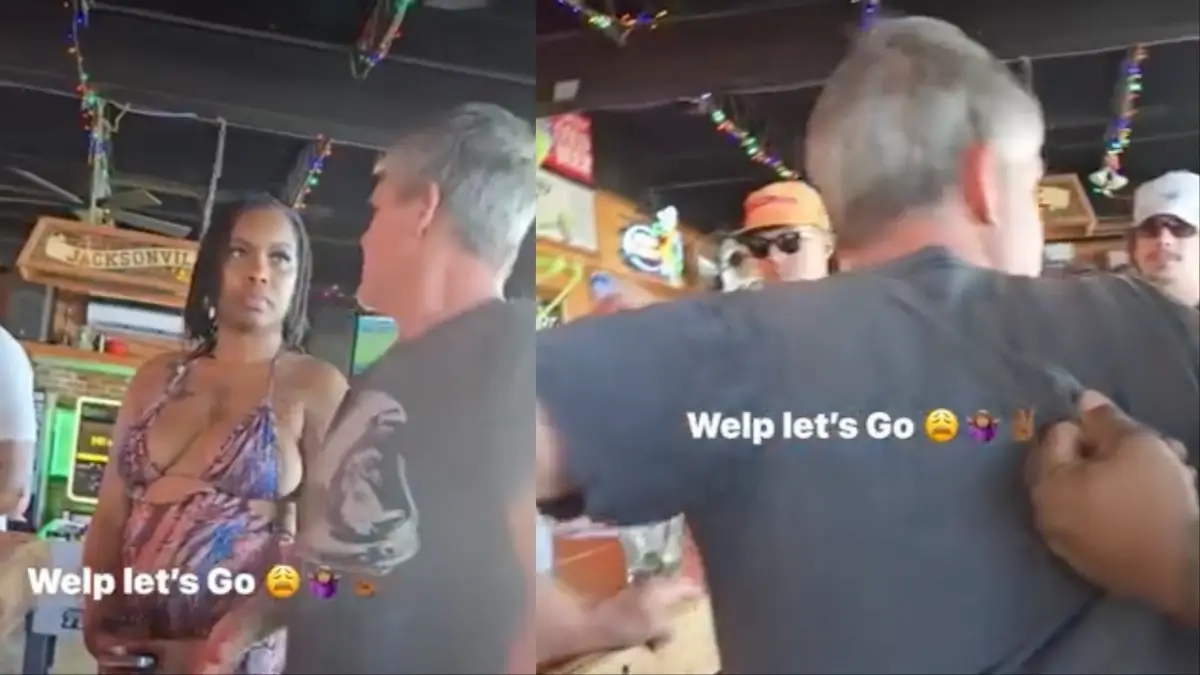
A Black Florida woman just wanted to relax with friends at a bar, but a cruel customer ruined her outing when he allegedly called her a racial slur. A video that emerged on Instagram over Memorial Day weekend shows a rude, older white man losing his temper as he’s being kicked out of Mango’s Beach Bar in Jacksonville after a bizarre and unwarranted interaction.
The clip, posted by Tonya Ridley on Instagram, has racked up 1.5 million views, with thousands of commenters cheering on a no-nonsense female bartender who screamed at the man before a helpful Black bar patron showed him the door.
Video screenshots show a confrontation in a Florida bar. (Photo: Instagram/aunttoya_)
Though the slur was not caught on film, it was bad enough to inspire the ire of Mango’s staff. “Absolutely not. Absolutely f*cking not. I don’t give a f*ck. Never say that word again,” yelled the bartender, as the soft country ballad “I Swear” by John Michael Montgomery played in the background. Many viewers found the contrast of the music amusing.
Video screenshots shows a confrontation in a Florida bar. (Photo: Instagram/aunttoya_)
“Acting like that with ‘I Swear’ on the speakers is wild,” quipped one.
The man made a meager attempt to justify himself by saying, “That’s the word she just used,” but was immediately shut down by the bartender.
As he was being kicked out, the man had the nerve to refer to his target as “sister” and lobbed one last insult.
He told her, “Sister, you got something to be ashamed of.”
“The fact that I’m Black…?” said the woman who had been giving him the stare-down of a lifetime. According to the video, a Black male patron pulled him out of the door by the scruff of his neck as he screamed and threw a fit.
The man’s audacity in apparently making a racial remark — and then getting upset when he was kicked out — infuriated commenters.
“So many racists out here outing themselves,” lamented one person, “If you wanna say it so bad, do it. Just don’t get upset when you have consequences.”
Viewers applauded the bartender as well. “As a server, I admire the way that bartenders get to talk to people. Would love to yell at a racist.”
Another top comment read, “Respect to the female bartender. She had those ladies back,”—referring to the second Black woman who was sitting at the bar who watched the interaction.
Unfortunately, many racists came out of the woodwork online, using derogatory language in the comments and even justifying the use of the N-word, because “they call each other that name.”
But as one commenter put it: “One group uses it internally with affection, the other group uses it with hatred as an insult or provocation. Intent and context matter. To pretend it’s just a word shows your ignorance of social history.”
Democracy needs journalism it can trust.
This election season, the stakes are higher than usual — and so is the pressure on newsrooms to soften their coverage, stay quiet, or just disappear. Independent reporting, the kind that answers to readers instead of advertisers or political pressure, matters more in a moment like this, not less.
For over 14 years, Atlanta Black Star has stayed independent and reader-funded. We have no corporate owner and no shareholders telling us what to cover or how to cover it. That independence is also our biggest vulnerability: nothing protects it except readers choosing to fund it directly.
Newspaper ad revenue has fallen more than 80% since 2005, and local newsrooms are closing at a rate of roughly two a week nationwide. When outlets go under in a moment like this, it's rarely the independent, reader-funded ones that get to stick around.
We know a request for support isn't why you came here. But without readers choosing to fund this work directly, the depth of reporting we can do at home and abroad shrinks along with everyone else's. If you're not in a position to give, that doesn't change how much we value you as a reader.
If you are able to, a recurring contribution does more for us than a single one-time gift, because it lets us plan the next investigation instead of just the next invoice. It takes about 30 seconds, no long form, no account. Thank you for continuing to support independent journalism and freedom of the press.