According to President Donald Trump, America is unequivocally at war — though few on Capitol Hill appear eager to describe it that way.
As it relates to Iran, Trump appeared to take a victory lap Wednesday while discussing the expanding U.S. military campaign — a fight that, so far, appears open-ended, with no clear plan yet emerging for how it ends.
The conflict is only days old, yet the death toll has already climbed to six Americans as Tehran continues attacking U.S. facilities across the Middle East. With the fight intensifying, lawmakers began describing the U.S. barrage as a “significant military operation,” underscoring a growing clash in Washington over how to define the campaign — and how to measure its success — which has become nearly as contentious as the battle itself.
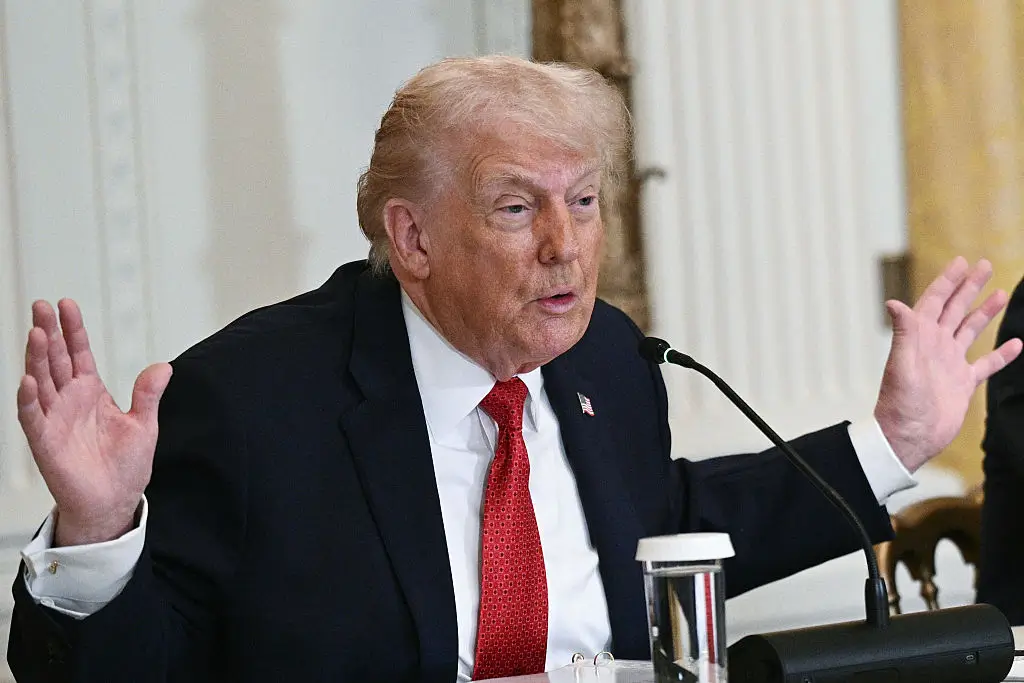
Trump, for his part, framed the conflict as a war that was going well while speaking with tech company executives at a roundtable on energy ratepayer protection Wednesday.
“These are exciting times. We’re doing well on the war front, to put it mildly. Somebody said on a scale of 10, where would you rate it? I said about a 15,” he told the audience, despite American casualties adding up. The remarks quickly sparked backlash, with many online accusing the president of keeping score in a deadly conflict.
“I thought it wasn’t a war, you absolutely rotting sack of dementia,” one critic wrote on Threads.
View on Threads
While Trump openly described the campaign as a war and praised its progress, House Speaker Mike Johnson insisted that the United States was carrying out a limited mission rather than fighting a new war.
“We’re not at war right now, we’re four days into a very specific, clear mission and operation,” Johnson said during his weekly press conference earlier in the day.
The contrasting messages fueled public anger over the rapidly escalating operation, with Washington’s leadership clearly not on the same page.
“Didn’t Mike Johnson just get done saying it’s NOT a war?” another critic fumed after Trump’s remarks, which landed as the conflict entered its fifth day.
Meanwhile, U.S. forces struck Iranian targets while allied operations continued alongside Israel on Wednesday. In one dramatic development, a U.S. submarine reportedly sank an Iranian warship off the coast of Sri Lanka as explosions were reported elsewhere in the Middle East.
At the White House gathering, Trump portrayed the campaign as an overwhelming success, saying Iranian leadership ranks were being wiped out as the strikes continued.
“We’re in a very strong position now, and their leadership … everybody that seems to want to be a leader, they end up dead.”
Trump noted that Iran’s ballistic missile capabilities were collapsing under the bombardment, telling the room that the country’s arsenal was being “wiped out rapidly.”
The president repeated his justification for launching the campaign, saying Tehran was moving toward developing a nuclear bomb.
To make matters worse, during the roundtable, Trump referred to the conflict as though it were a TV series or sports game. Telling Republican Sen. Bernie Moreno from Ohio, he was anxious to go “watch the war.”
“I have to go back and look at the war. You know, I have a lot of things happening,” Trump said gleefully.
“When crazy people have nuclear weapons, bad things happen,” Trump said.
His tone and framing quickly ignited social media users, who pointed to the human cost of the fighting.
“Families of 6 fallen soldiers would like a word. How unbelievable,” one said.
“Glorifying death is disgraceful,” added another.
Others focused on the contradiction between Trump’s words and the message coming from Republican leaders earlier that same day.
Speaker Johnson sat in the same room, yet hours before Trump’s remarks, he argued that Iran had effectively started the conflict, even though the United States and Israel launched the opening strikes that decapitated much of Iran’s leadership structure, including the country’s supreme leader, Ayatollah Ali Khamenei.
Johnson suggested the campaign could end soon if the U.S. gains full control of the skies over Iran. At the same time, he repeated Trump’s message urging Iranians to overthrow their government, recalling the president’s call to the public: “When we are finished, take over your government” and “This will be probably your only chance for generations.”
Despite Johnson’s attempt to avoid the term, Trump and Defense Secretary Pete Hegseth have both openly described the campaign as war.
“The lives of courageous American heroes may be lost, and we may have casualties,” Trump said days earlier when announcing the strikes. “That often happens in war.”
Hegseth used the same language when discussing the campaign’s objectives.
“This is not a so-called regime change war, but the regime sure did change, and the world is better off for it,” he said.
The growing conflict has also triggered a fight in Congress over oversight and funding. Senate Republicans voted down a resolution that would have required congressional approval before additional military strikes. The measure failed 47–53, largely along party lines, though Republican Sen. Rand Paul voted in favor and Democratic Sen. John Fetterman voted against.
Meanwhile, the White House signaled that a large request for war funding could soon arrive on Capitol Hill. Officials are reportedly weighing a proposal for as much as $50 billion to support the campaign.
Johnson acknowledged lawmakers are waiting for the administration to formally request the money. “We’re waiting on the White House and [the Pentagon] to let us know, but we have an open dialogue about it,” he said, according to Politico.
Passing such a measure could trigger a major political battle. Democrats have already raised concerns about the lack of details surrounding the operation’s cost and scope, while some Republican fiscal hawks remain wary of approving tens of billions in new spending.
Fears of possible Iranian retaliation on U.S. soil also linger as tensions in the Middle East escalate.
During a phone call with Time magazine’s Eric Cortellessa on Wednesday, Trump was asked whether Americans should be worried about a potential strike on American civilians.
“I guess,” Trump replied, before adding that the threat of such attacks is something officials consider constantly. “But I think they’re worried about that all the time. We think about it all the time. We plan for it. But yeah, you know, we expect some things. Like I said, some people will die. When you go to war, some people will die.”
Meanwhile, Iranian Foreign Minister Abbas Araghchi dismissed suggestions that Iran might directly strike the U.S. homeland. In an interview with NBC’s Tom Llamas on Thursday, Araghchi said Iran’s military focus remains on U.S. bases and other targets across the Middle East.


