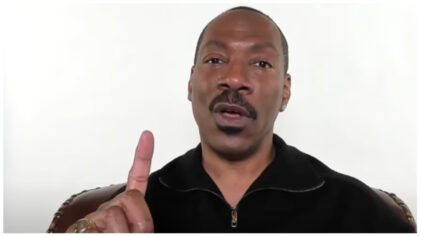
Eddie Murphy has been famous long enough that even his restraint reads as authority — but every now and then, someone else tells a story that explains why his name still carries authority far beyond box office numbers.
That happened when Guy Torry shared his experience filming “Life,” offering a behind-the-scenes look that reframed the movie not as a nostalgic comedy, but as a workplace where power, race, and protection were constantly in play.
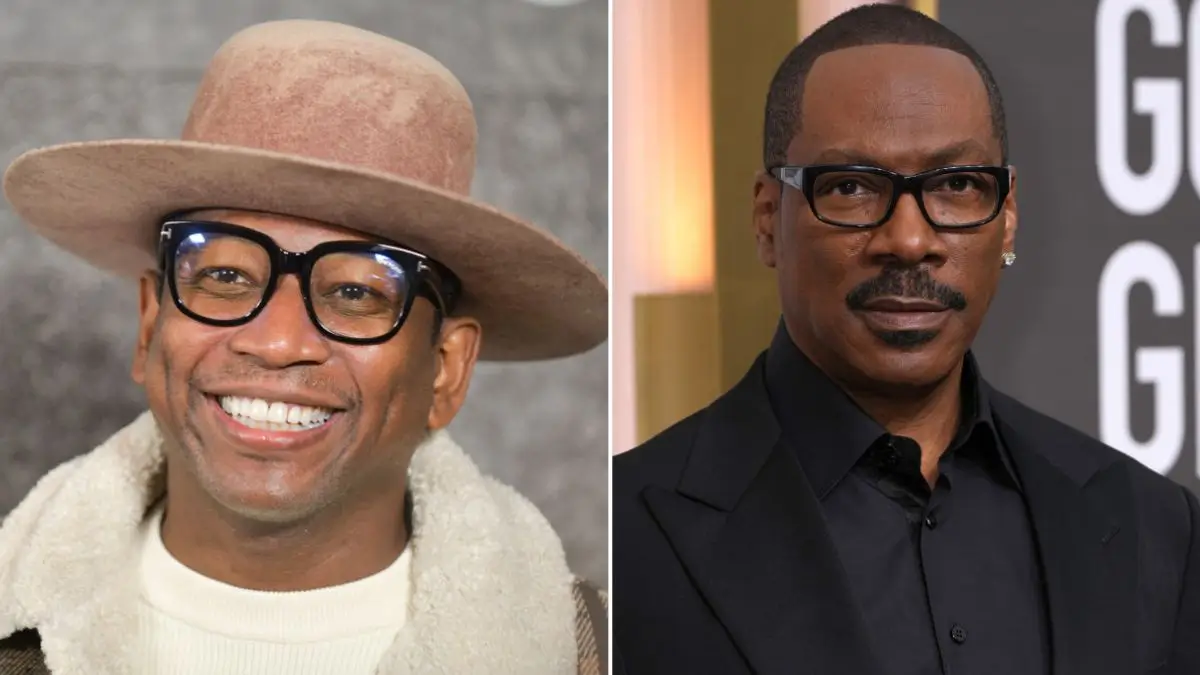
Torry shared the story during a recent appearance on the “TFU Podcast” with AD Dolphin and Alejandro G., easing into the conversation before revealing what really stayed with him from the 1999 film’s production.
“Man, Eddie Murphy was looking out for brothers in that film. There was some bulls—t going on behind the scenes, some racist s—t. And Eddie Murphy was checking mother—kers right then and there, like, ‘OK, no, we ain’t allowing this on this set.’”
The stories escalated quickly. Torry described walking into the barracks where they slept during filming and seeing something that stopped him cold on his first day on set.
“We came in one morning, and there was a stick figure with a noose neck hanging in there that one of the crew had put in there,” he revealed, to which the host responded, “It’s a Black film?”
“Black film but some of the crew was white,” Torry added.
Did you know? Of all the movies on which Eddie Murphy and makeup artist Rick Baker collaborated, Life (1999) is the only one where Murphy did not play more than one character. Baker only used the makeup to age Murphy's character in this movie. pic.twitter.com/O0odnCa3Ej
— Blackout Cinema (@Blackoutcinema1) January 7, 2026
When asked whether the person responsible was ever identified, Torry’s answer was simple: no. Murphy handled other moments that crossed the line in real time, as Torry recounted a scene involving pickaxes when a white assistant director attempted to correct a Black background performer. He claims Murphy overheard it and exploded.
“Motherf—ker, wait a minute. What? You gonna tell a n—ga how to pickaxe?” Torry recalled. The message landed. “And the next day, that guy was gone. He wasn’t there no more.”
Acts like this, the comic says, made him respect the former “SNL” cast member even more, writing, “Especially my generation, that’s our hero. As a comedian, for sure. He’s on most comedians of my generation’s comedy Mount Rushmore.”
Guy Torry talks about the cast of the, ‘Life’ movie finding a stick figure with a noose around its neck, from a member of the filming crew and how Eddie Murphy handled racism from the film crew, while on the set of the movie pic.twitter.com/DXrviuBeVA
— JaValle (@JaValle) January 21, 2026
When the podcast clip circulated on Instagram, the reaction felt less like surprise and more like delayed confirmation.
“So, we’re just now hearing this and the movie ‘Life’ has been out for 27 years?” DJ Quik wrote.
“Salute Eddie Murphy!!” another commenter added.
Others were more direct. “Love to hear Eddie wasn’t allowing that s—t,” one person wrote.
Another drew a hard line: “I’m telling you right now and no o wasn’t there, they could have found out who put that noose there. They didn’t want to.”
One final comment summed it up: “Man if you look at Eddie’s resume…he been putting on for the culture for decades!”
As one of the most popular movie stars in Hollywood, Murphy maintains a reputation for being professional on set. And while stories like this show how he also sets the tone of the production, he himself has shared stories about set etiquette and camaraderie.
In a 2025 interview reflecting on filming “Dreamgirls,” Murphy shared a quiet backstage exchange between Beyoncé and Jennifer Hudson.
“Neither one of them know that I know this,” Murphy stated. “They were on stage. Jennifer was new in show business and she had, I guess a finger… was ashy, and she was licking her fingers and getting the ash like that. Beyoncé grabbed her and said, ‘Ooh girl, don’t do that. I’ll get you some cream.’ And it was quiet between the two of them, but I saw it.”
Taken together, the “Life” recollection and the “Dreamgirls’ memory sketch the same pattern: Murphy watching closely, intervening selectively, and understanding when presence mattered more than performance. He never positioned himself as a spokesperson, but he didn’t look away either.
That approach mirrors the ecosystem Torry helped build for himself offscreen. Long before “diversity pipelines” became industry language, he launched Phat Tuesdays at The Comedy Store, creating space for Black comedians to work without translating themselves. The platform didn’t just showcase talent — it forced the industry to follow.
Torry has always framed that era as collective, not individual. His “Life” story lands the same way. It isn’t about canonizing Eddie Murphy. It’s about documenting how power functioned when someone chose to use it without asking for applause.