Secretary of State Marco Rubio’s tried to power through questions during his Sunday appearance on NBC’s “Meet the Press,” leaning into a fast-talking defense that only grew more strained the longer he spoke. Instead of keeping control of the exchange, Rubio’s rapid-fire delivery began to work against him.
Asked by ABC’s This Week host George Stephanopoulos what legal authority the United States has to “run” Venezuela, as President Donald Trump vowed, Rubio offered a winding response that ultimately rested on U.S. economic leverage — arguing that seizing sanctioned Venezuelan oil tankers allows Washington to pressure the government into compliance.
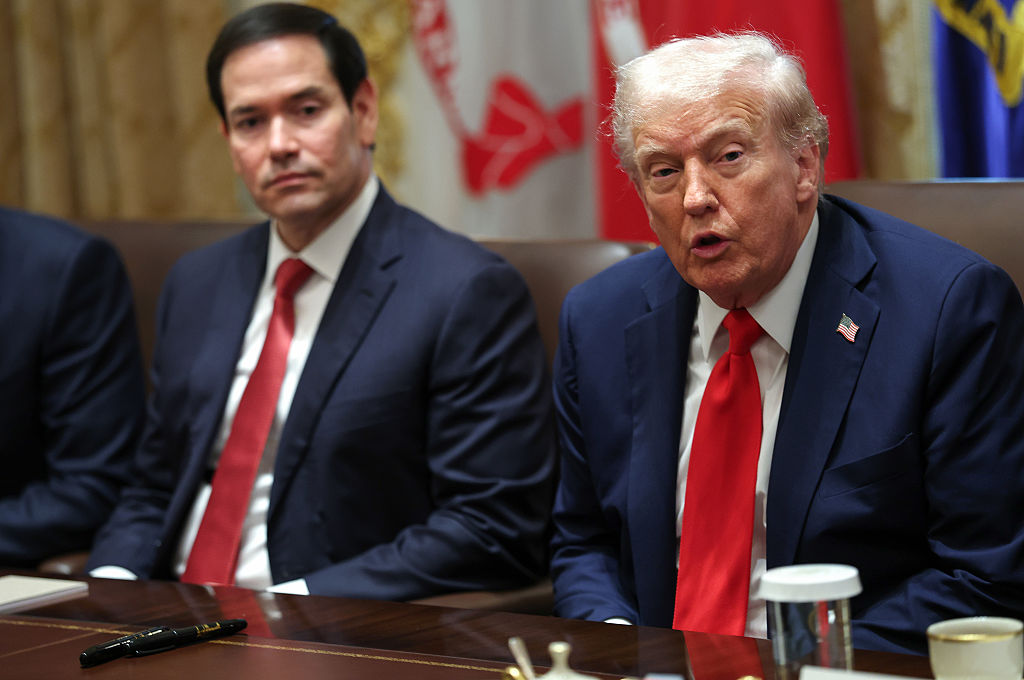
That framing diverged sharply from Trump’s declaration a day earlier that the officials standing behind him, including Rubio and Pete Hegseth, would be running the country.
When pressed again by Stephanopoulos and later by NBC’s Kristen Welker on “Meet the Press,” Rubio downplayed the idea of direct control, expressing frustration that “People [are] fixating on that” and insisting instead that the goal was to force “changes in Venezuela.”
His comments, coming a day after U.S. forces captured Venezuelan President Nicolás Maduro, prompted a wave of disbelief online, with reactions ranging from incredulity to outrage.
Rubio insisted the administration wasn’t focused on Venezuelan oil, despite Trump’s earlier victory lap concerning American access to the country’s vast crude reserves.
“We don’t need Venezuela’s oil. We have plenty of oil in the United States,” Rubio said. But he made clear the administration’s objective is to prevent U.S. rivals — specifically Russia, China, and Iran — from “controlling” the nation’s energy resources.
“What we’re not going to allow is for the oil industry in Venezuela to be controlled by adversaries of the United States. You have to understand, why does China need their oil? Why does Russia need their oil? Why does Iran need their oil? They’re not even in this continent,” Rubio said sharply.
View on Threads
Adding, “This is the Western Hemisphere. This is where we live, and we’re not going to allow the Western Hemisphere to be a base of operation for adversaries, competitors and rivals of the United States.”
Welker attempted to cut in asking “has specific oil companies…” but a fast talking Rubio rolled right over Welker, even telling her “hold on” without missing a beat.
Rubio continued on before closing out saying, “This is deeply destablizing stuff, it’s not going to continue to happen. They’re not going to continue to come from outside our hemisphere, destabilize our region in our own backyard and us have to pay the price for it, not under President Trump.”
The remarks triggered a torrent of reactions online.
One commentator on Threads asked, “WTAF??? Did those words really come out of your mouth Marco?”
Another dismissed Rubio’s nuanced delivery, “He thinks if he talks rapidly it makes him sound important.”
Critics also decried his framing of the hemisphere as U.S. territory, “The Western Hemisphere is not ours. It is made up of independent sovereign nations. This is absolutely disgusting. They are all raving lunatics drunk with power.”
View on Threads
Another added bluntly, “No you f00l, you sanctioned Venezuela to choke they economy so that there is no choice for the citizens but to leave Venezuela… That’s what you have done to all the countries you have invaded. Sanction all the countries cuts trades and then you want to act like a crazy beach when countries get alternative help elsewhere.”
Despite Rubio’s attempt to downplay the oil grab, some critics were not buying it.
“This is such bullshit framing. But at least now they are admitting it’s all about the oil,” said Patrick on Threads.
Coach Paul added an eerie prediction, “The loudest in the room is usually the weakest in the room. This never ends well. The bully usually always has one that he cant bully. When that one arises all hell is gonna break loose.”
View on Threads
Rubio emphasized that Venezuela’s oil wealth should benefit its people, contrasting with Trump’s focus on U.S. access to the reserves and his stated goal of targeting the Maduro regime for drug trafficking. Rubio’s framing, however, suggested that the operation was primarily about limiting foreign influence, not domestic energy needs.
“During Maduro’s rule, the regime and its cronies enriched themselves with oil, contributing to an economic collapse and the mass exodus of people out of the country,” Rubio added.
In turn, it appears to be America’s turn to do the enriching.
View on Threads
Meanwhile, Trump touted U.S. oil company investments, saying, “We’re going to have our very large United States oil companies, the biggest anywhere in the world, go in, spend billions of dollars, fix the badly broken infrastructure, the oil infrastructure, and start making money for the country.”
Congressional reaction was swift. House Minority Leader Hakeem Jeffries called the operation an act of war, disputing Rubio’s insistence that congressional approval was unnecessary.
“There’s been no evidence that the administration has presented to justify the actions that were taken in terms of there being an imminent threat to the health, the safety, the well-being, the national security of the American people,” Jeffries said. “This was not simply a counternarcotics operation. It was an act of war.”
View on Threads
Rubio, by contrast, insisted that “we will seek congressional approval for actions that require congressional approval … and this is not an operation that required congressional approval.”
Despite Rubio’s insistence on legality and national interest, many Americans remain shocked by the blunt articulation of U.S. ambitions. One social media user summed up a widespread reaction: “The audacity of their thuggery to be studied.”


