President Donald Trump cracked a joke at a White House reception that initially played like familiar off-the-cuff banter — the kind that usually drifts by with a laugh and little follow-up. This time, it didn’t.
Standing beside billionaire casino magnate and Dallas Mavericks owner Miriam Adelson, Trump told the crowd during a Hanukkah even on Dec. 16 that she had dangled “another $250 million” if he pursued a third term, practically daring Trump to defy the Constitution’s explicit ban on a third White House stint.
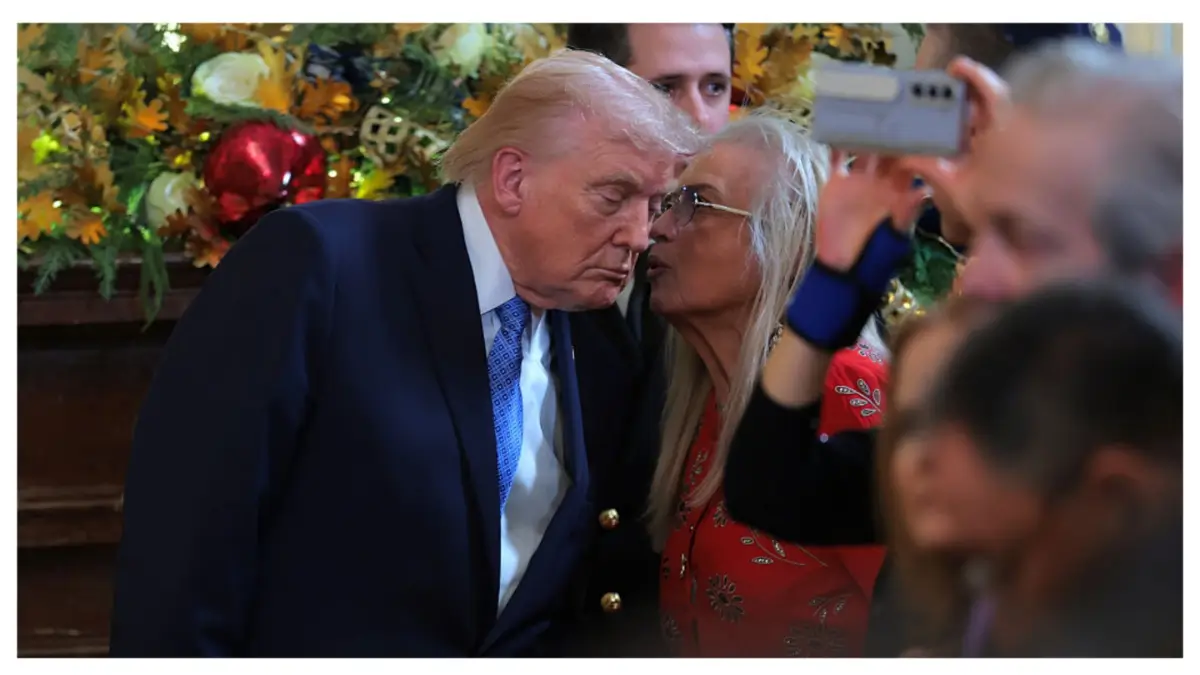
The remark drew laughter and chants inside the room, but outside it fueled a renewed debate about “oligarch” influence, legal loopholes, and how far moneyed allies like Adelson — among the wealthiest political donors in the country — might push to keep Trump in power.
The exchange unfolded after Adelson referenced “four more years” while speaking at the tuxedoed event. She suggested legal theories were already being explored and then revealed she had consulted criminal defense lawyer Alan Dershowitz about what she called the “legal thing about four more years.”
“Alan, I agree with you,” she said, before turning to the president and adding, “ So, we can do it, think about it.”
Members of the audience erupted into a chant of “four more years!” Adelson then whispered something to Trump, prompting him to quip, “She said, ‘Think about it, I’ll give you another $250 million,’” drawing more laughter, according to Forbes.
Standing nearby, Adelson again makes the stunning admission: “I will give” with seemingly no end in sight.
Online, the reaction was far less amused. On Yahoo!, critics said the exchange crystallized the dangers of concentrated wealth colliding with political power.
“Adelson’s pledge of $250 million to support Trump for an unlawful third term is a perfect example of the dangers of oligarchy—where the ultra-wealthy are willing to subjugate constitutional and legal principles to their interest in accumulating even more wealth.”
Another commenter underscored the stakes straight from the shoulder: “200 plus years of democracy can be flushed for the bargain price of $250 mill!!”
Adelson’s comments marked one of the most explicit public calls yet for a third Trump term since he returned to office last January.
Trump himself has acknowledged the constitutional barrier.
Last month, Trump reviewed a draft of a forthcoming book by Dershowitz examining whether he could constitutionally serve a third term, with Dershowitz telling The Wall Street Journal that the Constitution is “not clear” on the issue and lays out scenarios in which a president might do so despite the ban on being elected more than twice.
Dershowitz said Trump asked about his conclusions, smiled after the discussion, and then moved on to other matters.
The 22nd Amendment states, “No person shall be elected to the office of the President more than twice.” Trump served from January 2017 to January 2021 and is now nearing the end of the first year of his second term.
Legal scholars note that altering the Constitution requires an extraordinary political lift: two-thirds approval in both chambers of Congress and ratification by at least 38 states.
As Reuters reporters Jack Queen and Luc Cohen noted in October 2025, Republicans hold only narrow majorities — 219-213 in the House, 53-47 in the Senate, and control of 28 state legislatures — making such a change highly unlikely.
Another workaround circulating among conservatives is Trump running for vice president and ascending by succession, drawing even more skepticism.
“Nope. That’s not possible either,” one voice noted on Yahoo!.
“The 12th Amendment prevents that. The 12th Amendment clearly states that anyone ineligible to assume the role of the Presidency cannot run as Vice President. And since Trump is ineligible to assume the role of the Presidency after already having served two terms, that makes him legally ineligible to run for Vice President.”
Others argued the political math may be irrelevant, given voter fatigue with Trump.
“All of this may be a moot point since Trump’s second term has been such an abject display of incompetence and corruption so far that far fewer people would vote for him again,” one wrote.
Criticism also widened to the role of super PACs and unlimited political spending, fueled by the Supreme Court’s Citizens United decision, which allows wealthy individuals and corporations to pour vast sums into elections through outside groups.
“Rich people should not be able to buy politicians outright like that. Or buy elections. $1000 limit, overturn Citizens United. Adelson should not have that kind of influence because of her money,” one person argued.
For some, the episode symbolized deeper corrosion.
“Every time I see Billionaires throwing hundreds of millions of dollars into our political areanas, it quickly puts into focus how dark money and Citizens United has up-ended any fair rational legislation for Main Street America… Corporate people always seem to be the beneficiary over We the People!”
One comment framed the moment as a race against time, especially for Trump, who will turn 80 years old in June.
“The 22nd amendment is quite clear on the subject, but there will always be scurrilous, underhanded individuals trying to circumvent it. With luck, Mother Nature will render the issue moot. We will not awaken from this national nightmare until the morning we wake up and he doesn’t.”
And others saw the stakes as history repeating itself.
“Trump will try to sell out the Constitution if he gets the chance. It is so sad the 1% community appears to be encouraging it… The fall of Rome has begun.”


