
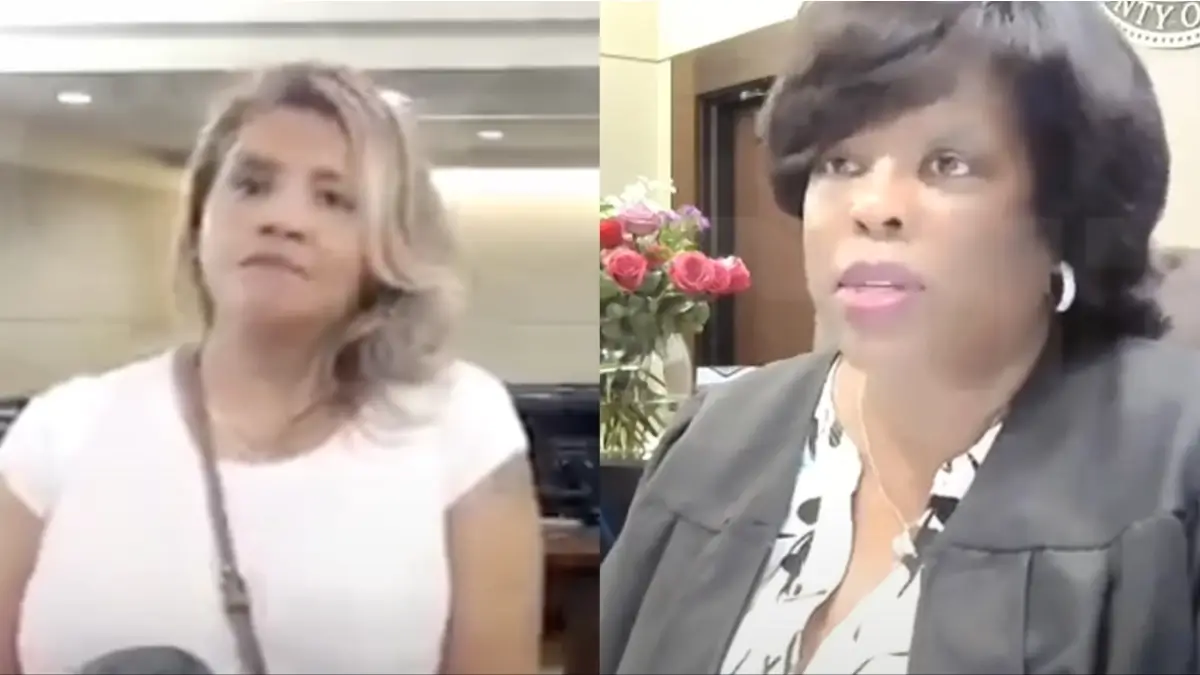
A criminal court judge’s exchange with a woman accused of assaulting a minor took a turn when the judge questioned why the woman used the N-word.
A viral YouTube clip shows a hearing overseen by Texas District Judge Stephanie Boyd for a woman pleading no contest to a misdemeanor charge of assault causing bodily injury.
After the judge ensures the defendant understands her rights and terms of her plea agreement, she finally asks for clarity on a point in the police report stating that the woman told officers that the victim had “n-knocked” on her door.
When the judge asks the defendant what the term means, the woman and her attorney hesitate until the woman fesses up and says, “n—r knocking.”
The judge asks her to explain further, and the woman says the term refers to when someone knocks on a door and runs away.
“Then why is it n—r knocking?” Boyd asks.
“That’s what they call it,” the woman responds while shrugging her shoulders.
“Why isn’t it Caucasian knocking, why isn’t it Asian knocking, why is it some other knocking? Why is it called that?” the judge asks.
“I don’t know, that’s just the way they say it,” the woman responds.
“No, that’s the way you say it because that’s what you said,” the judge states.
The woman explains that her use of the term “wasn’t to be racist.” She goes on to say how she was irritated by some kids who constantly knocked on her door, but that she “did not touch” one child and doesn’t want to plead to confess she did.
When Boyd suggests the case can go on to a jury trial, the woman opposes the idea and begins to talk about stress from her teen son’s murder two years prior and her desire to end her assault case as quickly as possible, and complete probation.
When Boyd asks the race of the victim, the defense attorney states the child is Hispanic.
Boyd also points to another portion of the police report alleging the defendant appeared intoxicated when the alleged assault took place, and probes further. She clarifies to the defendant that she’s trying to understand why the woman would use the term so she can set proper conditions for her probation.
“I’m sorry, you caught me off guard with the question that you asked me,” the defendant states. “I feel kinda set up with that question, I understand it’s not a word to be used and I understand I used it in a wrong way, and I apologize for that, so I’m sorry.”
Boyd concludes the proceedings by ordering the woman to pay a $500 fine, serve community service, take anger management classes and sober meetings, and adhere to certain employment conditions and prohibitions.
Videos of court proceedings overseen by Boyd often go viral. She once went viral for taking a woman to task for her court attire. Then, she scolded a man for bringing his child to a sentencing hearing, alleging it was a tactic to score sympathy points with her in the hopes of getting a lesser sentence.


