Donald Trump said Monday their lives are in danger, escalating their plight to a “genocide” as he welcomed 59 white Afrikaners, the descendants of Dutch settlers living in South Africa, to their new homes in the United States. Minnesota, Idaho, and Alabama are among the states taking in the refugees, prioritized ahead of about 12,000 already approved refugees from places like Venezuela and Africa.
Why the urgency?
“Because they’re being killed,” Trump said Monday. “And we don’t want to see people be killed … it’s a genocide that’s taking place. Farmers are being killed. They happen to be white.”
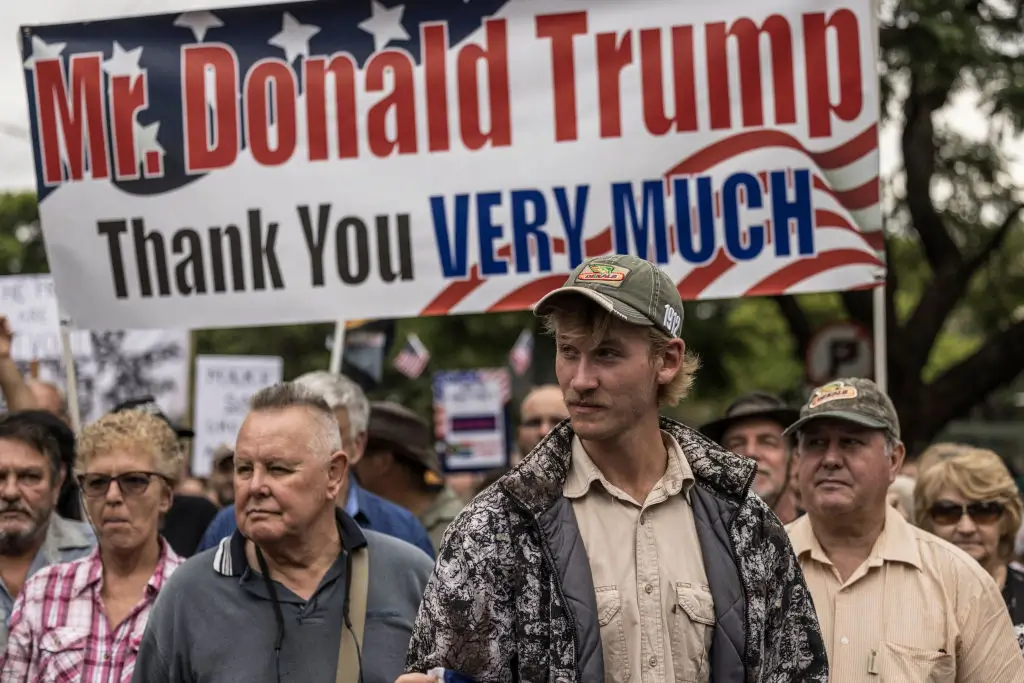
Trump, influenced by another South African immigrant, Elon Musk, has joined many on the right who have have accused that country’s government of enacting anti-white legislation and policies that have fueled violence against white landowners in the nation that for decades was ruled by a white minority that subjugated the country’s majority Black population until 1991.
The numbers suggest much has gone unchanged since the end of apartheid. Whites still own three-quarters of private land and have about 20 times the wealth of the Black majority, according to international academic journal the Review of Political Economy.
Less than 10 percent of white South Africans are out of work, compared with more than a third of their Black counterparts.
In order to close those disparities, South Africa last month passed a new law regulating property expropriation. Trump accused the ruling party, without evidence, of illegally confiscating land from white farmers, according to Agence France-Presse. That in turn gave new life to claims about white farmers being murdered, though experts maintain all racial groups have been targeted of the approximately 50 farmers killed annually in South Africa, AFP reports.
South African President Cyril Ramaphosa, speaking at a conference on the Ivory Coast, said the white Afrikaners had left because they were opposed to policies aimed at addressing racial inequality persisting since apartheid ended three decades ago.
“We think that the American government has got the wrong end of the stick here, but we’ll continue talking to them,” he said.
Ramaphosa called the situation “deeply concerning” in an interview with CNN and emphasized that the 59 Afrikaners that came to the U.S. do not meet the internationally accepted definition of refugees.
“We have raised our own concern because those people who are being enticed to go to the United States do not fit the definition of a refugee” in that none are fleeing persecution due to their political or religious beliefs or economic status.
White South African journalist Simon Ateba went even further, saying the refugees’ real fear is not violence, “but equality,” noting that 70 percent of the country’s resources are controlled by whites, who make up just 7 percent of South Africa’s population. Adding, “That’s not persecution that’s privilege on a guilt trip.”
In its official welcome to the Afrikaners, the State Department said the move shows the U.S. “will take action to protect victims of racial discrimination. We stand with these refugees as they build a better future for themselves and their children in the United States”
“No one should have to fear having their property seized without compensation or becoming the victim of violent attacks because of their ethnicity,” the press release states. “In the coming months, we will continue to welcome more Afrikaner refugees and help them rebuild their lives in our great country.”
Trump said he expects to meet with South Africa’s leadership next week. He said he will not attend a G20 meeting scheduled there in November unless the “situation is taken care of.”


