A court battle to settle a lawsuit filed by two Black men who were wrongly convicted of murder and incarcerated for a combined 32 years has come to an end with a $120 million settlement.
John Fulton and Anthony Mitchell were arrested in 2003 for the first-degree murder and kidnapping of Christopher Collazo. Fulton and Mitchell were 18 and 17, respectively, when they were charged in 18-year-old Collazo’s death.
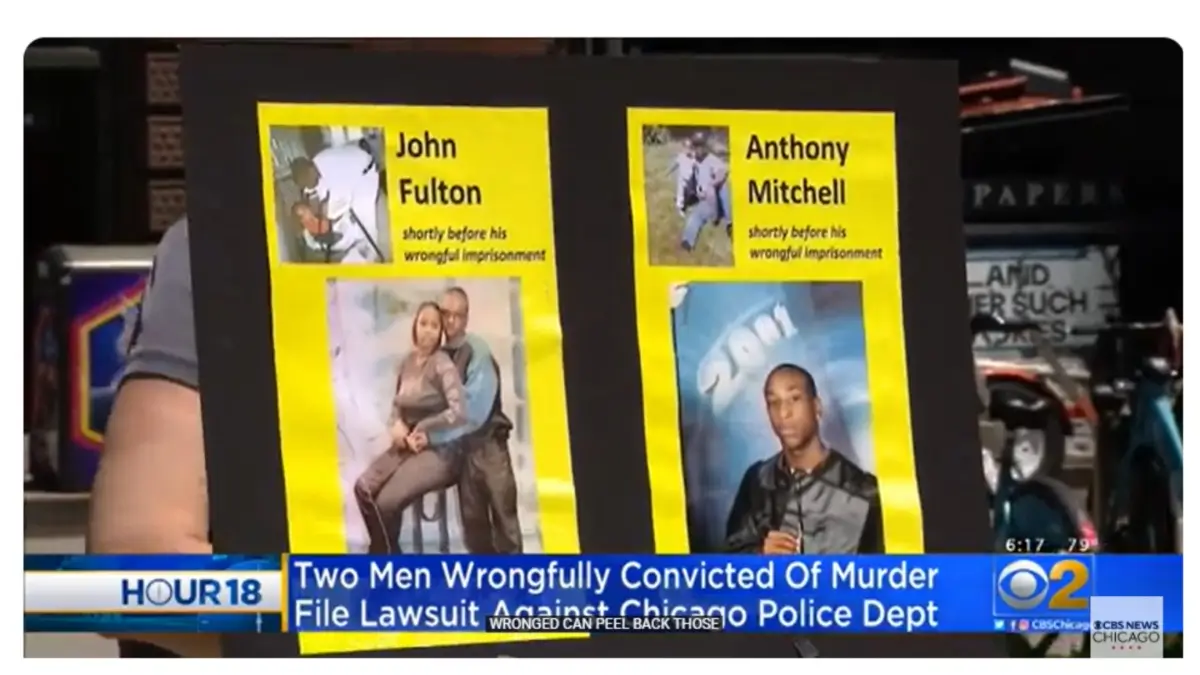
After being found guilty in 2006, they were each sentenced to 31 years in prison.
They remained behind bars for 16 years each until their joint releases in 2019 after their convictions were vacated.
In 2020, both men filed a federal lawsuit against the city of Chicago, the Cook County State Attorney’s Office, and more than a dozen former and current Chicago police officers and state attorney’s employees alleging they’d been framed for Collazo’s murder through a slipshod investigation and coerced into falsely confessing to the crime when they were teenagers.
Testimony lasted a month in their federal trial and after two days of verdict deliberations, the jury determined that detectives pressured Fulton and Mitchell to give false confessions and falsified evidence to pin Collazo’s murder on them, according to court records cited by The New York Times.
Both men were awarded $60 million each in damages.
On March 10, 2003, authorities were called to a fire in an alley where they found Collazo’s burned body and duct tape wrapped around his wrists, ankles, and mouth.
No physical evidence linked Fulton and Mitchell to his death, but detectives coerced witnesses into giving false statements to manufacture proof, according to court documents.
A mutual friend of Fulton and Collazo told police that weeks before Collazo’s murder, Fulton tried to purchase a gun from Collazo, despite an earlier dispute in which Collazo robbed Fulton at gunpoint, court filings cited by the Chicago Sun-Times state. She initially told police there was no connection between the robbery and the murder, then changed that statement in another interview. She later recanted her statements.
“Through threats and intimidation, and by feeding her a false narrative that they had concocted, defendants coerced [the mutual friend] into falsely implicating [Fulton] in Collazo’s murder,” court documents stated.
Both Fulton and Mitchell initially denied responsibility for the murder. Fulton told police he was at the hospital with his fiancée on March 9, returned home, and didn’t leave his apartment until the next morning to go to school.
During an interrogation that lasted days, detectives promised Fulton leniency and used intimidation tactics and physical abuse to bully him into giving a false confession.
Mitchell was interrogated for roughly 40 hours and subjected to the same “abusive” tactics until he falsely confessed as well.
Fulton and Mitchell maintained their innocence for years until a Cook County judge tossed their convictions in 2019, citing constitutional violations and a discovery that jurors in their murder trial did not see surveillance footage at Fulton’s apartment that confirmed his alibi. The footage supported Fulton claim he was in his building around the time of Collazo’s murder, and electronic key records would have verified his account.
“Justice is finally here,” Fulton, now 40, said at a news conference. “I knew my time was gonna come one day … [But] you can’t make up for that lost time.”
“They can’t just close a case to close a case,” Mitchell’s and Fulton’s attorney John Loevy said of the authorities who incriminated his clients. “Whoever really killed that kid is still out there and got away with it because they focused all their energy on these two kids who didn’t do it.”
According to city data obtained by WTTW, Chicago taxpayers have paid a staggering $200 million to resolve lawsuits brought by more than three dozen people wrongfully convicted of crimes based on evidence gathered by the city’s police force.
The $120 settlement awarded to Fulton and Mitchell marks one of the biggest payouts for a wrongful conviction in U.S. history.
Fulton said he and Mitchell plan to use some of the settlement money to fund initiatives that help other wrongly incarcerated individuals clear their cases.
“They need to be brought home, too,” Fulton said. “The day of celebration will be when all the wrongfully incarcerated individuals can step in the free world.”


