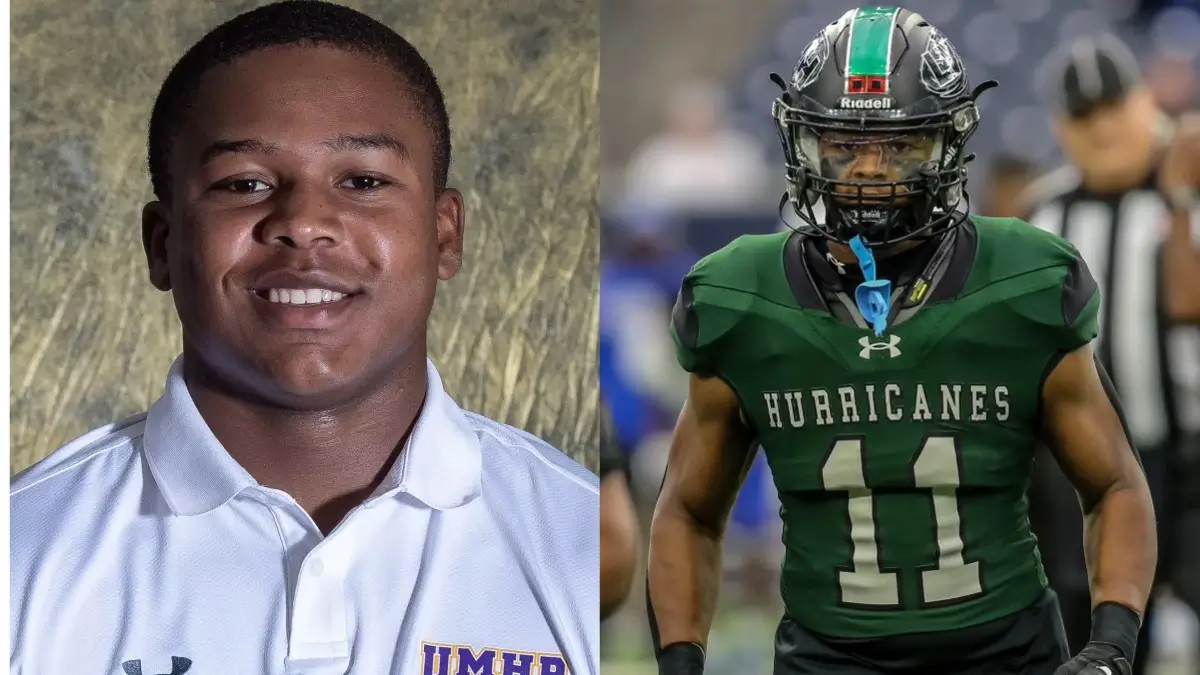
Braylen Kizzee had just left home in Fort Bend County, Texas, heading for class at Mary Hardin-Baylor University last Tuesday morning when an unmarked truck stopped suddenly in front of him.
He swerved to avoid hitting the car but was hit twice in the side by another unmarked vehicle, forcing him off the road.
“They rolled down their windows and told me to put my hands up, or they were going to blow my head off,” said the 19-year-old, who plays linebacker for Mary Hardin-Baylor.
The gunmen didn’t identify themselves, Kizzee said. They forced him to crawl to the passenger side and exit on his hands and knees.
“I really thought someone was trying to jack me for my car,” he said.
Guns still pointed in his direction, Kizzee crawled another 30 feet to one of the unmarked cars. Someone yanked the beanie from his head.
“And that’s when they recognized I wasn’t their guy, the guy they were looking for,” he said.
The wanted man had robbed a number of ATM machines in Kentucky. He’s 6 feet 1, a good four inches taller than Kizzee, with a heavily tattooed neck. Kizzee has no tattoos and no criminal record.
“We look nothing alike … I don’t know how they could’ve gotten us mixed up,” he said.
KTRK-TV 13 reports three of the officers involved in the Dec. 3 incident with Kizzee serve on the Gulf Coast Violent Offenders Task Force, run by the U.S. Marshals Service. A spokesperson for the Marshals office said that the agency declined to comment, citing an “ongoing fugitive investigation.” They also declined to say whether an internal review would be launched.
Kizzee’s father, Byron Kizzee, who also works in law enforcement, said everyone involved should be held accountable.
“If he made one wrong move, I probably would be burying my son,” the elder Kizzee said.
“Nothing they did was procedure,” he said. “You never identified yourself. You’re in unmarked cars. The unit behind him, that was marked, never turned on the lights. It’s terrifying.”
The officers involved followed Braylen home, apologized to the family and offered him a claims form to fix his damaged vehicle.
They told Byron Kizzee they had been shadowing his son, believing he was behind the ATM robberies.
“If you was watching him with binoculars like you say, then it’s obvious you seen it’s not your suspect,” he said.
Braylen’s mother, who asked not to be identified, told KTRK the only thing her son had in common with the suspect was skin color.
“No amount of sorries, apologies, could ever fix this, ever fix this, so fixing the car, repairing the car is the least of my worries,” she said. “It’s about the life-long trauma.”
“Law enforcement did not do their job,” she continued, “and we all need therapy because of this. Any wrong move, this could’ve ended in such a bad way. But I thank God that we teach him to do the right thing.”
Outside a few scrapes and bruises on his knee, Braylen was uninjured, but his psyche took a hit. He said he’s having trouble sleeping at night.
Still, he remains determined to follow in his father’s footsteps and become a police officer.
“It doesn’t give me a bad taste, but that just teaches me to always follow procedure because I wouldn’t want to wish that on any other human being,” he said.


