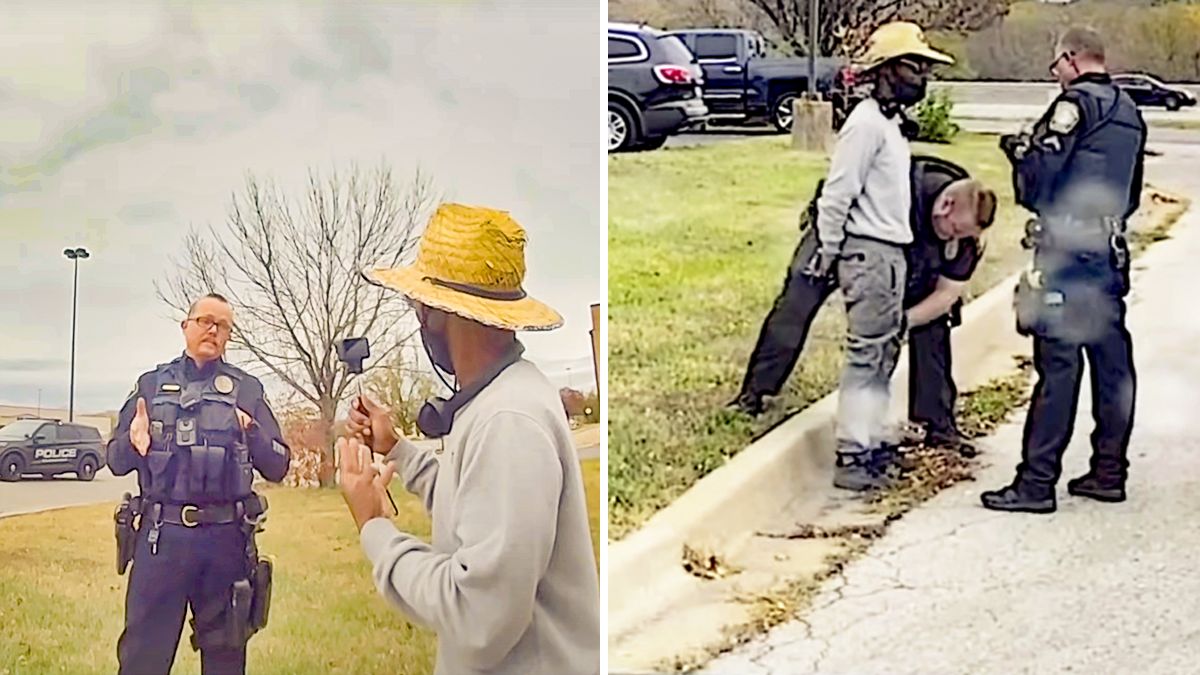
A Missouri cop who bragged about his 17 years on the force without getting sued arrested a Black man for failing to identify himself who was doing nothing more than recording video in public last month.
“I’ve been doing this line of work for 17 years, right. I have done that without complaint or lawsuit on my record,” said Grandview police Officer Beau Bailey, according to bodycam footage recorded on Nov. 4.
“OK, this will be your first,” responded the Black man, whose name appears to be Ariel Moses, the person who runs the First Amendment auditing YouTube channel Kansas City Accountability.
“No, it won’t because between the two of us, I am the subject matter expert on the law, and that includes Constitutional law,” Bailey said.
“I have hundreds of hours of study and application of that in my line of work. We’re out here for a lawful reason. You’ve been contacted for a lawful purpose.”
“And it is within the course of my duties, I am asking you to provide a name and date of birth that I can verify and we can let you go. I’m not going to ask you again, you’re going to go to jail for failure to identify yourself.”
However, even though Missouri is a so-called “Stop and ID” state, police must still have a reasonable suspicion the person has committed a crime or is about to commit a crime, according to a Missouri attorney’s website.
In this case, Moses was doing nothing more than recording in front of a bank, which prompted bank employees to call the police.
Had Bailey learned constitutional law during those 17 years he boasted about, he would have known that recording in public is protected by the First Amendment and not reasonable suspicion a person is about to commit a crime.
But Bailey’s partner also tried to manipulate his interpretation of the law in his favor by insinuating he may be planning on robbing the bank because he was recording it from the outside.
“The suspicious part we’re talking about is that you’re recording a building, not only just a building, a bank, which banks get robbed,” Grandview police officer Thorrin Savage.
But Moses corrected them on their misinformation.
“I’m doing nothing wrong, just simply out here with my GoPro in public,” he said. “There’s no expectation of privacy in public.”
But Bailey continued to insist he was “suspicious” because he was recording in public.
“We are out here on a suspicious activity call; we have every legal right to identify you; there’s case law you need to do more research on.”
But when Moses asked him to elaborate on that case law, the cop responded by saying, “I cannot tell you the name of the case law right now.”
Then, Bailey insisted he respected Moses’ First Amendment right to record by allowing him to record their interaction.
But Moses pointed out that they were violating his Fourth Amendment rights by demanding his identification when they had no reasonable suspicion he was involved in a crime.
As promised, the cops arrested him and transported him to jail. However, they ended up releasing him two hours later without obtaining his real name.
The end of the video shows the cops dropping him back off at the place where they had arrested him with Moses carrying a brown paper bag with his belongings and with the name “John Doe” scribbled on the bag along with the letters “B/M” to describe a Black male.
“I just got out of jail,” Moses said. “I didn’t give them my name. You all can’t get nothing from me.”
“He said he been on the force 17 years, he know what’s going on and I’m obligated to give him my ID. Yeah, he learned real quick.”
Moses has not yet responded to inquiries from Atlanta Black Star seeking more information as to whether he plans to file a lawsuit.


