The New Hartford Central School District in upstate New York is under investigation after displaying racist imagery that compared NBA champion LeBron James to a monkey at an art exhibit.
On May 4, the district held an art show, and at the center of the scandal was a display, believed to have been created by a middle school student, promoting a fictional cereal brand called “Monkey Premium.” The cereal was accompanied by a photo of James in his Los Angeles Lakers uniform, along with the words: “Eat Monkeys, Jump Like Monkeys!”
The piece appeared to be part of a student project. The made-up advertisement also claimed that drinking the chocolate and banana-flavored cereal would make someone “jump 2-5 inches higher for about 2 hours after eating.”
The district superintendent confirmed that the administration has launched an investigation to understand how the project was allowed to be displayed at the event.
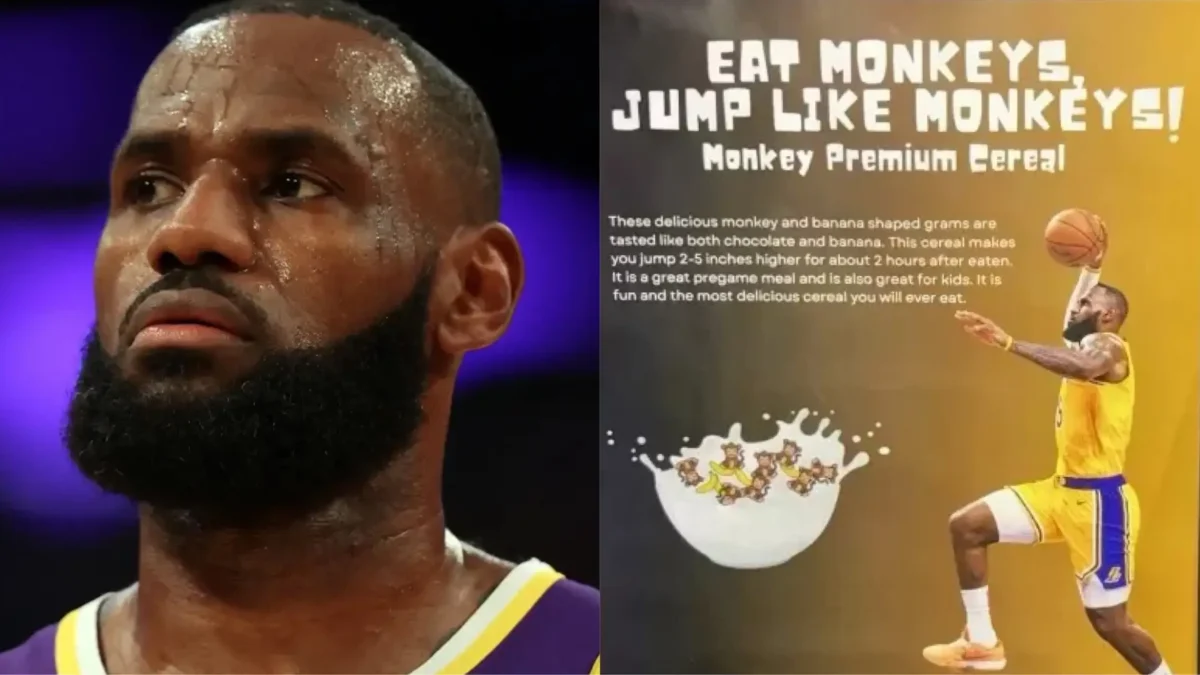
“It is disheartening that racist work was not only created but then overlooked and allowed to be displayed.” Cosimo Tangorra, superintendent of schools, said in a statement.
As the racist imagery made its rounds on social media, some users sounded off on the offensive display.
“This is exactly how I prefer my racism… Blatantly,” one user wrote on X.
Another person referenced the March 2008 issue of Vogue, where James appeared on the cover alongside Gisele Bündchen.
“This reminds me of the time when he was on the cover of a fashion mag with a model and the mag made him King Kong-like,” the person wrote.
James was photographed with his arm around Bündchen while he used his other hand to dribble a basketball. James, who was 24 at the time, was dressed in athletic apparel, while the Brazilian fashion model wore a slim-fitting dress. James’ muscles were flexing and his tattoos showed as he bared his teeth. Bündchen, on the other hand, simply smiled as she struck a pose.
James did become the first black American man to grace the cover of a high-profile magazine, but Vogue also faced criticism for “perpetuating racial stereotypes.” Some argued that the publication intentionally depicted James as a dangerous or aggressive black man who could be perceived as running off with a white woman.
Tangorra also described the incident at a school gymnasium during the district-wide art exhibition as a “teachable moment” for everyone involved.
“The student involved has been contacted, but due to student privacy, we cannot divulge specific details regarding the student and whether or not there were disciplinary consequences,” the superintendent continued. “Administrators have also spoken with staff members responsible for the oversight of the artwork, and we are using this as a teachable moment.”
While it remains unclear whether the student in question intended to be racist, America has a troubled history of wrongly and inappropriately comparing Black people to monkeys. Race remains one of the complex issues in society, and as the understanding of it changes, so must “our understanding of equity in the context of systemic racism we see in” different instances.


