A jury began deliberations in the federal civil trial of former Louisville Police Officer Brett Hankison after prosecutors rested their case Monday by alleging he “blindly” opened fire during a botched drug raid that killed Breonna Taylor more than three years ago.
During closing arguments, Justice Department attorneys accused Hankison of “spraying bullets through two covered windows, ripping through walls into a neighboring apartment” where another family was sleeping on March 13, 2020, when several members of a local drug enforcement unit, armed with improperly obtained warrant, arrived at the address and opened fire.
Further, prosecutors argued, Hankison failed to identify a specific target at the scene after he testified he was unable to discern who he was firing at or the precise location of shots, endangering multiple lives.
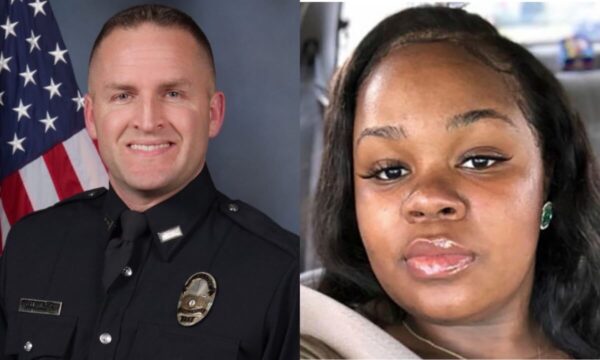
Hankison also took the stand in his own defense on the 10th day of the trial in which the 47-year-old former officer is accused of violating Taylor’s civil rights and faces up to life in prison if found guilty under a federal indictment handed down in August 2022.
The judge will rule in issuing the final sentence, but for now, the jury is still out on Hankison’s fate.
Deliberations began at 5 p.m. Monday and ended an hour later as the jury adjourned for the day. The members resumed the closed-door talks on Tuesday.
In a final appeal to the jury, prosecutors recalled testimony by several deputies who approached Taylor’s dwelling alongside Hankison that night, describing his actions as “shocking,” “unfathomably dangerous,” and “stomach-churning.”
“He didn’t care because he was angry that someone was firing at the police,” prosecutor Michael Songer said in summing up the government’s case, adding that firing indiscriminately into a dwelling contradicted Hankison’s training and breached the oath of office he took to protect the public. “He assumed his fellow officers would cover for him, but he was wrong,” he said.
Meanwhile, defense attorney Stew Matthews argued Hankison took the appropriate action in the moment while attempting to save his “brother officers,” adding that the government had failed to prove the case beyond a reasonable doubt.
He asked jurors to put themselves into Hankison’s shoes on the night of the raid and to consider what he was experiencing as one of his fellow officers was wounded when Taylor’s boyfriend, Kenneth Walker, opened fire in what was later determined to be a legal attempt to defend the home.
At the time, Walker and Taylor were in bed when they were awakened by banging at the door from what Walker believed then were intruders getting ready to force their way inside, leading him to retrieve a pistol and fire one shot that hit Sgt. John Mattingly in the left leg as the officers broke inside, prompting Hankison to fire nearly a dozen shots through Taylor’s window and sliding glass door. Mattingly and Detective Myles Cosgrove returned fire toward Walker and Taylor from their position at the apartment’s front door.
During testimony, Hankison said he did not see Walker shoot and admitted he was not sure where the shot came from as officers burst through the door, saying he directed his aim toward where he believed the shooter to be.
He admitted that he later realized that muzzle flashes he believed to be coming from a hallway inside the apartment were actually originating from the service weapons of his partners.
In a twist of fate, Hankison’s unit executed a no-knock search warrant at Taylor’s home in the middle of the night as part of a sting that was intended to target a drug dealer who lived 10 miles away.
No drugs were found in Taylor’s home; the 26-year-old Black woman worked as an emergency medical technician.
In March 2022, Hankison was acquitted on three state charges of wanton endangerment related to those who lived through the barrage of gunfire while Taylor was killed.
The federal investigation into the policies and practices of Louisville Metro Police Department and Louisville city government uncovered multiple violations of federal law when it comes to police encounters in the Black community, including a pattern of excessive force, the use of police dogs and Tasers, searches based on invalid warrants, unlawful traffic stops and searches, as well as actions to prevent free speech activities.
The city of Louisville has paid $12 million to settle a wrongful death lawsuit filed by Taylor’s family while enacting several police reforms to prevent a similar tragedy.
Taylor’s death, in addition to the police killing of George Floyd two months later, galvanized the Black Lives Matter movement and sparked fierce protests across the nation that toppled numerous Civil War relics and Confederate statues.
Three other former Louisville officers, Kyle Meany, Kelly Goodlett and Joshua Jaynes, also face federal charges related to their role in obtaining the search warrant for Taylor’s apartment.


