Barbers Hill High School, a campus that has made headlines multiple times for what many believe is race and gender discrimination, has transferred a Black male student to an alternative school because he refused to cut his locs.
School officials referred Darryl George to the disciplinary program because he simply would not adhere to the district’s dress codes.
Darryl George’s mother received the notice on Wednesday, Oct. 11, from the school’s principal, Lance Murphy, about her son being referred to a Disciplinary Alternative Education Program after he was put in in-school suspension on Tuesday, Aug. 31, regarding his hair.
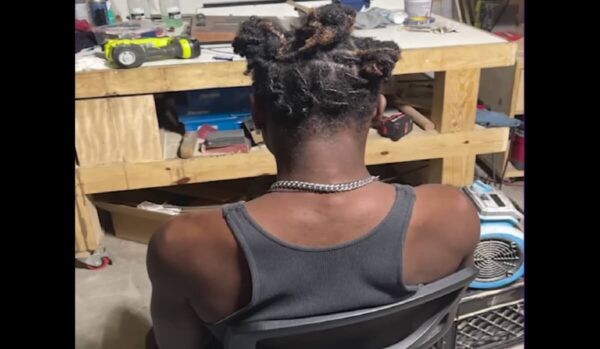
He said that George had engaged in “multiple infractions of campus and classroom rules.”
Trending Today:
- Body Camera Footage Shows Sauk Village Police Officer Shoot An Unarmed Eighth Grader Accused of Breaking Window; Attorneys Claim it Was ‘Excessive’
- White Connecticut Woman Shoots Up Lobby at Police Station and Is Taken In Alive; Reportedly Was In the Middle of Emotional Meltdown, ‘Felt Trapped’
- Students at High School Attended By Tupac Shakur Walkout In Protest of Video of Classmates Using the N-Word; Complaints Reportedly Ignored
“As the School Principal, I have determined that your child has engaged in chronic or repeated disciplinary infractions that violate the District’s previously communicated standards of student conduct.”
These infractions, the administrator said, were the “disruption of the ISS classroom” and the
“failure to comply with directives from staff/administration.”
Murphy also said that in addition to violating “the dress and grooming policy,” the 18-year-old was always late.
Attorney Allie Booker, who represents George and his family, says this is “retaliation” because the parents have decided to sue.
The school district’s recent action, according to Booker, is a reaction to an ongoing legal dispute about his locs hairstyle. The family contends that the young man usually wears his hair in braids or a ponytail and that the hair does not pass his eyes or ears. Technically, George’s family and attorneys argue that it does not breach the dress code’s restrictions.
The school and the district would not budge, saying the hair length is too long for male students in the district.
Before this, school authorities had warned the young man and his family that the consequences linked to his persistent dress code violations would lead to a referral to an alternative program.
Understanding the consequences, the family continued to stand on their belief that the rule violated their civil rights and even sued Gov. Greg Abbott, the state’s attorney general, and school officials for allegedly failing to enforce the law and protect the teen.
The law that the lawyers are pointing to is called the CROWN Act, which was enacted on the day George was placed on in-school suspension.
In 2020, the school faced a similar controversy involving two male students who also wore their hair in locs. De’Andre Arnold and Kaden Bradford were also placed on in-school suspension, which prompted their mothers to take action.
Instead of focusing on the racial discrimination implied by hair bias, these students’ mothers focused on the implicit gender bias in the policy. The district allowed girls to have long hair but not boys.
The mothers sued the district, “alleging that the District’s hair length restrictions, which apply solely to male students, constitute sex discrimination under the Fourteenth Amendment Equal Protection Clause, Title IX of the Education Amendments of 1972.”
The DOJ agreed with the parents, and this move was critical to the CROWN Act getting passed.
In George’s case, the legal team is focusing on how the school is violating this law. The district has tried to get out of this lawsuit, stating this is in no way a violation of the CROWN Act, and even filed a motion in the U.S. District Court for the Southern District of Texas for its dismissal. A judge over the case denied their request on Wednesday, Oct. 11.
This is evidence enough for the lawyers to claim retaliation, another violation of George’s civil rights.
“Today they filed a motion to pull (the case) out of the federal court, and the judge struck the motion for non-compliance with court rules, so they retaliated by putting Darryl in DAEP (the alternative school),” Booker said, according to CNN.
George will be sent to the school immediately until Nov. 29, in a move that allows for no appeal from the family, and will be allowed back to BHHS on Nov. 30.
The young man would have been under some form of disciplinary action by the school for the majority of the school semester that ends on Dec. 21, the last day before winter break.


