A Georgia police department has been under fire after it posted photos showing officers leading a firearms training session with targets plastered with images of Black men.
The picture, posted in June, shows white civilians at a firearms training course in the west Georgia city of Villa Rica aiming weapons at a human-sized image of a menacing Black man holding a gun.
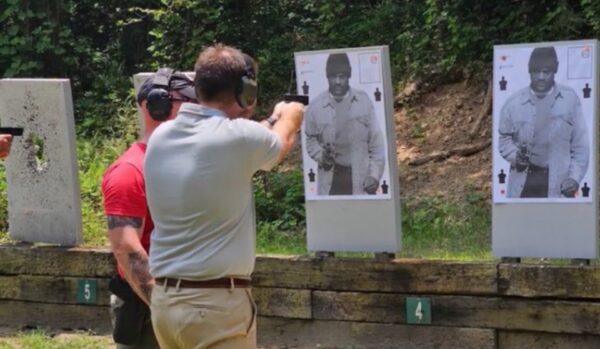
The public ire surprised the department, as the social media image was taken to promote the Villa Rica Police Department’s firearm safety course classes. But social media users quickly took up arms when they saw the photo.
The image went viral and led to a city investigation into discriminatory practices within the department. However, a thorough review found no racial bias was on display in the choice of target images.
Police Chief Michael Mansour explained in an interview with Atlanta Black Star that during these training sessions, there’s a very diverse amount of photo-realistic targets used for shooting practice.
Black, Hispanic, Asian-American, white, and many other types of photo-realistic targets are used at the range.
“The reason we use photo-realistic targets is because you can put a little bit of adhesive on the target,” he explained. “You can tape a picture of a cellphone or gun (on the target), so then it becomes a shoot/don’t shoot the target.”
U.S. Census data shows Villa Rica’s population is 45 percent white and 43 percent Black, and 7 percent of people identify as two or more races.
According to Chief Mansour, the targets being all Black was just the bad luck of the draw. Each box of photo-realistic images comes with 100 copies, and the team claims that the copies they used in the photos just happened to be African-American in this particular instance.
Mansour also explained to WSBTV that the team also used white photos for targets that day; they were not present in the image posted.
Still, the police chief promises that while they will still be using photo-realistic targets, the department will be more conscious of diversifying the types of targets their students shoot at.
Chief Mansour later explained that his department has many procedures implemented to ensure that racial discrimination never affects the citizens they are sworn to protect. While on duty, officers must record every interaction with citizens they stop, he said.
In addition, every stop must be carefully documented. The incident report has to include the race and gender of the person that was stopped. Monthly checks are done by the sergeant searching through some of the videos of each officer on shift for that month.
Every video is judged on the types of interactions, comments, and steps that were taken during the incident, and if any discrimination or error in judgment is made, mandatory training is enforced on the officer in question.
“We get very few complaints of racial discrimination,” said Chief Mansour. “We have many things in place so that we don’t have biased-based police, and this was just a bad optics issue. We showed that picture, and it just definitely rubbed people the wrong way, but it was not intentional.”
The Villa Rica Police Department plans on hosting at least one more firearm safety course this year with a stronger focus on diversifying the target variety. VRPD is aiming for a date no later than the end of September to avoid a session out in the cold.


