The brawl that broke out in Montgomery, Alabama, on Aug. 5, at the Riverfront Park happened near a historical site with a racist past.
Downtown Montgomery used to be the site of the domestic slavery trade in the state, and enslaved people were transported on the Alabama River and unloaded at the dock on Commerce Street.
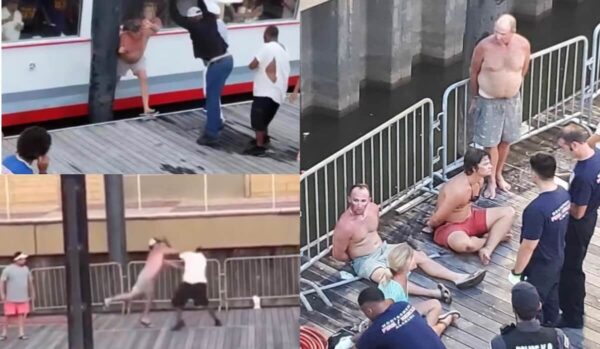
The chaotic scene that was divided between race lines reportedly began after a Black co-captain on the Harriott II Riverboat asked the owner of a pontoon boat to move because it was parked in the spot of the waiting dinner cruise boat carrying multiple passengers. He was attacked by multiple white people after they refused to move their boat, and several Black men came to his aid after witnessing the attack.
Pulitzer Prize-winning journalist Nikole Hannah-Jones noted Montgomery’s long, racist history and the fact that the city recently elected Democrat Steven Reed, its first Black mayor, in the more than 60 percent Black city.
“If you understand the history of Montgomery — one of the most prolific slave-trading cities in the US turned brutally repressive apartheid regime after, and majority Black but JUST got its first Black mayor — it gives so much more perspective to this video. Trust,” Hannah-Jones said in a tweet.
Hannah-Jones added that the site of the brawl is the same spot where Africans in bondage were unloaded and marched while in chains into the center of town to be sold off into slavery. (The Act Prohibiting Importation of Slaves of 1807 banned the importation of captured enslaved persons from other nations into the United States.)
However, between 1808 and 1860, Alabama’s enslaved population increased from 40,000 to more than 435,000, making Montgomery one of the largest slave-trading communities in the country. The Montgomery probate office granted at least 164 licenses to traders of enslaved Africans during that time.
Alabama also has a storied past of racism.
The city of Selma is known for a racist attack called Bloody Sunday because of the beatings that occurred on the Edmund Pettus Bridge after civil rights activists marched during a voting rights campaign on March 7, 1965.
The protesters were marching from Selma to Montgomery when Alabama state troopers beat them with nightsticks and fired tear gas at the group of men, women and children. The group was also marching in honor of Jimmie Lee Jackson, a Black man who was shot and killed on Feb. 18 by an Alabama state trooper for defending his mother during a peaceful civil rights demonstration.
The Montgomery Police Department was called to the scene of the brawl at around 7 p.m. “to detain several reckless individuals for attacking a man who was doing his job.”
During a press conference on Tuesday, Montgomery Police Chief Darryl J. Albert revealed that there are currently four warrants awaiting execution for the arrest of three white men who were on a private pontoon boat.
Those men are Richard Roberts, 48; Allen Todd, 23; and Zachery Shipman, 25. They are accused of assaulting Damien Pickett, who serves as a co-captain on the Harriott II Riverboat.
Many on Black Twitter saw the brawl as a “full-circle moment.”
“It’s a Juneteenth miracle in August!” wrote another user.
“Let freedom swing!” another X user wrote.
“Oh the way the ancestors across the diaspora are smiling right about now…,” echoed another.


