The president of Rwanda says it’s far past time for the continent of Africa and Caribbean nations to mobilize and implement stronger, more concerted efforts to address the collective challenges between both regions.
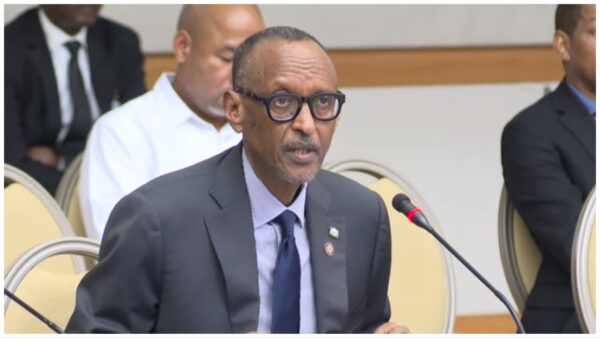
While making his first visit to Trinidad and Tobago, President Paul Kagame said the African Union and the nation-states that are part of CARICOM, also known as the Caribbean Community, should “come together in real terms” and move “beyond declarations of intent” to hammer away at their shared interests.
Kagame pointed to the regions’ closely-linked histories and that their mutual geopolitical difficulties should accelerate more integrative action.
“In our diversity, we share common traits. Our people are resilient, creative and, as our common history shows, also indestructible. This mutual recognition should have practical, tangible effects. We belong to a number of important multilateral bodies, including the Commonwealth and the Organization of African, Caribbean and Pacific States,” Kagame told legislators at the 45th Annual Caribbean Community Conference.
Also part of his July 5 remarks was a sharp focus on advancing global health and climate change initiatives as well as initiating more inclusive borrowing efforts to avoid soliciting aid from larger, more developed nations.
“Countries like ours can’t print money when we face a crisis. We have to borrow. Yet some of us are no longer eligible for concessional interest rates. Tools like the United Nations Multidimensional Vulnerability Index, and the Commonwealth’s Universal Vulnerability Index, reveal the special needs of small island developing states,” Kagame explained.
“In Africa, we have countries such as Seychelles, which I have just had the opportunity to visit, with similar climate financing difficulties as you face in the Caribbean. We can work together to advocate for a more responsive and inclusive international financial architecture.”
He also touted a proposal for people-to-people exchanges between both regions, especially for young workers and entrepreneurs, and improving connectivity when it comes to “transport and telecommunications.”
There are efforts already underway to support both CARICOM and the African Union like local vaccine manufacturing in Guyana, Barbados, and Rwanda and the Bridgetown Initiative, which reforms existing institutions to finance debt, climate, and inflation resilience. Kagame noted that some of these projects still require more procedures to make them sustainable over time.
“The starting point here is how we govern our own individual countries, striving to be the best we can be, with a culture of accountability,” Kagame stated. “Let’s come together, as Africa and the Caribbean, and do the best we can for ourselves and our people. If we are determined to join forces, there is no one who can impede that. More importantly, it will benefit all of us.
CARICOM, founded in 1973, is made up of twenty countries stretching from The Bahamas to South America. The African Union, originally known as the Organization of African Unity, is comprised of all 55 nations on the African continent. It was founded in 1973.


