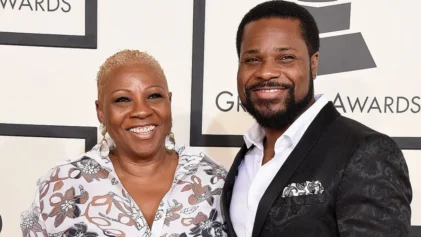
The amicable teenager that Malcolm Jamal Warner played on “The Cobsy Show” was just that, a character. As it turns out, Warner clashed with the actors who played his best friends on two different series.
He recently rehashed the frustrations that he and comedian Eddie Griffin once shared while starring on their hit UPN show, “Malcolm & Eddie.” The series debuted in 1996 and ran for four seasons. In it, Warner and Griffin played best friends and roommates, Malcolm McGhee and Eddie Sherman, who could not be more opposite one another, yet they still managed to come together to run a pub. In reality, the two actors could not have been more polar opposites.

“When I look back on the show, one of the dope things [is that] me and Eddie really did not get along in real life,” Warner, 52, said during his Jan. 25 appearance on the “Toure Show” podcast. “But every single week before taping, we’d come together, we’d put our hands together, we’d bow, and we prayed before we went out there,” he added.
Warner said that despite fighting behind the scenes, both men understood that reaching 100 episodes meant their show would go into syndication and ultimately land them a recurring paycheck well after the show ended. “F—k however we feel about one another, we gon’ get this money.” However, the show ended after 89 episodes. “They were tired of me fighting with the writers about their writing, and they were tired of Eddie’s shenanigans. … Eddie is a nut,” he said.
When Toure chimed in that he imagined Griffin showed up late, Warner said, “All of that. It was a miserable experience, and I have my version, Eddie has his version.” The actor noted that they left their animosity in the past and are “cool as f—k now.”
In 2018, the “Reed Between the Lines” star attributed some of the tensions between him and the “Undercover Brother” to their drastically different approaches to comedy. He told People TV, “I mean, you’re putting the school of Bill Cosby and the school of Richard Pryor together as a team. There were often creative conflicts that we had, so it wasn’t always harmonious between he and I.”
Similarly, Warner also butted heads with Carl Anthony Payne II, who played Theo Huxtable’s best friend, Walter “Cockroach” Bradley. During a sit-down with “The Breakfast Club” last month, he revealed that Payne auditioned for the role of Theo but obviously lost out. He claimed that the casting decision was the catalyst for their rift, along with the fact that Payne “had a huge ego,” something that he said he does not identify with.
“I don’t roll like that, I have very little tolerance for people who roll like that. So we never really, we just really never got along back then,” he told the radio show co-hosts DJ Envy and Charlamagne Tha God.