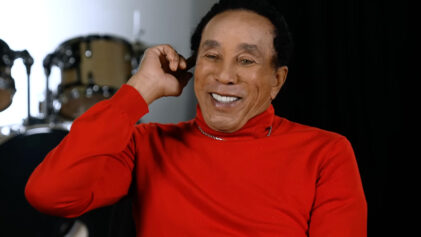
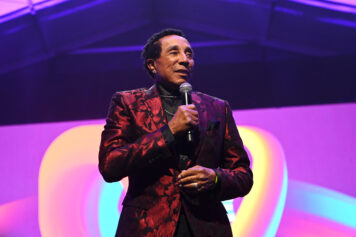
Motown legend Smokey Robinson shared details about his life in a new interview, which has fans raising their eyebrows. In this particular segment, the singer opened up about his long battle with drug addiction.
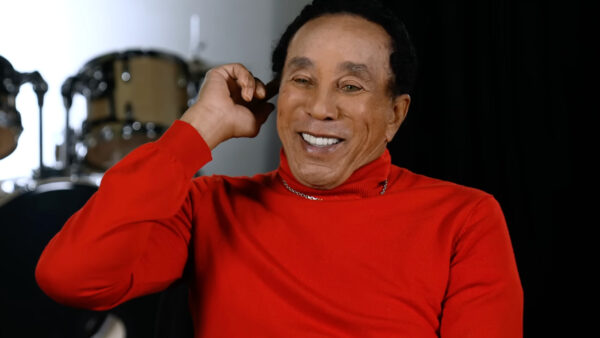
As his interview with VladTV began, the “Cruisin’” artist noted that cannabis was his initial “drug of choice” because he couldn’t stand the taste of alcohol.
“I hated the taste of alcohol. I still do. You know, so weed was my drug of choice,” Robinson said.
When DJ Vlad asked the soulful vocalist if he ever dabbled in using crack for his blunts, Robinson adamantly denied it but did admit he used to sprinkle cocaine in his blunts with weed.
“Yes, it was cocaine. You know after I started doing it,” he candidly stated.
As Robinson’s interview with VladTV continued, he explained why he would describe his previous self as a “walking corpse.”
“I got to that point where I was just walking around and uh, you know I’m 5’11 and I’m walking around and I weigh 120 pounds,” he shared to DJ Vlad, “I don’t have any belts or any pants or anything like that to fit me.”
The 82-year-old admitted that he used safety pins to hold his pants up and would hide it by letting his shirt hang outside of his slacks.
“I was in dire straits, it was ridiculous,” Robinson said.
During his time of addiction, Robinson revealed that he hated himself for being under those circumstances, but now looking back he understands what factors contributed to him testing them out.
“My dad died, you know, my dad was my man,” he continued, “then Marvin [Gaye] died, you know. It’s just a lot of stuff was going on that was getting to me psychologically, which I didn’t realize it was.”
A clip of creator/host of Soul Train Don Cornelius playing 1-on-1 basketball against singer Marvin Gaye with singer Smokey Robinson refereeing the game. The game was shown on an episode of Soul Train that aired on May 7th, 1977. pic.twitter.com/jmcNrytKiO
— '60s, '70s, and '80s History (@60sto70sto80s) December 15, 2022
Robinson has publicly spoken about his addiction in the past and disclosed that he became addicted to drugs in his 40s. In 1986, he overcame the harmful habit after going to church and receiving prayer from a minister.
“I walked into church that night I was a junkie. I was hooked on cocaine and weed, you know. I came out, I was free. That was it,” he told DJ Vlad.
Though the interview was over four minutes long, gossip outlet The Neighborhood Talk captured the quick clip of him addressing his usage of cocaine and uploaded it onto their Instagram page, where fans couldn’t find the difference between the two highly addictive stimulants.
“Is that not the same thing? ‘Crack cocaine?’”
“Like that makes it better.”
“Only difference is one pure and one have baking soda… idc it’s the same.”
“Should’ve took this to the grave man!”
“I see why they call him ‘Smokey’ Robinson.”
Robinson has acknowledged his addiction on other platforms such as in an episode of “Oprah’s Master Class” back in 2015 as well as in a 2013 radio interview with “Raised on Radio.”
It has been 37 years since Robinson concurred his habit, and now he prepares for the release of his new album, “Gasms,” which is set to arrive April 28th.