Francia Márquez has overcome racism and classism to become Colombia’s first Black vice president.
Márquez was a teen mom who once worked as a housekeeper. Now she will be second-in-command to the president after she and her running mate won the country’s election on Sunday. An activist for Afro-Colombian and environmental rights, Márquez worked the campaign trail in African garments and jewelry and an afro puff.
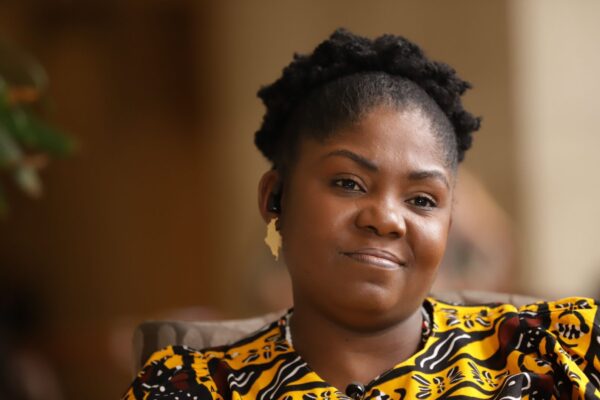
“It’s time to move from resistance to power,” Márquez would chant, raising her fist – with a smile.
Márquez’s political teammate, President-elect Gustavo Petro, is a former guerrilla who toppled a real estate millionaire in a runoff election. The win shifts the political climate in the South American country, which has been historically led by conservatives and social elitists. Márquez is a political newcomer, but she has been fighting corporations for the last two decades to protect Afro-Colombian communities and their land.
“I am someone who raises my voice to stop the destruction of rivers, forests and moors,” Márquez wrote on her campaign website. “I am someone who dreams that one day human beings will change the economic model of death, to make way for building a model that guarantees life.”
The 40-year-old reportedly grew up sleeping on a dirt floor in a part of the country plagued by violence and poverty. Pregnant at 16, she started working in gold mines and later became a live-in maid, according to reports. She started pushing for social change in her teens and gained public notoriety in 2014 for organizing a march against illegal gold mining in the community of La Toma, where she grew up, reports show.
Since her first rally, Márquez has earned a law degree and was awarded the Goldman Prize, the equivalent of the Nobel Prize for the environment. In 2019, she appeared on the BBC’s list of the 100 most influential women in the world.
Márquez said she ran for office “because our governments have turned their backs on the people, and on justice and on peace.”
Her candidacy has sparked discussions about race in a country that has denied the existence of racism. Still, some of Márquez’s critics have attacked her with racist tropes and classist blows. Others have doubted her competency.
Sergio Guzmán, director of Colombia Risk Analysis, a consulting firm, said that “there are a lot of questions as to whether Francia would be able to be commander in chief, if she would manage economic policy, or foreign policy, in a way that would provide continuity to the country.”
Unshaken, Márquez stood behind her roots and kept them central to her campaign.
“I am an Afro-Colombian woman, a single mother of two who gave birth to her first child at the age of 16 and worked in households to pay the bills,” she said. “But I am also an award-winning environmental activist. And above all, a lawyer who could become Colombia’s first Black vice president.”
Colombia has the second-largest population of people of African descent in Latin America. Afro-Colombians represent over 6.2 percent of Colombia’s population, although the numbers may be undercounted. About 31 percent of the Afro-Colombian population lives in poverty, compared to 20 percent of the national population, according to reports.
“Francia Márquez comes from civil society and not from the traditional political elite. This is an argument that she plays on, and that goes greatly in her favor,” said Olga Lucia Gonzalez, an associate researcher and specialist on Colombia at the University of Paris-Diderot.
“She brings with her issues that until now have been totally forgotten, like the relationship to colonialism, sexism, racism,” Gonzalez said.


