Keith Cooper reportedly has received the largest settlement paid in a wrongful conviction lawsuit in Indiana, more than two decades after being sentenced to 40 years in prison for a crime he did not commit, according to reports.
Cooper, 54, was released after serving more than eight years in prison when new evidence revealed that he was framed for armed robbery. The state governor pardoned him in 2017, the same year he filed the civil lawsuit against Elkhart, Indiana, its former police chief and four of its officers.
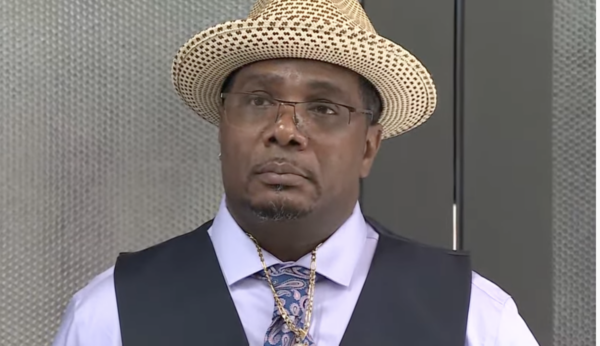
On Wednesday, May 4, city officials announced Cooper was awarded a $7.5 million award in the civil case. His co-defendant in the criminal case, another Black man, Christopher Parish, received $5 million in a settlement with the city in 2014.
“It’s been a long uphill battle. I’ve been waiting 14 years for this day and now it’s here,” Cooper said. “There’s no amount of money that can get me back the time I lost. But it helps build a better tomorrow for me and my family.”
Cooper had recently moved from Chicago to Indiana in October 1996, when he and Parish were arrested for a home invasion at Michael Kershner’s apartment. Kershner, his mother and four friends said two Black men stormed into the apartment and shot the 17-year-old in the abdomen.
Cooper was arrested in January 1997 for purse snatching, and former Elkhart detective Steve Rezutko noticed that Cooper looked like a computerized sketch of the gunman in Kershner’s case. So he included a picture of Cooper in a photo lineup, and Kershner, his mother and another witness picked Cooper out of the array of photos.
At the trial, a detective testified that a jailhouse snitch told him Cooper confessed to committing the crime. However, the other inmate came forward later and said the story was fabricated. The detective had promised him a deal in exchange for his testimony, he said.
Four eyewitnesses recanted their testimony. Kershner and his mother said Rezutko denied their requests for a live lineup. He also pointed out Cooper in the courthouse hallway so that they could identify him during the trial.
The DNA tests of a hat left behind at the scene by the gunman showed it did not belong to Cooper. It was reportedly linked to a man currently serving time in Michigan for murder. In addition, a crime scene technician, during testimony in Parish’s trial, said that there was no blood in the apartment, reports show.
Cooper was released from prison in 2006. He petitioned the parole board for a pardon that was not approved until 2014. Gov. Eric Holcomb granted Cooper a pardon of innocence in 2017.
Elkhart city officials apologized Wednesday, May 4, for how the city handled the case in the 1990s and for the “suffering” he experienced. When Cooper went to jail, his wife had to sell their belongings, and the family lived in shelters, reports show.
“We hope this settlement brings to a conclusion the obvious injustice that has been rendered to Mr. Cooper,” Elkhart spokeswoman Corinne Straight said. “The current administration and current leadership in the Elkhart Police Department have set upon a path of accountability in the hopes that this kind of case will never happen again.”
Elliot Slosar, Cooper’s lawyer in the civil case, said he welcomed the apology, but called on city officials to launch an investigation into all of the cases worked by the officers in the lawsuit.
Rezutko reportedly committed suicide in 2019, shortly after the city revealed that he retired in response to an internal investigation into his sexual relationship with a female informant. Rezutko left the Elkhart Police Department in 2001, with recommendation letters that would allow him to be rehired at other agencies, the report shows.
“Mr. Cooper’s wrongful conviction did not happen by accident nor was it an aberration,” Slosar said.
Cooper, a father of three and grandfather of 15, since has relocated to Chicago, and commits some of his time advocating for other wrongly convicted people. Cooper told reporters he plans to use some of the money to take all of his grandchildren to Disney World, buy an RV and take a road trip to Canada.
“I’m just overwhelmed. I’m a new man. I just gotta get a grip on it,” Keith reportedly told his wife. “I’m free … I can be things. I can go places.”


