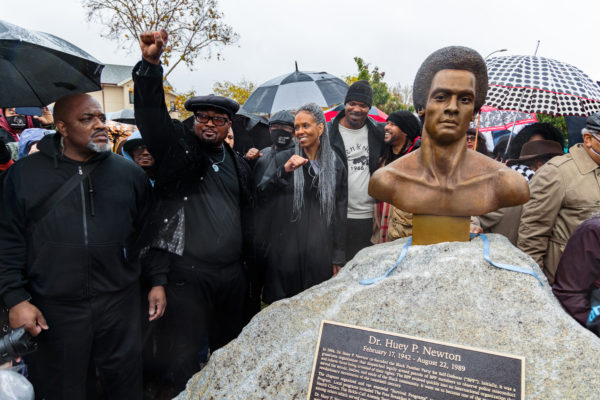
A bust of the Black Panther Party co-founder Huey Newton was unveiled on Oct. 24 in commemoration of the 55th anniversary of the organization’s founding.
The bronze figure of Newton was erected in the Oakland, California, neighborhood where the Black Power movement pioneer was killed in 1989.
Newton and the party’s other co-founder Bobby Seale are considered the frontmen of the Black Power movement on the West Coast
The Black Panther Party for Self Defense was more than the black beret and black attire emblematized in film, fashion and culture today.
Newton and Seale founded the party in October 1966 because they felt the civil rights movement in the South had failed to address the problems of Black people in the North and West.
The party’s free breakfast programs for schoolchildren reportedly served nearly 70 communities in the U.S. and abroad. The Panthers were also health activists, addressing disparities in the Black community that have plagued generations. The party created a sickle cell disease testing program after realizing the disease disproportionately impacted Black people.
Newton, who had a doctorate in social philosophy, was the party’s defense minister. The party’s initial commitment was to teach Black people self-defense against police brutality. That involved increasing housing, education and jobs, according to the National Library of Medicine.
Like the summer riots of 2020, Newton’s legacy includes controversy that has clouded his legacy. In 1967, Newton was arrested for the shooting death of an Oakland police officer. He was convicted of voluntary manslaughter in 1968. The conviction was overturned two years later.
The Panthers were noted for their willingness to confront law enforcement, as evinced by their practice of arming themselves and following police cars around Oakland Black neighborhoods to monitor the cops’ interactions with citizens. This perceived threat to police power would lead to a number of violent encounters between Panthers and law enforcement both in California and around the nation, such as when Fred Hampton was killed in Chicago in 1969.
“I think we also need to recognize the very real ways in which a lot of the violence that surrounded the Panthers was instigated and provoked by law enforcement themselves,” historian Robert W. Widell, Jr., who helped catalog Newton’s writings at Stanford University, told The Associated Press.
The party was the subject of years of law enforcement surveillance. In 1969, former FBI Director J. Edgar Hoover described the Black Panther Party as “the greatest threat to the internal security of the country.”
Newton’s widow was one of the first people to view the permanent piece of art made in the likeness of the historic icon. It is on display near Dr. Huey P. Newton Way in Oakland.
“It just glowed, like he did,” Fredrika Newton told reporters. “His skin just glistened.”
Newton was gunned down on an Oakland street in 1989, seven years after the Black Panther Party was disbanded. A California court later sentenced Tyrone Robinson to 32 years in prison for Newton’s murder. Robinson claimed he killed Newton in self-defense. However, authorities believed he killed the former community leader to get stripes in a prison gang.


