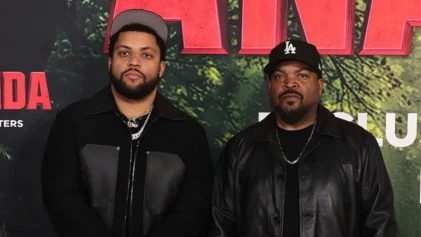
Rapper turned filmmaker Ice Cube went from rapping “F—k the police” to portraying a well-to-do family guy in several Hollywood blockbusters.
His ability to transition from one facet of the entrainment industry is a testament to his range as a creative, but his ability to avoid the pitfall of being typecast has everything to do with the content he wants audiences to consume.
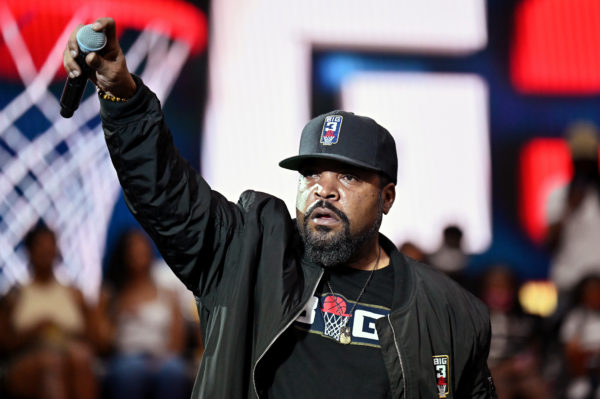
Cube, real name O’Shea Jackson, burst onto the scene with iconic West Coast rap group N.W.A. in the late ’80s. From there, the rapper transitioned to a solo act and ultimately landed his first movie role in the highly acclaimed “Boyz N Da Hood.”
“Playing Doughboy was kind of parallel to the music we was doing, it didn’t feel like; it was just a natural progression,” Cube explained of starring in director John Singleton’s debut film. With movie producers eyeing him for more projects, Cube steadily picked up offers. “And then my next movie after ‘Boyz N Da Hood’ was ‘Trespass’ so playing Savon, which was another street dude; it kinda fell in, you know, into place, but then you know I was offered if I wanted to play O-Dog in ‘Menace II Society’,” he revealed to Kevin Hart during an interview for the “Hart to Heart” show.
But despite the influx of interests he received from Hollywood, Cube was clear that despite playing “street dudes” for other films, it was not a role to which he wanted to be pigeonholed.
“I felt like I was playing the same character. You know it was like from Doughboy to Savon now to O-Dog [which he ultimately turned down], I felt like I was gone be trapped in this you know L.A. gang bang,” he added.
“I just knew about typecasting.” Despite regular offers for various movie roles, Cube explained he wanted to do more. “I wanted to do stuff that was not you know just the normal ‘hood movie because there were so many coming out.”
He further revealed that his disposition fueled him to write the film “Friday.”
“That’s why I wrote ‘Friday.’ I wrote ‘Friday’ because me and Pooh [co-writer of “Friday”] would look at these movies and was like ‘D—n was it that bad growing up around here because it seem like it’s terrible, like a war zone,’ ” said the 52-year-old.
While he agreed that at times the gang violence in some parts of L.A. could be perceived as a “war zone,” there was no way he could not acknowledge the fun that was also present. “So I wanted to show that, like let’s show how we looked at this stuff, how we approached it, how we cope with it, you know, and laughed at things that I guess would make most people cry.”
The 1995 blockbuster was so well-received that it became a franchise with two additional installments. As for Cube, the departure from the run-of-the-mill street figure helped pave the way for his roles in family-oriented comedy films like “Are We There Yet?,” the “Barbershop” franchise and several others.
As his film catalog grew, so did his audience, which has enjoyed his evolution as a filmmaker and actor.
“Cube Is That Dude let’s give this bother his flowers while he’s here 🙏🙏🙏🙏”
“Love that Ice Cube pointed out that folks who live in the hood also have fun. Trauma an the comedy outlet is very in sync. You have to compose because you can’t afford to leave.”
“Cube went from turning up a 40 ounce of Old English with a jerry curl to sipping red wine and chilling”