Minnesota real estate listings no longer contain the phrase “master” bedroom as the word is replaced with alternatives like “main” and “primary” in a effort to be more inclusive.
The new real estate terminology has emerged during a time of racial reckoning as the movement to replace the term gained momentum following the death of George Floyd in Minneapolis.
“There’s a hidden discriminatory piece that falls when you say ‘master’ bedroom,” said Jackie Berry, a Minnesota listing agent.
“I’m a person of color and every time the term ‘master bedroom’ was used, I kept saying to myself, ‘I don’t like how it sounds,'” she said. “Now as I’m walking through a property, I’ll just say it’s the owners’ or primary suite.”
An increasing number of realtors in the Twin Cities area have opted to replace the term with alternatives.
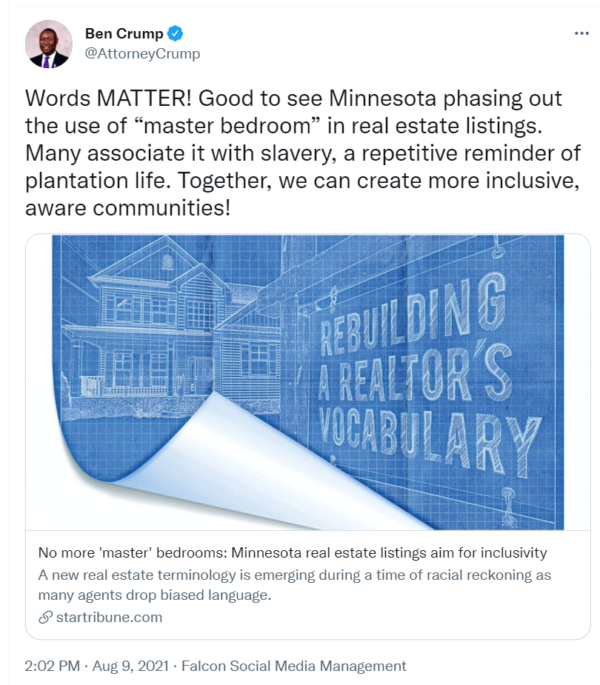
Civil rights attorney Ben Crump applauded the move on Twitter. “Words MATTER! Good to see Minnesota phasing out the use of “master bedroom” in real estate listings,” he wrote.
Crump also said the term is linked to the era of American slavery. “Many associate it with slavery, a repetitive reminder of plantation life. Together, we can create more inclusive, aware communities!”
The movement to remove the word “master” from real estate listings predates last summer’s protests. The Washington Business Journal reported in 2013 that some builders in the Washington-era were phasing out the term and replacing it with “owner’s suite.” At the time, some builders predicted the word “master” would ultimately be phased out entirely.
The movement gained new support in 2020. The Houston Association of Realtors announced last summer that it would no longer allow the terms “master bedroom” or “master bathroom” to be used in descriptions.
The National Association of Realtors asked the U.S. Department of Housing and Urban Development (HUD) to weigh-p in on the issue, and HUD contended that the term “master bedroom” is not discriminatory and doesn’t violate fair housing laws.
“NAR sees no reason that real estate professionals cannot use the term, as there is also no evidence that it has any historical connection to slavery or any other kind of discrimination,” said NAR President Vince Malta in June 2020.
Other terms have been phased out in the name of greater inclusivity. Instead of man caves or she sheds, listings are more likely to call the spaces an “accessory dwelling unit” or “den.” Those in the industry say avoiding terms that could be offensive to buyers is good for business.
But according to Berry, more needs to be done to achieve greater inclusivity. “There’s more that needs to be done [in Minnesota] on education around racism and diversity,” she said.
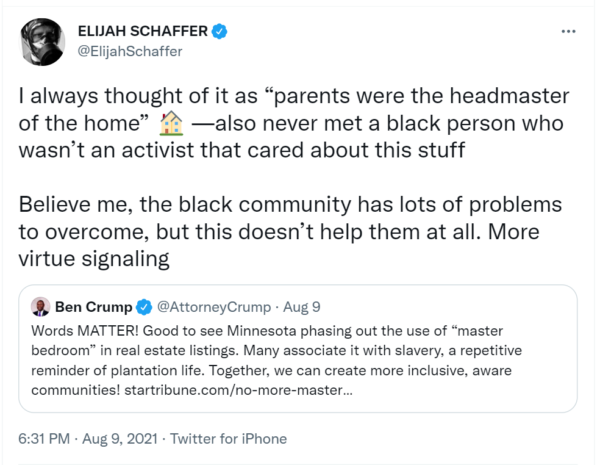
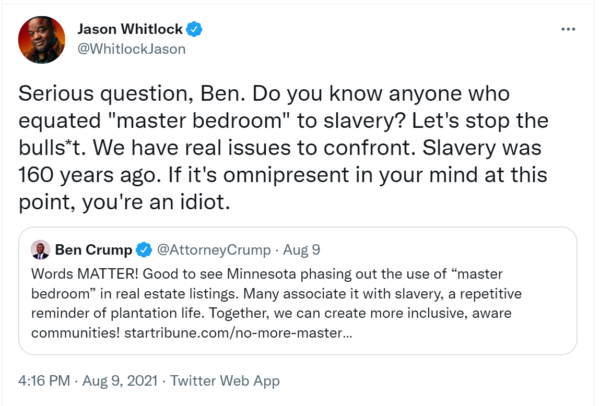
On Twitter, some people criticized the move to remove the word “master,” saying the term isn’t tied to slavery and suggesting the use of the word is not the most important issue at hand.
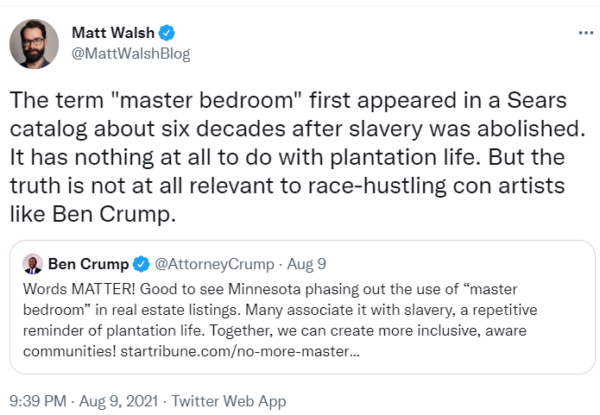
The New York Times reported last year that first use of the term “master bedroom” appeared in a 1926 Modern Homes catalog by Sears, Roebuck and Co. A historian speculated that Sears may have introduced the word “as a way to attract aspirational suburban home buyers who aimed to be viewed as part of the expanding middle class after World War I.”


