“That girl” Sha’Carri Richardson’s name continues to be a trending topic after her qualification and subsequent ban from one event in the Tokyo Olympic Games, and now as she faces the societal lashing for her use of marijuana.
The 21-year-old’s seeming fall from grace in the media has garnered her support from those outraged by the suspension. Now the controversy has led some to suggest more than THC was at play with the phenom’s test results. In particular, Claire Lehmann, an Australian journalist and founder of Quillette magazine, caused a stir with a string of tweets implying that while Richardson may have been popped for marijuana, she also should be suspected of steroids use.
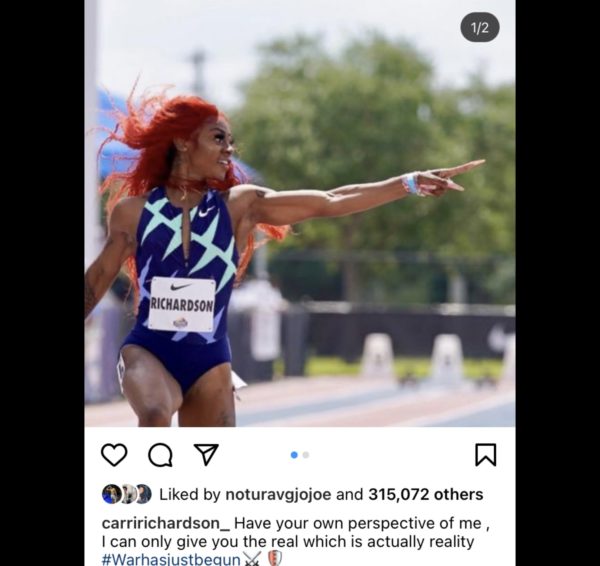
“The fact that she has accepted the one month ban for marijuana & is not fighting to go to the Olympic means that is likely more to the story, in my opinion,” wrote Lehmann. (Richardson’s ban ends before the women’s 4×100 relay Olympic competition, meaning she could still compete in that event in Tokyo.)
But that’s not where she stopped. Lehmann went on to liken Richardson’s hair, long, colorful nails, and overall speed to those of Olympian Florence “Flo-Jo” Griffith Joyner, whose legacy is marred with suspicion of doping. “Not sure whether the nails are real or fake, but in case you didn’t know very strong nails & hair can be a side effect of steroid use,” the journalist tweeted.
Lehmann’s unpopular opinions were met with a barrage of comments calling her out as racist and falsely accusatory.
Griffith Joyner never tested positive for steroid use, although her 1988 Olympic performances in the 100- and 200-meter races has left many suspecting she managed to mask her use when tested. Her records, which still stand today, loom as a shadow over female sprinters who still can’t get close to her times.
As for Lehmann’s claims that steroid use played a role in the late track star’s death, social media users were quick to rebut her. The 38-year-old Flo-Jo was pronounced dead on Sept. 21, 1998. Her official cause of death was suffering an epileptic seizure during her sleep.
Actress Holly Robinson Peete took up for her “friend” Griffith Joyner on Twitter against the Australian journalist. “My beautiful and talented friend Florence Griffith Joyner, aka Flo Jo, died from an epileptic seizure caused by a congenital vascular abnormality that caused seizures, NOT FROM DRUGS I don’t know who you are but keep her name out of your lying mouth. #FloJo,” she tweeted.
On July 2, the United States Anti-Doping Agency announced Richardson would face a 30-day suspension after a June 28 drug test revealed she had THC in her system. The positive test cost her a chance to compete in the 100-meter race at the Tokyo Olympics; the very race Richardson was praised for completing in 10.86 seconds on June 19 during the Olympic Trials in Eugene, Oregon. Recreational marijuana is legal in Oregon.
”The rules are clear, but this is heartbreaking on many levels; hopefully, her acceptance of responsibility and apology will be Ann important example to us all that we can successfully overcome our regrettable decisions, despite the costly consequences of this one to her,” said USADA CEO Travis T. Tygart.
Drugs on this year’s USADA’s prohibited list include, but are not limited to:
- Anabolic androgenic steroids — which aid in muscle growth and presence of the male hormone testosterone
- Peptide hormones and growth factors such as HGH (human growth hormone) — uses include assisting with muscle growth and aerobic output
- Hormone and metabolic modulators
- Diuretics and masking agents
However this year, the USADA added cannabinoids to the list because “it is frequently used in society the context of sport.” A positive result carries a three-month provisional suspension, but satisfactory completion of a Substance & Abuse program can reduce the sanction to one month, such is the case for Richardson.
While supporters are rallying around her, Richardson says this letdown won’t preclude her appearance at future Olympics.
“This will be the last time the Olympics don’t see Sha’Carri Richardson, and this will be the last time the U.S. doesn’t come home with a gold metal in the 100.”


