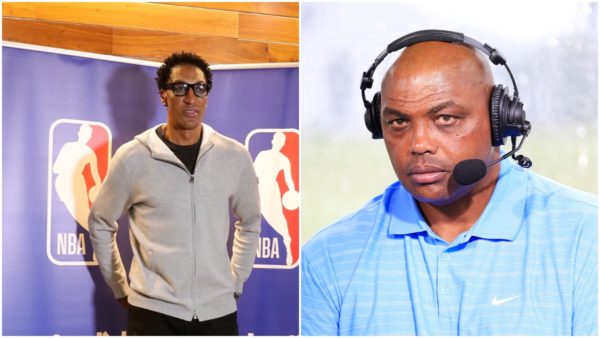
Just over two decades have passed since former basketball giants Scottie Pippen and Charles Barkley were feuding teammates for one season. And that rift is still the topic of discussion for Pippen.
Speaking of his former teammate, Pippen recently said Barkley was nothing more than a big guy pretending to be tough.
In September 1999, just months after playing a single lockout-shortened season with the Houston Rockets, Pippen slammed Barkley as having a lack of work ethic. Pippen was already a six-time NBA champion who’d spent years playing in the shadow of Michael Jordan with the Chicago Bulls.
His move to Texas was an opportunity for the 6-foot-8 forward to finally be seen in his own light, but instead he endured first-round playoffs defeat that left him seeking an exit route during the off-season, a decision he vocalized to the media, much to Barkley’s dismay. But what made matters worse were Pippen’s comments about his teammate being “fat” and a “sorry” player that lacked dedication to the game. Words Barkley demanded an apology for, but would never receive.
“I wouldn’t give Charles Barkley an apology at gunpoint,” said Pippen to The Associated Press in September of 1999. “He can never expect an apology from me. … If anything, he owes me an apology for coming to play with his sorry fat butt.”
Barkley, obviously aware of his teammate’s desire to leave the Rockets said he was disappointed, but also very much prepared to coerce an apology out of Pippen.
“He said he would never apologize. As you know, I always carry a gun with me,” Barkley joked with media. “I’m going to go to my truck and get my gun and see. So if I get arrested for murder ya’ll know he didn’t apologize.”
Pippen, who got traded to the Portland Trail Blazers just days after those 1999, remarks, is very much still alive and unapologetic and currently gearing up for the fall release of his memoir “Unguarded.” In it he holds nothing back when it comes to how he views his legacy, his experience playing for the Dream Team, or Barkley. He told “GQ” in a June feature that Barkley’s “threat” was never of concern.
“I wish he woulda went through with it. I never apologized to him, but I’ll tell you what: He only got arrested for throwing some little white guys out of a window,” said the NBA Hall of Farmer.
But he didn’t stop there.
“I ain’t never seen him fight a Black man unless there were referees around. He plays his role like he’s tough. I don’t know nobody he done whupped. Go back and check his record. Did I apologize to him? I told him to get me the hell out of there. That’s what I recall.”

