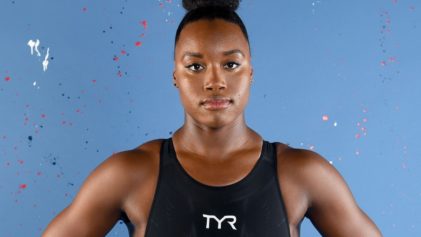
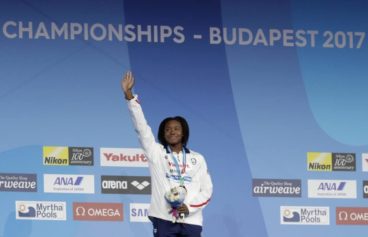
Just three days after her eligibility for the Summer Olympics was in limbo due to losing the 100m freestyle trial, it looks like Simone Manuel has redeemed herself. On Sunday, 50m freestyle trial at the U.S. Olympic Trials, Manuel came in first place by 0.01 seconds, which means she will be going to the Olympics. After her win, she was embraced by Olympic medalist Abby Weitzel and cried tears of joy in the pool.
Manuel made history in 2016 becoming the first Black woman to win an Olympic gold medal in an individual swimming competition. However, it was uncertain whether she would get the opportunity to defend her title after losing the 100m freestyle last Thursday. After her disappointing finish, Manuel said at the news conference that it was her overtraining syndrome diagnosis that made her fail to deliver in Thursday’s Trials.
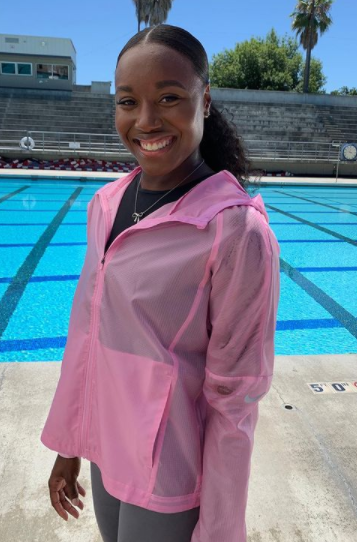
Manuel tearfully explained that “it started a little bit in January,” she said, “I think it was something that I didn’t quite notice until my body, like, completely crashed.” According to Healthline, “Overtraining can occur when you work out without allowing enough recovery time between sessions.” The site also noted, “Overtraining syndrome (OTS) can lower your fitness level, negatively affect your performance, and cause injuries.”
This all came as a surprise to Manuel’s fans who had just watched her dominate the pool in the 50m and 100m frees in a March meet in San Antonio. But the two-time Olympic champion revealed that it was a week after the meet that she went to the doctor in Houston and was diagnosed with OTS. Following the diagnosis, Manuel modified her training and said “after about two weeks of modified training I wasn’t seeing any progress with my performance in the pool; it actually was declining.”
Per her doctors and her coach Greg Meehan’s advice, she took some time away from the pool for three weeks and was back training by April 17. But she was met with more disappointment when she returned to the pool and realized that her body still refused to perform the way she knew it “was capable of.” She said, “I had moments where I didn’t even want to go to the pool because I knew it was going to be bad. “
Despite the outcome, Manuel tearfully noted, “To sit here and even do what I did and to be at this meet is something that I can’t take lightly.”