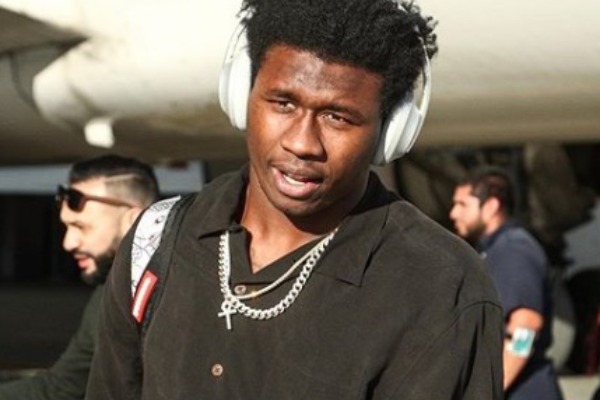
Sammy Watkins, wide receiver for the Kansas City Chiefs, talked about battling depression, abusing alcohol and the world going through a dark period during a recently published interview with Bleacher Report.
He admitted to getting “wasted” every night as a member of the Buffalo Bills, before becoming a Chief, then showing up to practice the next morning. It was something his body would pay for over time.
Watkins continued that routine of drinking and trying to stay on course, and it led to multiple injuries, including broken ribs, fractures in his foot and hamstring problems. But his body wasn’t the only thing that was suffering; he was also facing some mental turmoil.
Watkins had surgery during the 2017 offseason, at a time when he felt “lost” in life. So while healing, he closed himself off to the world and began studying every faith he could find, including Christianity, Judaism, Hinduism and Islam. He said the studying was “controlling” him.
It also caused him to develop his dark ages theory.
“It’s a new world coming. It’s definitely coming,” Watkins explained. “I don’t know what direction it’s going, but there’s definitely a new order coming. I don’t know who’s going to be in control of it, but we’re in the dark ages right now … Just darkness.”
He added, “Just the way the world is turning. The s–t you’re seeing. People are getting taken. Killings. The dying. The way the world is turning. I don’t think it’s any human that’s doing [it]. There are other things.”
His interview was in March, before COVID-19 took over the entire globe, although it was published recently. Watkins was later asked if the virus were linked to his dark ages theory in any way, and he said there’s a “New world order” coming. “I’m ready.”
The Clemson University alumni explained that his depression wasn’t only linked to on-the-field struggles as part of the Bills. He also faced financial pressure, he said, and was worried about his brother Jari McMiller, who was arrested in a sweep of alleged gang members.
“I don’t think the world knows what athletes go through off the field,” Watkins stated. “We have family. We have lives. You have good and bad in your family.
“I’m like f–——g Jesus in my family. I was putting family before football. I wasn’t focused on football. I was like: ‘F–k football. I have to figure out how I’m going to put my family in a position to be successful or not to get killed or not to get in a situation where they can go to jail.’ I was fighting a war outside of football.”
Watkins won a Super Bowl as a member of the Kansas City Chiefs last season after being traded in 2018 from the Los Angeles Rams.
He revealed during the interview the Bills wanted to re-sign him, but the team’s General Manager Brandon Beane totally denied it.
“That’s 100 percent false,” Beane told WGR 550 earlier this week. “We never spoke to Sammy Watkins or any of his representation about trading for him. Secondly, we never discussed him with anyone in our building that matters. End of discussion.”