‘It Kills Me’: Derrick Rose Says He Suffered From PTSD While Growing Up in Chicago, Admits That He Hates Fame

Derrick Rose was in Chicago on Thursday for the upcoming All-Star Weekend, and during a panel discussion in Dorin Forum, located on the University of Illinois at Chicago, he touched on his level of mental health while growing up.

Rose grew up in the neighborhood of Englewood on Chicago’s South Side, and he said some of the things that he witnessed as a kid gave him mental trauma.

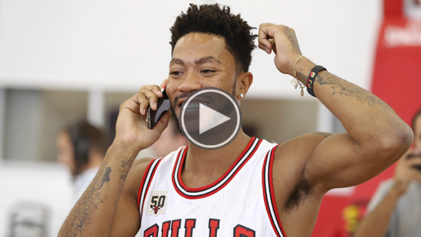
Derrick Rose talked about having PTSD when he was a child in Chicago. (Photo: WXYZ-TV Detroit Channel 7’s YouTube page)

“When I was younger, we used to have a lot of things that used to happen in my house and on my block to where I kind of got PTSD (post-traumatic stress disorder) in a way,” he explained. “I’ll be downstairs in the basement doing something and I’d hear somebody playing upstairs and I’d run up there thinking somebody was bursting in our house about to attack my cousin.”

“This girl, she used to beat up everybody in the neighborhood, like she would beat up somebody and I would think they were coming back for revenge,” added Rose. “So any little bumps or sounds in the house, I’m scared, or at night I would hear something and get scared because I was thinking that these people came back.”

Elsewhere, during the panel discussion, Rose implied that being an NBA star isn’t cracked up to what he thought it would be, and he’s envious of those who can live a quieter life.

“I hate living with boundaries,” he said. “It kills me when I go on vacation and I just know people are chilling there as a dentist or somebody with a regular job.”

“They’re able to live the life to just walk around freely, and I’m jealous of that, because deep down I want that, but I can’t have it. So be careful for what you pray for because you’ll never know how it’ll turn out,” added Rose.

The 69th NBA All-Star Game will be on Sunday, Feb. 16., at Chicago’s United Center.


Democracy needs journalism it can trust.

This election season, the stakes are higher than usual — and so is the pressure on newsrooms to soften their coverage, stay quiet, or just disappear. Independent reporting, the kind that answers to readers instead of advertisers or political pressure, matters more in a moment like this, not less.

For over 14 years, Atlanta Black Star has stayed independent and reader-funded. We have no corporate owner and no shareholders telling us what to cover or how to cover it. That independence is also our biggest vulnerability: nothing protects it except readers choosing to fund it directly.

Newspaper ad revenue has fallen more than 80% since 2005, and local newsrooms are closing at a rate of roughly two a week nationwide. When outlets go under in a moment like this, it's rarely the independent, reader-funded ones that get to stick around.

We know a request for support isn't why you came here. But without readers choosing to fund this work directly, the depth of reporting we can do at home and abroad shrinks along with everyone else's. If you're not in a position to give, that doesn't change how much we value you as a reader.

If you are able to, a recurring contribution does more for us than a single one-time gift, because it lets us plan the next investigation instead of just the next invoice. It takes about 30 seconds, no long form, no account. Thank you for continuing to support independent journalism and freedom of the press.

Back to top