Since the Chicago rapper and singer Juice WRLD passed away from a suspected drug overdose earlier this month, the topic of glorifying drug use in hip-hop has resurfaced.
Juice died on Dec. 8 at the age of 21 after arriving in Chicago from Van Nuys, California, on a flight. Some of his team members said he took some unknown pills on the plane, as well as some Percocets when police were searching it.
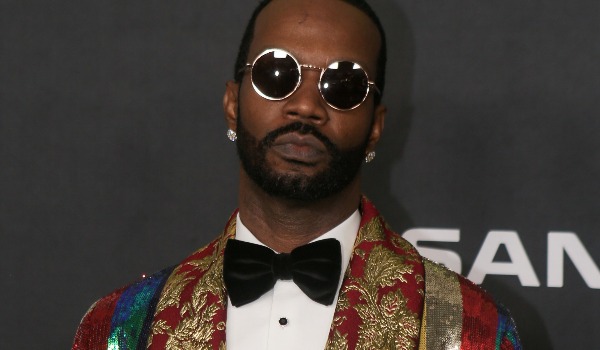
Rappers like Vic Mensa and Joyner Lucas have blamed hip-hop for Juice’s death, while many artists have been accused of promoting drug use in their lyrics.
And although he didn’t mention the late rapper’s name or his tragic passing, Juicy J recently apologized for promoting that type of lifestyle in his music.
Juicy often talked about recreational drug use throughout his career, whether it was in his group Three 6 Mafia, who scored a huge hit in 2000 with “Sippin On Some Sizzurp” or as a solo act.
On Juicy’s 2011 cut “Drugged Out,” for example, the chorus goes: “I brought the drugs in, got the club drugged out n—a / F–k with my high and you gon’ get drugged out.”
And he brought up pill use on Rae Sremmurd‘s 2018 cut “Powerglide” as well. It was after the rapper Lil Peep died of an overdose of fentanyl and Xanax in 2017.
“R.I.P. Lil Peep, I gotta slow down on them Xans,” rapped Juicy in the song.
But on the cut “Neighbor,” featuring Travis Scott, Juicy implies that he’s done taking Xanax pills.
“I go live like Kodak / N—-s keep dying’, f–k Xanax,” he rapped.
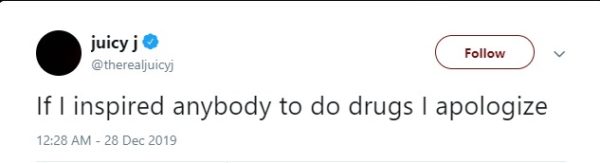
Then on Saturday, Dec. 28, Juicy tweeted about his lyrics surrounding drugs and wrote, “If I inspired anybody to do drugs I apologize.”
Juice WRLD was laid to rest on Dec. 14 at Holy Temple Cathedral Church of God in Christ, located in Harvey, Illinois.
Mensa was asked about his passing last week while in West Hollywood, California, and he admitted to changing his approach when it comes to delivering certain lyrics.
“In younger times, I definitely did not feel no responsibility to the youth or to anybody but myself,” he told TMZ. “And I’m, like, I’ma just talk about the Xans on the plane going to France. But it’s, like, you got to be careful about what you say, because kids take what you say for real.”
“They take it as the gospel,” added Mensa. “So give them something they can use, not sh-t that’s killing them. And when we see these things happening to the young brothers, rest in peace Juice, too early … 21. And rap is much to blame for it.”