A curl and press here, and a root touch up there. Common hair products can do a number on one’s hair, but how does it affect your overall health? A newly released study suggests some products could be more dangerous than others.
A report by the National Institute of Environmental Health Sciences published Wednesday suggests that women who use hair dyes and chemical straighteners are at increased risk of developing breast cancer over those who don’t.
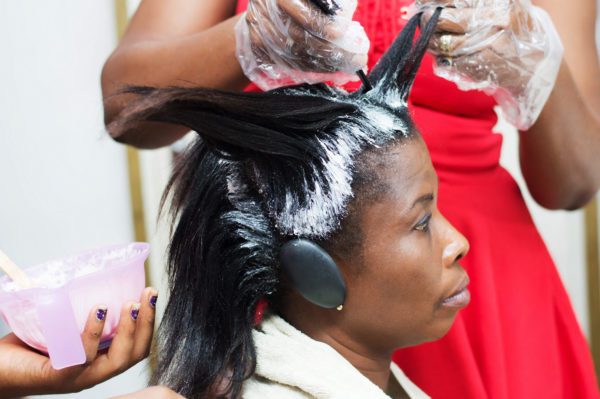
Women who regularly used chemical hair straighteners had a 30 percent increased risk of developing breast cancer, a new study showed. (Photo: Getty Images)
Analyzing data from an ongoing study of 46,709 women who had a sibling diagnosed with breast cancer, researchers found that those who routinely used permanent hair dye were 9 percent more likely to develop the disease. The hazard was much higher for African-American women: Among Black woman who used permanent dyes every five to eight weeks researchers saw a 60 percent increased risk of breast cancer, compared to the 8 percent in their white peers. The team found no significant increase in risk associated with semi-permanent or temporary dye use.
Over the years, similar studies have explored the link between hair dyes, chemical straighteners and cancer. However, the results have been inconsistent.
“We are exposed to many things that could potentially contribute to breast cancer, and it is unlikely that any single factor explains a woman’s risk,” co-author and chief of NIEHS Epidemiology Mr. Branch Dale Sandler said in a statement.
“While it’s too early to make a firm recommendation, avoiding these chemicals might be one more thing women can do to reduce their risk of breast cancer,” Sandler added.
For the report, researchers used data from a study called the Sister Study, which examines medical records and lifestyle surveys from overs 46,000 women between the ages of 34 and 74 who had a sister affected by the life-threatening disease. The survey also asked the women about their use of hair dyes and straighteners.
Those who used the products regularly, about every month or so, had an increased risk of getting cancer, the study results showed. Chemical hair straighteners are also cause for concern for ladies who use it every five to eight weeks, upping their risk of cancer by 30 percent.
Though the cancer risk with straighteners didn’t vary by race, about 75 percent of Black women surveyed in the study reported straightening or relaxing their hair.
“For the chemical straighteners one of the big concerns there is formaldehyde, which is a known carcinogen,” said study author and epidemiologist Alexandra White.
Still, questions remain about the suggested links. As NPR notes, researchers are unsure which ingredients in the products could be harmful, as the study didn’t identify exactly what type of hair dye the women used or the specific ingredients. It only looked at whether they used the product(s), and if they developed breast cancer.
Dr. Megan Kruse, a Cleveland Clinic breast cancer medical oncologist who wasn’t associated with the study, also pointed out that many of the women surveyed were already pre-disposed to breast cancer because they had a family member who had it.
Kruse argued the sample may have affected the results, telling USA TODAY, “I think that might change how you may view the results.”
Though the findings are concerning, researchers say the study needs to replicated and more research done before any action is taken.


