As the townsfolk of Ath, Belgium, cheered the arrival of “the savage,” a lead protagonist in the annual Ducasse d’Ath festival held in Belgium this past weekend, anti-racism advocates denounced the beloved blackface character and his racist get-up.
“This character has all the degrading attributes that black people are given in the racist imagery of our societies,” Mouhad Reghif, a spokesman for the Brussels Panthers told Reuters on Sunday. “It’s totally racist and maintains a degrading image of the Black person — which has consequences in every day life.”
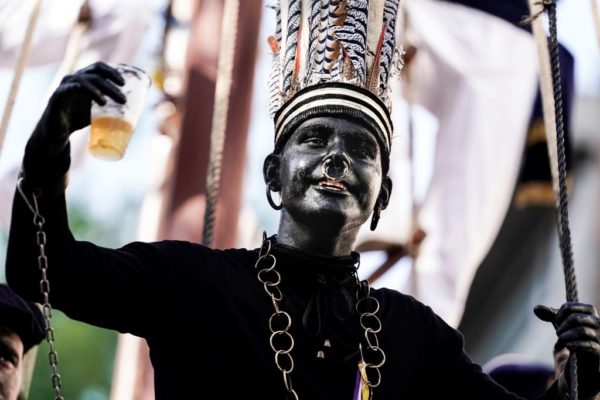
A man wearing a controversial makeup colouring blackface and called “the savage” gestures during a folk parade “Ducasse” of Ath in Ath, Belgium on August 25, 2019. (Photo by Kenzo TRIBOUILLARD / AFP) (Photo credit should read KENZO TRIBOUILLARD/AFP/Getty Images)
The folk festival, which traces its roots back to the 15th century and is recognized by UNESCO as a cultural heritage, is held every August in the small Belgian town, according to the outlet.
The so-called “savage” typically makes its appearance during the effigy parade, in which a white man slathered in black body paint from head to toe with chains dangling from his ankles and wrists hops around yelling incomprehensible sounds and runs around spooking young children.
The character, who also sports a feathered war bonnet, a long chain around his neck and a large hoop nose ring, is also known for cuddling and leaving traces of his dark paint on the faces of those he’s loved on. Ath mayor Bruno Lefebvre explained that “when one gets a kiss from ‘the Savage,’ we’ll have good luck all the year ahead.”
Lefebvre, who’s led the town of 30,000 for a year now, shot down criticism of the beloved character and denied that it’s racist.
“It’s mostly people from outside who talk about racism, anti-black sentiment,” the mayor told Reuters in a recent interview. “At Ath, we never considered ‘the Savage’ to be a racist figure.”
The Brussels Panthers disagree and launched a petition, which has gained support from other advocacy groups and locals, arguing that the folkloric character is an insult and mockery to black people. The group has since called on UNESCO to withdraw its recognition of the popular festival.
Belgian outlet Le Soir reported that UNESCO officials are taking the group’s concerns seriously, though it’s unclear if the agency is actually considering stripping the festival of its cultural heritage designation, Reuters reported.
This isn’t the first time a European festival character has drawn criticism for apparent mockery of blackness. Last year, violent protests erupted in the Netherlands and dozens were arrested as folks clashed in the streets over the controversial holiday character “Black Pete.”
As Santa’s little helper, Black Pete or “Zwarte Piet” accompanies ‘Ol St. Nick as he shimmies down chimneys to deliver presents to children. The holiday character sparks outcry across The Netherlands every year, however, with critics slamming the blackface, red-lipped character as a distasteful play on negative racial stereotypes rooted in the country’s not-so-distant ties to slavery and colonialism.
Reghif, 45, who lives and works in Brussels, said those in Belgium are just as ignorant of the country’s dark past. In May, outraged ensued after attendees put on blackface and wore traditional African garb for an event hosted by the Brussels’ African Museum.
“This ‘Savage’ character… is symptomatic of the problem we have in Belgium with the colonial history of our country,” he told the outlet. “People still think … that we brought civilization to Africa, that they’ve evolved thanks to us, which is totally false.”
In a statement, the Brussels Panthers said they one day hope to put an end to blackface in Belgium.