ODENTON, Md. (AP) — Gun-rights advocates like to say, “The only way to stop a bad guy with a gun is with a good guy with a gun.” Some black gun owners, though, are not so sure it’s a wise idea for them to try to be the good guy and pull out a weapon in public.
Twice in the span of 11 days last month, a black man who drew a gun in response to a crime in the U.S. was shot to death by a white police officer after apparently being mistaken for the bad guy.
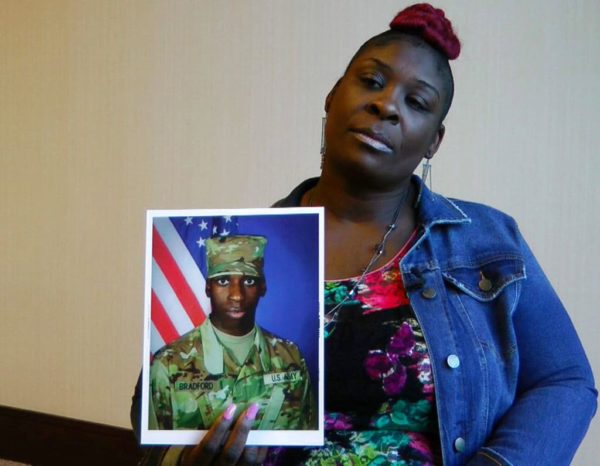
April Pipkins holds a photograph of her deceased son, Emantic “EJ” Bradford Jr., during an interview in Birmingham, Ala. (AP Photo/Jay Reeves, File)
Some African-Americans who are licensed to carry weapons say cases like those make them hesitant to step in to protect others.
“I’m not an advocate of open-carry if you’re black,” said the Rev. Kenn Blanchard, a Second Amendment activist and host of the YouTube program “Black Man With a Gun TV,” a gun advocacy show. “We still have racism. … We still scare people. The psychology of fear, it’s bigger than the Second Amendment.”
The recent shootings of Jemel Roberson and Emantic Bradford Jr. amplified long-held fears that bad things can happen when a black man is seen with a gun.
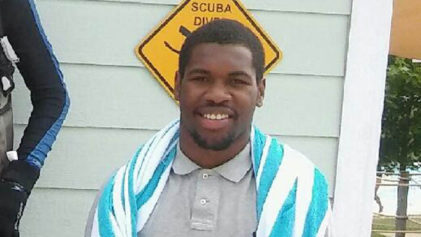
Roberson was working security at a Robbins, Illinois, bar when he was killed Nov. 11 while holding at gunpoint a man involved in a shooting. Witnesses said the officer ordered the 26-year-old Roberson to drop his gun before opening fire.
But witnesses also reportedly shouted that Roberson, who had a firearms permit, was a guard. And a fellow guard said Roberson was wearing a knit hat and sweatshirt that were emblazoned “Security.”
Bradford, 21, was killed Thanksgiving night by an officer responding to a report of gunfire at a shopping mall in Hoover, Alabama. Police initially identified Bradford as the gunman but later backtracked and arrested another suspect.
Ben Crump, a lawyer for the dead man’s family, said witnesses claimed Bradford was trying to wave people away from the shooting. Crump said Bradford was licensed to carry a weapon but was presumably seen as a threat because he was a black man.
The two shootings have brought up some of the same questions about racist assumptions and subconscious fears that were asked after the killings of Michael Brown in Ferguson, Missouri, and Trayvon Martin in Sanford, Florida.
Trevor Noah, host of “The Daily Show,” lamented Bradford’s death.
“That’s what they always say, right? ‘The good guy with a gun stops the crime,'” Noah said. “But then if the good guy with a gun turns out to be a black good guy with a gun, they don’t get any of the benefits.”
In some other cases involving black men killed by police: Philando Castile was shot in a car in 2016 in Minnesota, seconds after informing the officer he had a gun. The officer was acquitted of manslaughter. And John Crawford III was shot in a Walmart in Ohio in 2014 while holding a BB gun he had picked up in the sporting goods section. Security footage showed he never pointed it at anyone.
According to the advocacy group Mapping Police Violence, 1,147 people were killed by police in 2017, 92 percent of them in shootings. While blacks made up 13 percent of the U.S. population, they accounted for 27 percent of those killed by police, 35 percent of those killed by police while unarmed, and 34 percent of those killed while unarmed and not attacking, the organization said.
Andre Blount of Tomball, Texas, once pulled out his shotgun to help a neighbor who was being attacked by an armed white man. The police eventually arrived and defused the situation, he said.
“For me, being a legally registered owner and having a concealed weapon permit, I feel like I have to be more careful than the next person,” Blount said. “Because if not, the only thing anyone sees is a black man with a gun.”
Blount said he tells younger black gun owners to really consider whether it’s worth risking their lives in coming to someone’s aid with a weapon.
“You want your kids to help someone, but you don’t want them to be shot trying to help someone,” he said. “It’s a sad thing.”