ATLANTA (AP) — Break racial and gender barriers with a liberal Democrat. Double down with a Republican Trump loyalist. Or opt for four more weeks of a bitter, race-laden campaign for governor.
That’s the choice Georgia voters face Tuesday, as Republican Brian Kemp and Democrat Stacey Abrams meet in one of the signature contests of the 2018 midterm elections.
Abrams is the 44-year-old Atlanta attorney, former lawmaker and moonlighting romance novelist who’d be the first black woman in American history to be elected governor in any state and the first woman or nonwhite governor in Georgia history. She’s already made history as the first black woman to be a major party gubernatorial nominee.
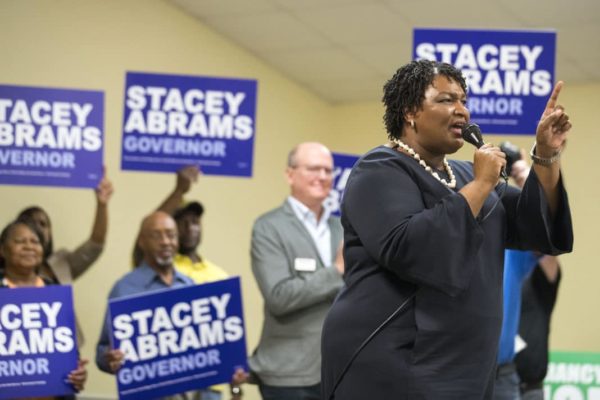
Georgia gubernatorial candidate Stacey Abrams speaks at the Macomber Recreation Building during a “Get Out The Vote” rally in Rincon, Ga., Monday, Nov. 5, 2018. (Alyssa Pointer/Atlanta Journal-Constitution via AP)
Kemp is the 54-year-old businessman and veteran secretary of state vying to keep the GOP’s hold on a state that is nearing presidential battleground status courtesy of its growth and diversity. Republicans have won every Georgia governor’s race since 2002.
Both nominees frame it as no less than a battle for Georgia’s soul, a contest so intense that early voting has approached the overall number of ballots cast in the governor’s race four years ago. Georgia law requires a majority to win, so the presence of a Libertarian on the ballot could yield a Dec. 4 runoff.
Adding to the drama, Election Day voters will cast ballots amid an ongoing dispute over Kemp’s management of the election system he runs in his current job as secretary of state, leaving open the possibility that partisans on the losing end may not quietly accept the outcome.
“I’ve never seen a time where the state of Georgia had more at stake than we do in this contest,” Kemp told supporters at one of his final campaigns stops before Election Day polls open.
In the closing days, Kemp basked in President Donald Trump’s glow, after a Sunday rally that drew thousands of boisterous Georgia Republicans to central Georgia to see Trump deplane from Air Force One and urge his support for Kemp.
Abrams, meanwhile, continued as she has throughout her campaign noting the potential historical significance but arguing the contest should be about more. “I don’t want anyone to vote for me because I’m black,” she told supporters in Savannah on Monday. “And no one on the ballot needs a vote because we’re women. And I don’t even want you to vote for us just because we’re Democrats. You need to vote for us because we’re better.”
On policy, the principal dividing lines are health care (Abrams wants to expand Medicaid insurance; Kemp wants to maintain Georgia’s refusal and boost rural hospitals other way); education (Kemp supports private school vouchers; Abrams opposes them); and criminal justice (Kemp is a law-and-order Republican; Abrams focuses on rehabilitating non-violent offenders and criticizes cash bail as unfair to poorer defendants).
But even the policy debates have played out as much as cultural identity battles as they have nuanced debates over policy details.
Kemp and other Republican groups have blasted Abrams as an extremist with backing from “socialists” who, in Kemp’s estimation, “want to turn Georgia into California.”
Abrams blasts Kemp as “an architect of voter suppression” for the way he’s opted to enforce federal and state election laws. Ballot access and election integrity flared up in the final weekend after a private citizen alerted the Georgia Democratic Party and a private attorney of the potential vulnerability in the online voter database Kemp manages. Those private communications ended up with Kemp announcing, without providing any evidence, that he was launching an investigation into Georgia Democrats for “possible cybercrimes.”
Kemp pushed back Monday against concerns that his call for an investigation is politically motivated.
But Abrams would have none of that, declaring Kemp a “bald-faced liar” intent on deflecting attention from security problems with his system.
The Georgia outcome is among the most closely watched of any midterm contests for reasons beyond Abrams’ race and gender. Democrats are expected to pick up several governor’s seats around the country, particularly across the Midwest region that helped propel Trump to the White House in 2016. But flipping what has been a GOP stronghold like Georgia would signal a potential meaningful shift in the electorate and open up a new battleground ahead of 2020.