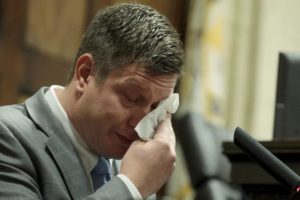
Chicago police Officer Jason Van Dyke dabs his eyes as he testifies in his murder trial Tuesday Oct. 2, 2018, in Chicago, for the shooting death of Laquan McDonald. (Antonio Perez/Chicago Tribune via AP, Pool)
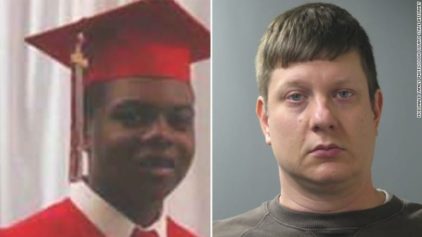
CHICAGO (AP) — A white Chicago police officer charged with murder in the 2014 shooting of Laquan McDonald testified that he opened fire when the black teenager kept advancing toward him while waving a knife, adamantly sticking to his version of events even when confronted with video that showed a different scene.
In a clear but sometimes halting voice, at times fighting back tears, Officer Jason Van Dyke described arriving in his police SUV to find McDonald in a city street, carrying a small knife that the 17-year-old had previously used to puncture the tire of a squad car after officers responded to a report of someone breaking into vehicles. Van Dyke later turned defiant under Tuesday’s questioning by prosecutors who pointed out that video of the Oct. 20, 2014 shooting didn’t match his account, telling jurors: “The video doesn’t show my perspective.”
The video shows Van Dyke exit his vehicle and start firing even as McDonald appears to veer away from police. After the bullets start, McDonald spins and falls to the ground. Van Dyke continues firing, shooting a total of 16 shots. About 10 other officers were on the scene and prosecutors have stressed that none of them — including Van Dyke’s partner — opened fire.
Van Dyke described McDonald as being “without expression,” his eyes “bugging out of his head” and looking “right through me.” He said McDonald was getting closer to him and was ignoring repeated commands to drop the knife. An autopsy shows McDonald had the hallucinogenic drug PCP in his system.
“His back never once turned towards me,” Van Dyke said. “He could have made a decision to turn and walk in the other direction; he could have dropped the knife and ended it right there.”
But prosecutors picked apart his story, asking why Van Dyke didn’t step out of McDonald’s path and pointing out that the video shows Van Dyke actually stepping toward McDonald.
“I know that now, yeah,” he said. “Not intentionally. I thought I was backpedaling.”
When Van Dyke insisted that McDonald raised the knife across his chest just before the officer opened fire, prosecutor Judy Gleason asked: “Where do you see that on the video?”
“The video doesn’t show my perspective,” Van Dyke responded.
When she asked why Van Dyke resumed firing after McDonald lay motionless on the ground, he responded: “All I could see was him starting to push up with his left hand off the ground. I still see him holding his knife in his right hand, eyes still bugging out of his face, still showing no expression.”
He also described being obsessed with the knife that was still in McDonald’s hand until another officer eventually kicked it away.
“I shot at the knife. I wanted him to get rid of the knife. My focus was just on that knife. … That’s all I could think of,” Van Dyke said.
Lawyers for clients who aren’t police officers typically advise against testifying because it opens them up to potentially devastating cross-examination. But it’s not obvious whether the right legal strategy for officers, like Van Dyke, is to stay off the witness stand. In several similar trials elsewhere in the U.S. in recent years, officers have testified. Some who did were acquitted or the juries couldn’t reach a unanimous verdict.
Cook County Judge Vincent Gaughan said late Tuesday that Van Dyke’s attorneys will rest their case Wednesday morning. After that, prosecutors will have a chance to call rebuttal witnesses. Closing arguments could come as soon as Thursday.
Even before the trial started, the case had made an impact on law enforcement in the city. Chicago’s police superintendent and the county’s top prosecutor both lost their jobs — one fired by the mayor and the other ousted by voters. It also led to a U.S. Justice Department investigation that found a “pervasive cover-up culture” and prompted plans for far-reaching police reforms.
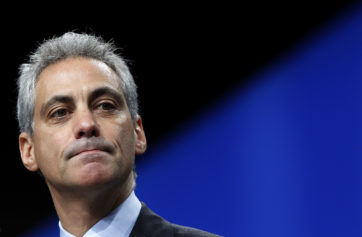
Mayor Rahm Emanuel also had faced criticism that he had fought the release of the shooting video until after his re-election in April 2015. A week before jury selection in Van Dyke’s trial, Emanuel announced he would not seek a third term, although his office insisted the case had nothing to do with his decision.
Earlier Tuesday, Dr. Laurence Miller, a psychologist who interviewed Van Dyke for defense attorneys had told jurors that he believed the shooting was a “reasonable response” to what Van Dyke perceived as a deadly threat posed by McDonald. But Miller also said that even before he got out of the squad car, Van Dyke had told his partner that he believed they would have to shoot the teen.
Van Dyke later told the jury: “I thought the officers were under attack and the whole thing was shocking to me.”