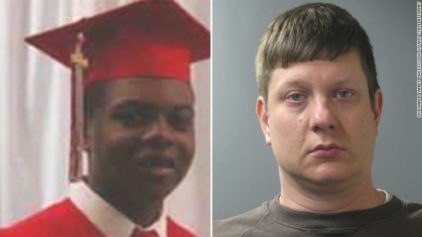
CHICAGO (AP) — A doctor testifying in the trial of a white Chicago police officer charged with murder in the death of a Laquan McDonald said Wednesday that it’s impossible to determine the exact order of the 16 gunshot wounds the black teenager had.
Dr. Ponni Arunkumar, Cook County’s chief medical examiner, testified about each gunshot wound as jurors viewed autopsy photos of them.

In this Tuesday Sept. 18, 2018 photo, Chicago Police Detective Roberto Garcia holds officer Jason Van Dyke’s 9mm semiautomatic Smith and Wesson at the trial for the shooting death of Laquan McDonald at the Leighton Criminal Court Building in Chicago. Garcia was asked to confirm it was the gun Van Dyke turned in hours after the shooting that Van Dyke used to kill McDonald. (Antonio Perez/ Chicago Tribune via AP, Pool)
Officer Jason Van Dyke is charged with first-degree murder in McDonald’s death. Video from the October 2014 shooting shows Van Dyke opening fire as McDonald walks away from police with a small knife in one hand.
Arunkumar said it’s impossible to determine the order of the gunshots in such cases because the shooter and the person being shot are in “constant motion.”
She was among several witnesses who testified Wednesday about the science behind McDonald’s death. A paramedic who brought McDonald to a hospital and an emergency room nurse who wrote down all of the things doctors said as they examined McDonald both described the medical care he received. An Illinois State Police forensics expert testified about bullets and shell casings found at the scene, saying they were all from the same gun.
Prosecutors have stressed no other officers who encountered McDonald opened fire. Van Dyke’s attorneys say he was afraid for his life and acted as he was trained.