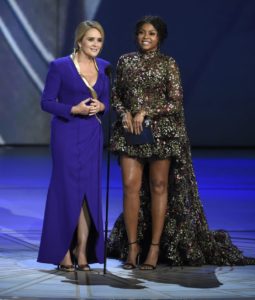
Samantha Bee, left, and Taraji P. Henson present the award for outstanding supporting actor in a drama series at the 70th Primetime Emmy Awards on Monday, Sept. 17, 2018, at the Microsoft Theater in Los Angeles. (Photo by Chris Pizzello/Invision/AP)
“The Proposal.” It was a 2009 movie starring Sandra Bullock, but now will forever be the informal title of the 2018 Emmys telecast, thanks to a memorable romantic gesture from Emmy-winning director Glenn Weiss — who summoned the courage to propose to his girlfriend on live TV.
She said yes — thank the Lord. The stars in the audience responded with gasps (we saw you, Leslie Jones) and even tears (we saw you too, Queen Elizabeth — er, Claire Foy.)
That feel-good moment — along with crowd-pleasing speeches by Henry Winkler and Betty White — lightened the mood of an evening that otherwise had a lackluster feel, and disappointed many with the lack of ethnic diversity among its winners.
The Emmys began with a happy announcement — this was the most ethnically diverse group of Emmy nominees yet — and a cheeky musical nod to the diversity issue in Hollywood, a song aptly called “We Solved It!” Kenan Thompson, Kate McKinnon, Sterling K. Brown, Tituss Burgess and Ricky Martin, among others, sang — tongue firmly in cheek — about how far things had progressed, joined by a company of “One of Each” dancers.
But they couldn’t have known how the evening itself would progress — award after award would go to a white winner. Presenter James Corden finally said what everyone was thinking. “Let’s get it trending: #EmmysSoWhite,” he quipped, a double reference to both Betty White, who preceded him, and the prevailing color of the evening.
The string was finally broken about halfway through when Regina King was awarded best actress in a limited series or movie for “Seven Seconds.”


