A former Kansas City reporter’s re-post of an article on white fragility was so bothersome to her white colleagues, they got her fired.
Lisa Benson Cooper, who was already suing her former employer for racial discrimination, says KSHB-TV suspended her after co-workers complained about an article she shared on her personal Facebook page about how white women weaponize their tears. The May 7th article, published in The Guardian, argues that white women often play “victim” whenever women of color assert themselves, and is aptly titled ” …How White Women Use Strategic Tears to Silence Women of Colour.”

Lisa Benson Cooper, 42, sued the station in 2016 alleging racial discrimination. (Image courtesy of 41 Action News)
According to the Kansas City Star, two white females colleagues at the local news station saw the article on Cooper’s Facebook page and complained to human resources. It wasn’t long before Cooper said she was suspended for making “broad, unfair characterizations of white women as a group based on their race and gender.”
“I want you to know, I did not quit my job 41 Action News — KSHB-TV,” she wrote in a FB post in June. “I was suspended for sharing a meme & a Guardian US article on my personal FB page and subsequently told I ‘shall not report to work’ for the duration of my contract.”
The former newswoman’s story is making new waves after Ruby Hamad, the author of the article, shared in folks’ outrage over the matter in a Twitter thread.
” … On May 9th, Lisa shared this piece this I wrote for The Guardian, about a common but only recently voiced phenomenon where WoC (women of color) who raise issues about race & their mistreatment esp. at work are punished by white women who claim the WoC is ‘attacking’ them,” Hamad wrote Monday.
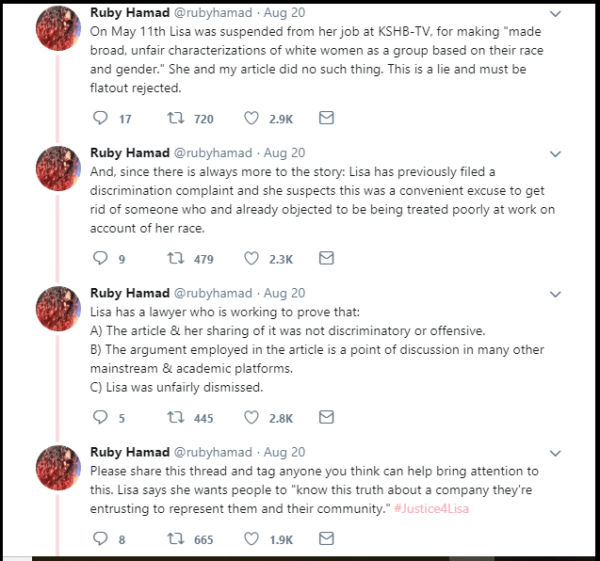
Twitter screenshot.
Hamad denied her article made any unfair generalizations about white women and blasted the actions of Cooper’s colleagues, saying they “won’t get away with it.” She says Cooper suspects that KSHD used the article as a “convenient excuse” to get rid of her for speaking out against workplace discrimination.
“My article went viral with most page views & shares occurring in the US,” she added. “We can also make Lisa’s story go viral to ensure she is adequately compensated for this blatant targeting and discrimination. All she did was share my article to her personal page. WoC: we are strong together.”
KSHD-TV, which is owned by Scripps, has denied Cooper’s discrimination claims and declined to comment on her lawsuit, citing pending litigation.
“We can confirm that, in line with its contractural rights, KSHB did not renew Lisa Benson’s contract,” News Director Carrie Hofmann told The Kansas City Star. ” … [but] we stand by our commitment to diversity and inclusion in our workplace.”
Cooper previously filed a suit against the station in 2016, alleging her race was constantly used to decide where and what topics she’d report on, according to the newspaper. Not only was she consistently given “urban” stories and passed up for promotions, but Cooper said she was even once sent to interview a KKK member by herself.
Cooper’s case is scheduled for trial next year.


