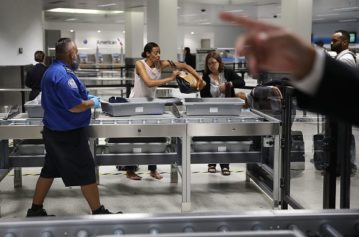
MIAMI, FL – OCTOBER 24: Travelers use the automated screening lanes funded by American Airlines and installed by the Transportation Security Administration at Miami International Airport on October 24, 2017 in Miami, Florida. (Photo by Joe Raedle/Getty Images)
Transportation Security Administration employees are immune to allegations of assault, abuse and false arrests according to the U.S. Court of Appeals as of Wednesday.
The Third Circuit court in Philadelphia, PA ruled in a 2-1 decision that TSA staff are protected by the Federal Tort Claims Act. Meaning, the agents are not considered “investigative or law enforcement officers”
Travelers have questioned the court’s recent decision and feel there’s a small array of legal options in case they experience malpractice from a TSA agent. One judge objected to the ruling and said in his opinion that flyers won’t have many options to pursue legal justice.
“[W]e are sympathetic to the concerns this may raise as a matter of policy, particularly given the nature and frequency of TSOs’ contact with the flying public,” Judge Thomas L. Ambro wrote in a dissenting opinion.
The judge also noted that passengers who could accuse TSA of extreme misconduct in the near future would be left without “remedy.”
“Even if a TSA assaults them, wrongfully detains them or fabricates criminal charges against them” there isn’t much a passenger can do legally.
The Third Circuit said the airport security agents conduct “administrative searches” and not legal searches compared to law enforcement officers. The agents reap the benefit of the FTCA laws.
In the case of the 2006 incident of Pellegrino v. the United States of America Transportation Security Administration, a Florida business consultant Nadine Pellegrino was arrested after a controversial screening by TSA agents at a Philadelphia Airport. The woman was accused of making “terroristic” threats and was charged with assault. She later sued, claiming TSA was rough with her and caused her emotional distress. However, the federal district court ruled in the favor of TSA on all claims except one and refused to let it go to trial.
Circuit Judge Cheryl Ann Krause challenged Ambro and wrote in the final court ruling, “For most people, TSA screenings are an unavoidable feature of flying, and they may involve thorough searches of not only the belongings of passengers but also their physical persons — searches that are even more rigorous and intimate for individuals who happen to be selected for physical pat-downs.”
Krause noted that TSA’s initial job is completely different than officers. Law enforcement officials are provided with firearms and are given the power to make arrests.
“[W]e are persuaded that the phrase ‘investigative or law enforcement officers’ refers only to criminal law enforcement officers, not to federal employees who conduct only administrative searches,” the opinion stated.
The court said the finals decision lies in the hands of Congress.