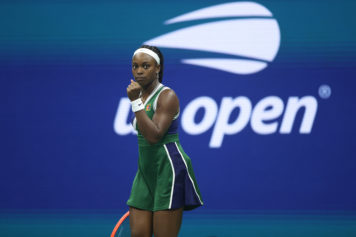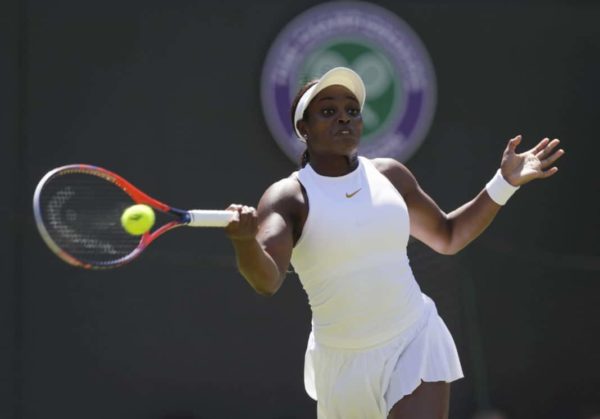
Sloane Stephens of the US returns the ball to Donna Vekic of Croatia during the Women’s Singles first round match at the Wimbledon Tennis Championships in London, Monday, July 2, 2018. (AP Photo/Kirsty Wigglesworth)
LONDON (AP) — Sloane Stephens’ Grand Slam career has fallen into an all-or-nothing pattern: She alternates runs to the final with first-round losses.
At Wimbledon on Monday, it was time for another early exit.
Stephens was the U.S. Open champion last season and the French Open runner-up last month, but otherwise, she can’t seem to win a match at the majors. The No. 4-seeded American bowed out at the All England Club in the first round for the second straight year, lasting a mere 71 minutes in the tournament before her 6-1, 6-3 loss to 55th-ranked Donna Vekic of Croatia was over.
“Not too much you can do,” said Stephens, her arms crossed and face a blank slate, revealing no emotion. “I’m not going to, like, go cry a bit, bang my racket.”
Might have made her forget how she played, though.
Vekic, who entered the day with a 0-5 record against opponents ranked in the top five, barely needed to produce much in the way of the spectacular. She generated only 12 winners among the 64 points she won.
The other 52 were split evenly between forced and unforced errors by Stephens, who is capable of playing much more cleanly and letting her superior defense hurt opponents. Instead, Stephens’ uneven strokes allowed Vekic to overcome nine double-faults.
“It was frustrating. Obviously, I wasn’t making the shots I wanted to make. Wasn’t being as consistent as I wanted to. My feet were a little bit slow,” Stephens said. “Sometimes it happens. There’s nothing more, nothing less to it. I wish I would have made some more shots.”
In 2017, she arrived at Wimbledon to begin a comeback after sitting out for about 11 months because of an injured right foot that required surgery. Stephens quickly began playing the best tennis of her life, posting a 15-2 record to climb from 957th in the rankings and collect her first Grand Slam title in New York.
Right after that U.S. Open triumph, though, Stephens went through a rough patch, losing eight matches in a row, including a first-round loss at the Australian Open in January.
Her coach, Kamau Murray, spoke at Roland Garros last month about how Stephens was able to shrug off that troublesome time without letting it push her off course. He credited Stephens with knowing what matters and what doesn’t, and not allowing “the outside pressure to sort of … make her panic. That’s sort of the key to her success.”
Asked about her attitude in the face of days such as Monday, Stephens said she doesn’t dwell on the bad moments.
“We play a very long season. There’s no one that is going to win every single week. Even the No. 1 player in the world loses. It happens. Sometimes people do overreact, say, ‘I need a new coach, new physio,’ whatever it is,” she said. “I do believe that if you just work on yourself and focus on yourself, you’ll allow yourself to have success, no matter what else is going on around you.”