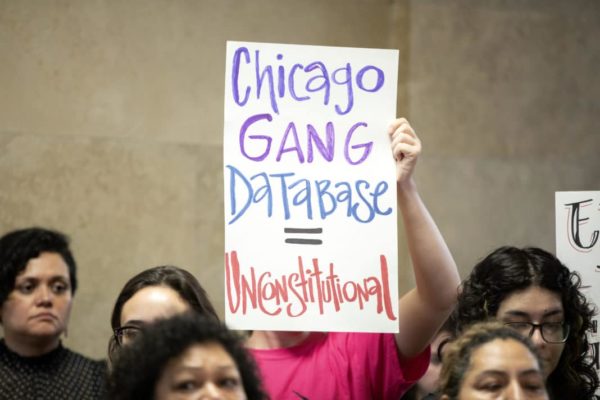
People holds signs during a protest announcing a federal class-action lawsuit filed against the city by several community groups, alleging that officers, given “unlimited” discretion to add individuals to the department’s massive gang database, often falsely label people as gang members. (Erin Hooley/Chicago Tribune via AP)
CHICAGO (AP) — Civil rights groups filed a lawsuit Tuesday alleging that the Chicago Police Department relies on an error-plagued database that names up to 195,000 people as gang members, including many who have never been in a gang.
A Tattoo, Social Media Posts Got Thousands
Many people were erroneously listed in the database simply because of a tattoo, social media post or address, according to the federal lawsuit from Northwestern University’s MacArthur Justice Center and other groups. Those listed as gang members have a harder time landing jobs, are more likely to be denied bond after arrests and are often targets of harassment by police or immigration officers, it contends.
The way police manage the database is “arbitrary, discriminatory” and “over-inclusive,” and it gives beat officers “unlimited discretion” to falsely label people gang members “based solely on their race and neighborhood,” the lawsuit states. In some cases, license-reading devices flag cars registered to someone in the gang database, increasing the odds of the car being stopped.
The lawsuit was filed on behalf of Chicagoans for an End to the Gang Database, several other groups and four individual plaintiffs. It questions the overall accuracy of the database, noting it contains many obvious mistakes, including the names of two supposed gang members who are listed as being 132 years old.
One plaintiff, Donta Lucas, was falsely named a Gangster Disciple based on tattoo on his ankle that officers saw when they arrested him in 2012 for a bowling alley fight. Lucas says officers never told him they suspected he was a gang member and never said they would register him as one. He couldn’t get a concealed-carry permit he needed in 2016 for a security job because he was in the database.
The lawsuit, which seeks class-action status, names the city, police Superintendent Eddie Johnson and several officers as defendants, saying they violated the constitutional rights of people falsely listed as gang members. It calls for a court order halting the way the database is compiled and a process for getting a name removed from it.
The city’s legal department declined to comment about the lawsuit. Police spokesman Anthony Guglielmi said in statement that although he couldn’t speak directly to the lawsuit, “the validity and reliability” of such data was important. He said the department has been working on “a revised database order” and that proposed policies will be announced soon.
The number of people officially designated as gang members in Chicago, which has a population of about 2.7 million, dwarfs the numbers in gang databases kept by other U.S. cities. The database for New York City, which has a population about three times larger than Chicago, lists just 17,500 names, the lawsuit contends.
There’s a racial element, too.
Of the more than 128,000 adults in Chicago’s gang database, 70 percent are black, 25 percent are Latino and less than 5 percent are white. That means around 11 percent of Chicago’s black population is named in the database. But whites are undercounted, the lawsuit says, noting the database names just 23 people as members of white supremacist organizations.
Police have confirmed there are now more than 128,000 adults in the gang database. It hasn’t confirmed how many juveniles are included, though the lawsuit estimates it’s between of 28,000 to 68,000.