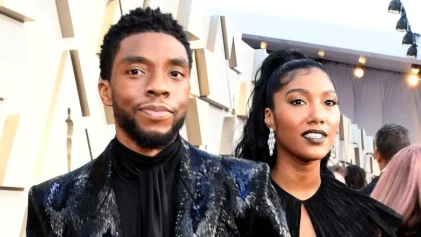
Chadwick Boseman, a cast member in “Black Panther,” poses at the premiere of the film at The Dolby Theatre in Los Angeles. (Photo by Chris Pizzello/Invision/AP, File)
JOHANNESBURG (AP) — Much of what is seen in “Black Panther” is fictional, including the country where the movie is based. But in Wakanda, they do speak a language that is very much real, with distinctive click sounds that had some cast members struggling to speak it.
“The clicks are no joke,” Oscar-winning actress Lupita Nyong’o said recently, calling isiXhosa “one of the hardest languages on the planet.”
The idea to use isiXhosa, one of South Africa’s 11 official languages, in the blockbuster came from South African actor and cast member John Kani. Kani plays the father of the king T’Challa, played by Chadwick Boseman.
Now, in the wake of “Black Panther,” the language is having a moment. Even the foundation of Nobel Peace Prize-winner and anti-apartheid activist Desmond Tutu, who rarely makes public statements these days at the age of 86, pointed out this week on Twitter: “Archbishop Tutu comes from a #Xhosa background as well.”
Some South Africans at the film’s Johannesburg premiere said it was humbling to hear isiXhosa spoken in a major Hollywood film, even if they found the accents of some actors a little eyebrow-raising.
“I’m not so impressed, but they tried,” said South African reality TV star Blue Mbombo with a good-natured smile.
Somikazi Deyi, a lecturer at the University of Cape Town’s School of Languages & Literature, said of isiXhosa: “It’s a wonderful language.” Deyi also dismissed any assertion that the clicks of the language were hard to grasp.
“They’re kind of easy,” she said.
She walked The Associated Press through it. For the “X” sound, push your tongue against the side of your mouth and click as if calling a horse. For the “C” sound, do the same but against your front teeth. And for the “Q” sound, pop the tip of your tongue off the roof of your mouth.
The tricky part, perhaps, is incorporating them into words at normal speed.
Those “click” sounds that are unusual to many outside South Africa are a combination of the Khoi and San languages of the region’s original inhabitants, Deyi said. Now they’re a key part of isiXhosa, which is spoken by almost everyone in Eastern Cape province and whose famous speakers include South Africa’s first black president, Nelson Mandela.
IsiXhosa carries a person’s emotional identity, a sense of kinship, Deyi said.
“You own it. You’re in control. There’s some spirituality to it.”
You speak more to a person’s heart when using their Xhosa clan name, she added — a reason why Mandela is often warmly called “Madiba” in South Africa.
Deyi hasn’t yet seen “Black Panther” but is thrilled by the film’s prospects for globalizing a language that she said is well-equipped for economy and law, not only for communication in one corner of the world.
“I hail the movie-makers. I pray they make more space for it,” she said, already looking ahead to a sequel. “Let there be another ‘Black Panther.’ I want to see more!”