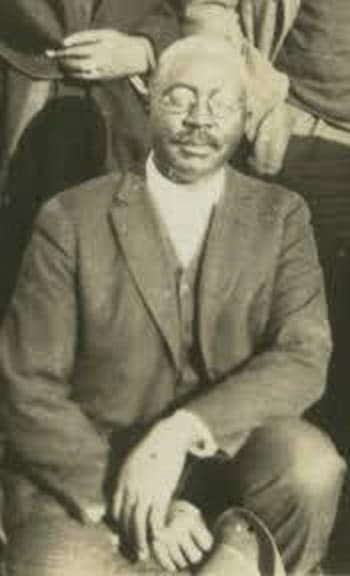
O.W. Gurley (??? – sometime after 1921)
- O.W. Gurley was a wealthy Black landowner, born to former enslaved Africans, who traveled the United States to take part in the Oklahoma Land Grab of 1889.
- The young businessman resigned from a presidential appointment under then-president Grover Cleveland to venture out and found his own town.
- In 1906, Gurley moved to Tulsa, Oklahoma where he bought 40 acres of land that was only allowed to be sold to Black folks.
- One of Gurley’s first businesses was a rooming house which was built along a dusty trail near the railroad tracks. This road would later become Greenwood Ave. of the legendary Black Wall Street.
- Adding to the rooming house, Gurley went on to build three two-story buildings and five residential homes. He also purchased an 80-acre farm in nearby Rogers County.
- The entrepreneur later founded a church, today known as Vernon AME Church.
- By 1913, more businesses began springing up in Gurley’s Greenwood district, including hotels, law and doctor’s offices, cafes, pharmacies, barbershops, movie theaters and hair salons. Eventually, there were hundreds of businesses, all were Black-owned and operated.
- Greenwood’s unpaved roads served as Tulsa’s racial division lines and African-Americans flocked to the thriving city to escape racial prejudice elsewhere.
- After years of economic success in the thriving Black “enclave,” the entrepreneur lost all he had built after an angry white mob attacked and set fire to the Greenwood district, burning everything to the ground. He lost an estimated $200,000 in the 1921 race war.
- It was rumored that Gurley had been lynched by a white mob in the race war, but the memoirs of fellow Greenwood pioneer, B.C. Franklin indicate that he exiled himself to California where he later died.
O.W. Gurley is part of our Black Success series for Black History Month.